
Translated material
Flying Dutch
Dutch painting occupies the best halls in the main museums in the world. Without artificially excessive excitement, the Dutch always look, curators periodically arrange thematic exhibitions - mainly about life, objective world, details and so on, which is rich in genre painting. In February, the Leiden collection, the largest private assembly of Rembrandt and the “small Dutch”, appeared on her own site in high -quality digitization. The exposition of the same name was presented in Paris, Beijing, Shanghai, Abu Dhabi. The powerful exhibition of Johannes Vermera, only closed in the Louvre , will go to Ireland in June, then to Washington. As we see, the Dutch exhibitions “colonize” both the West and the East. What is the reason for this interest in museum workers and spectators to the distant XVII century, I will try to explain.
First of all, the Dutch painting of the middle of the XVII century represents a single cultural layer, saturated with characteristic types, charismatic and charming. In addition, the "small Dutch" is a wide concept. The number of works carried out in the Netherlands province during the heyday is multiplying the entire previous machine painting. Even the peripheral European museums are saturated with the Dutch, which means that the logistics itself in the organization of the exhibition is easier than, for example, in the case of the epoch -making exposition of Caravaggio. Nevertheless, the proximity of European cities, where the pearls of the Dutch golden age live, can be considered the main reason for the popularity of thematic exhibitions. There were not so many works by the master from the Netherlands meetings at the Vermer's loud exhibition in the Louvre.
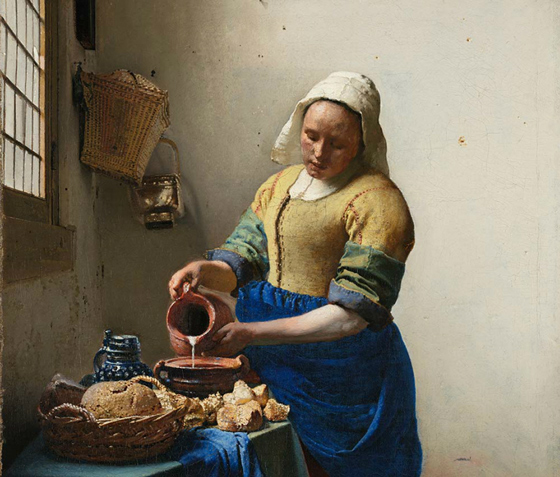 © Amsterdam, The Rijksmuseum Johannes Vermer. Thrush, approx. 1658–1659
Going to Vermeur in the Louvre, you are waiting for the pastoral, incomprehensibly pacifying environment and mood. Approximately the one in which a sluggish but lovely film "Girl with a Pearl Seryozha" was shot. Vermoer was not as fruitful as his colleagues in the workshop, he wrote slowly and carefully, reaching phenomenal technical heights, thanks to which his painting was well preserved. In a relatively quiet January Reiksmyusum, I saw how they shot from the constant exposition “thrush” - there was a Parisian exhibition on the way. As a result, it was the "thrush" that became the main star of the exhibition in the Louvre. Catalogs, notebooks, magnets-a cheerful blue-yellow spot flickers everywhere. The Louvre also offers a monograph by the mysterious Delfta artist. There is no “Girl with a pearl earrings” from the Hague or “Girl reading a letter” from the same Reixmyusum.
Under the current format of the exhibition of one artist, curators disguised the classic, conservative exhibiting method of the “small Dutch”. Instead of the image of a hermit artist, we are served a brief excursion in the era, designed according to the canons of thematic scientific work. At one stand - a plot with a “imaginary patient”, on the other - ladies reading (writing) letters. Critics approve of the curatorial technique of reducing the image of the great and inaccessible Vermaur, many reviews about the exhibition were written as if their authors themselves noticed that Vermer, among other things, was a Dutchman, lived in the era of the country's rise and perceived the images inherently sensitively than the folk favorite of the Jan walls.
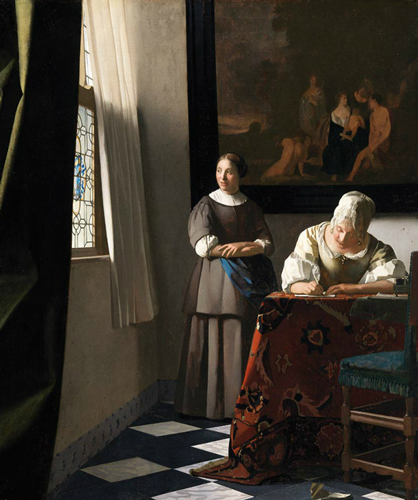 © Dublin, National Gallery of Ireland Johannes Vermoer. A lady writing a letter, and her maid, approx. 1670
But why did it take, in addition to a considerable number of work of the title master, to adjust the avant -garde of the “small Dutch” to the exhibition? Indeed, in the case of Gerard Terborch and Jan Wall, it is noticeable that the museum was not set by the search for masterpieces, but used verified ties. In a good half of the stands, canvases from the Hermitage and Reiksmyum could soloize, but they were not brought. The most vivid of contemporaries, almost along with Vermer, is represented by Gabrielle Metsu. But the viewer is hardly a view about the wall and Terborch. Neither the glorious self -irony of the first, nor the ringing sincerity of the second are shown in their secondary work, which spaces between Vermashes filled in the Louvre. And this is all - despite a large -scale five -year training. By the way, Vermer's work, living in the Louvre (for example, “astronomer”, c. 1668) stand out with a muddy, faded color and unsuccessfully selected frames. Suppose that in the case of the frames, verbose gilded curls of Rococo cannot yield to the Protestant black baguette on their own, so to speak, territory. But what happened to the color - a long -standing unsuccessful restoration, storage nuances? In any case, painting, designed for strict black frames and those who are alien to the empty decoration of Dutch interiors, greatly loses from the exposition style of the Louvre. The viewer, who has not been to the Dutch museums, risks not to recognize in the Paris blockbuster the declared topic - the unobtrusively relevant sound of the 17th century Dutch today.
The provinces, which in 1609, which concluded a truce with Spain in the war for independence, abandoned the leadership of the papal church. The country received a 12-year economic and social respite, having an ultra-high geographical position and a desire to conquer its swampy land not only in Spain, but also from the North Sea. Probably, the modern European consciousness was born: instead of being part of a huge empire, the Netherlands preferred a profitable neighborhood with several empires at once did not lose (and then created their own, but this is another story). Add here a prosperous Leiden University, a hospitable migration policy along with an increase in national identity.
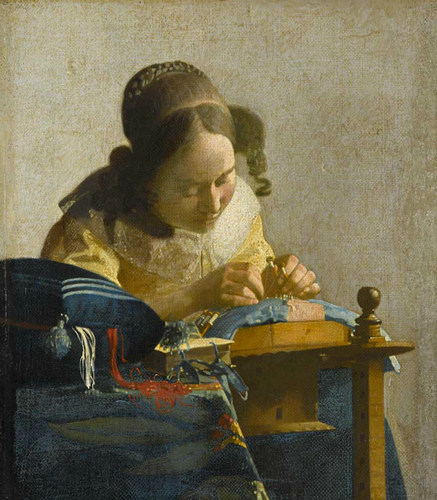 © Rmn-Grand Palais / Grard Blot Johannes Vermer. Lace, approx. 1669–1670
It is important, in this period it is already clear that the earth is round and rotates around the Sun, and humanity has not yet approached the discoveries about the vastness of space and the futility of a person. The scale of a person and his capabilities in a worldview, already free from the monopoly of Catholicism and also - from the latest astronomy, and today causes envy. In the Dutch spirit of the Golden Age combines identity and openness to the world, a thirst for knowledge and creative, warm attitude to the man -made world of the native republic. This is surprisingly consonant with today's Europe: migration flows, Middle Eastern wars, small town problems if necessary to act together. European humanism wanders in double standards, remaining ethical, human, while the DNA of human embryos edit in China. The evil puppeteer from history beats the old light even by economic, but mental and worldview problems. What should be the structure of society, new humanism, to be believed in it? A person needs a soil under his feet, the foundation is not a nationalist fumes a la Marin Le Pen, but a certain bright, bold embodiment of European civilization as a whole. And the Dutch Golden Age is best suited here.
And in this sense, it is pleasant that Russian museums expose the "small Dutch" with a tact and understanding, feeling a trend, but without copying European developments. A few years ago, the Hermitage reconstructed the tent hall, where the main exposition of the Dutch genre is located. Although the museum is often reproached for ill -conceived, forced to gloomy lighting, it is the “small Dutch” who is now exhibited at the highest level. They brought to St. Petersburg and Vermera - “Geographer” and “Love Letter” . It is pleased that instead of “Yana Vermaur”, as the artist was called in Soviet literature, they finally expose “Johannes” (and Gerard Dow turned into a DAU).
In theowers to them. A.S. Pushkin in 2016 was held by the exhibition “The Art of Living. The interior of the Burgher House in Holland of the heyday. ” Tastely collected work of the same Vermaur, Metsu, Terborch and Peter de Hoch, a high -quality catalog published in Latvia. Against the background of monographic blockbusters, the exhibition of inflorescence of Dutch masters looked like an island of calm and curatorial professionalism. Having outlined the circle of interests as “genres in the interior”, in the Pushkin Museum, it was also put up by applied art, showing the Russian audience the main topic - burgher (if you like, “bourgeois”) life - extremely literally. In fact, the viewer was given what was missing in our nearest historical past - the art of living. Live in abundance, without breaking into luxury and kitsch, to live with dignity, to be in its place.
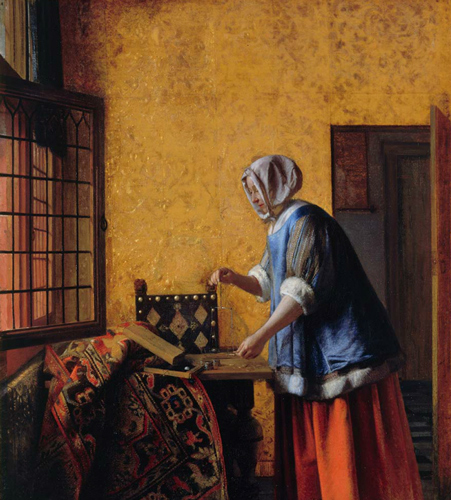 © BPK, Berlin, Dist. Rmn-Grand Palais Peter de Hoch. A woman weighing gold, approx. 1664
The Dutch painting of the Golden Age is sometimes called the “realism of the XVII century”, although in addition to a thorough spinning of life, it is saturated with symbols and the entire property, the objective world has an allegorical dimension. You can fully understand the meaning of the picture, only knowing that oysters are a hint of a love affair, and the doctor’s visit to the patient - one might say, burgher erotic fantasy of the 17th century. But it is easy to notice that artists of the first magnitude along with symbols and a competent composition, not overloaded with everyday life, fill the painting by the air, if not psychological, then a sincere emotional component that today's viewer sees as the basis of the plot. For example, the “glass of lemonade” by Gerard Terborch is an illustration of youth and most delicate romance, but this plot in the same interior could be written much more straightforward.
So Vermoer was by no means lonely, moreover, experts still argue how much Peter de Hokh influenced him - a thin master, not surrounded, however, the Vermeur halo of exclusivity. Vermoer is only a brand under which in the Louvre they made up an urgent (as far as this word applies to the 17th century) exhibition. True, against the background of contemporaries, this artist still looks distant and almost arrogant. Neither the wall nor even Terborch paints the neighborhood with him, but against the general average background of the Dutch genre (and this is a huge layer of painting), Vermier stands at a radically different level. If you return to what the curators wanted to show and what, judging by the giant queue and the price tag, modern Europeans strive - the image of thoughts and life in the Netherlands of the heyday of the heyday - we can diagnose. Search for modest happiness, feeling at home and security. Fashion for the Scandinavian "cozyness" of Hyugge goes from there. As the work in the Netherlands idealized work, so Hyugge promotes the departure of offline, how the Dutch proudly opened the national landscape, so the Scandinavians call for nature. One way or another, regardless of Vermaur’s fashion in numerous exhibitions of the Dutch, more likely a golden age, than one -handed, albeit filigree, skill.