
Translated material
How we became Stalinists
Alexander Morozov keeps a philosophical diary on Colt.
In the middle of the zero, I worked in one office in which there was a large apparatus. He was recruited from well -educated, but very dented people, my peers. In the way, having met everyone, I realized that these are former employees of our embassies - some were people from the Komsomol who went to diplomatic work, and some of the radio reconnaissance. It was clear that they flew with their “good life” in various biographical circumstances: who was due to drunkenness, who was because “the boss burned down”, and the new one changed the team. And all of them simply overwhelmed the interval of life in this apparatus until one of the friends or former colleagues drags them to a large bank or state corporation. In each of them, some mannerism and “charm” of Soviet men who lived abroad were felt.
Each of them, in addition to women and drunkenness, had some kind of hobby. Because a person is supposed to have some kind of cultural addiction that distinguishes him against the background of uniting all hardware life. Someone understood aviation, someone collected throwing knives. There was one completely refined gentleman, with whom we once talked, and he told me that every year he went on vacation to Georgia, because it is fine there. I nodded. Do I know that there is a Stalin Museum in Gori? Yes, of course, I heard about it. And he told me that during the tourist visit of this museum, he talked with his leadership and made friends with these wonderful people that he even became an informal representative of the museum in Moscow. “You know, I just buy them new books about Stalin, published in Russia, or some kind of artifacts that come across on flea markets ...”
I remember what I thought after this conversation: how everything is bizarre! Here is an educated westernized guy of my years, he began to make a party career in a period when Stalin was practically not mentioned in the official discourse, then restructuring and anti -Stalinism, then successful work in a new, capitalist, economy.
And, most importantly, there was nothing in my interlocutor from the retro -communist, no “Zyuganovschina”. That is, he simply began to collect something about Stalin-about the same as we collected stamps with the image of Hitler. Why did they arouse such interest and awe and all the children of the USSR collected them in the 60s? As well as the brands "colonies". These were the petals of the disappeared worlds, the defeated civilization ...
So my interlocutor-without any agitation about Stalin-with joy, as a collector, discovered a year after year more and more books, works of art, posters, some artifacts with the image of Stalin-in icons, in election leaflets, in photographs from school performances for Victory Day. But each such episode was “marginal”, unexpected, anecdotal.
And then I thought: why not? He is not a Stalinist in the views, but simply he has such a “joke”.
It was 2004. For some reason, the beginning of the zero is remembered as if "yesterday." Although 13 years have passed - a huge term.
* * *
In the 90s, retired Lieutenant General Nikolai Leonov conducted a program on one of the television channels, which was then completely marginal, perceived as a ridiculous attempt to transfer the worldview of the “deadly battle of the two worlds” of the Cold War to post-Soviet Russia. That is, to create such a scheme: the whole “West” after the end of the Cold War rushed to the destruction of “Russia”. The same was taught by Metropolitan John (Snychev) in his books (they said that he was not written by himself, but by the St. Petersburg journalist Konstantin Dushenov). The same idea was developed by some activists of the Congress of Russian Communities (KRO). But in general, in those years, bureaucracy and the educated class of Russia have not yet gone crazy and remained on the basis of reality. No one was guided by the idea that the entire imaginary West rushed to the destruction of Russia from some mystical reasons of "eternal hatred and fear."
The first big turn occurred in 2003. When, during the election campaign in the Duma, the head of the Communist Party Zyuganov published the program book “Holy Rus' and Koshcheevo Kingdom”. And it became clear that the Communist Party switched to new positions. The book laid the idea of Danilevsky about the fundamental conflict of Russia and the West. The West sees “another” in Russia and exists due to the rebuilding from this “other”. Between Russia and the West is an inescapable civilizational conflict. And Russians can be saved in this conflict only in the form of an empire. And the historical zenith of this empire was the Stalinist USSR.
The Communists continued to actively influence the minds of pensioners and the population of the Russian province. And if earlier the combat “Orthodox-patriotic synthesis” was marginal, then from that moment it became systemic, since the second largest political party in Russia began to teach that “Holy Rus'” is an island surrounded by the “Koshcheev kingdom” of the West. To understand in which darkness the Communist Party plunged into, it is necessary to re -read the conversation of Konstantin Dushenov, at that time the editor -in -chief of the newspaper “Orthodox”, later planted for anti -Semitism, with Gennady Zyuganov.
The second largest political party in Russia became openly Stalinist.
* * *
In 2005, Vladimir Putin for the first time publicly used the expression “the largest geopolitical catastrophe” against the USSR. The context was still different. No one doubted that the Putinists were anti -Stalinists. Federal channels have not yet shown revisionist films. In 2008, the active vote for Stalin in the fashion project “Name of Russia” (A. Lyubimov - N. Mikhalkov) caused surprise and even forced the project management to manipulate the results in order to avoid the demonstration of “restalynization”.
Nevertheless, from 2006 to 2013, a continuous process of sprawling marginal Stalinist discourse throughout public space took place. Non -Stalinism was in the same package with the concept of the "millennial war of the West with Russia." The mass book publishing of Alarmist literature "for reading in the train" began. Until about 2006, books like “Two thousand years of the West War with Russia” published at their own expense the admirers of the holy elder Grigory Rasputin who had crazy. But then this direction as a commercially profitable picked up the largest publishers of mass literature.
In 2009, the famous Russian philosopher Vitaliy Kurennaya tried to draw attention to the fact that the ex -mass circulation publishes a series of books “Rossiya Project”, and to analyze how the group of authors (later included in the Izborsky club) is trying to construct a total description of the world built on the “Conspiracy against Russia” for “reading in the train”.
In 2011, there was even an open letter from two famous journalists N. Klimenyuk and M. Kaluga, who tried to organize a public campaign , urging monopolists to stop this stream. Nevertheless, the book regiments of all stores of the country were filled with tons of literature constructing the Russophobic policy of the West “From the Creation of the World to Yeltsin”, into which the stream of revisionist books about Stalinism was built in.
The line of all this period of 2006-2013 can be considered the defeat of the Gulag Museum Perm-36 with the already obvious support of the federal authorities.
In 2012, Medinsky became the Minister of Culture, and with it the concept of the new “PR patriotism” finally won. Medinsky was a protege of conservative circles, in the past, of course, anti -Stalinist. Nikita Mikhalkov was the author of the anti -Stalinist film "Tired of the Sun." The paradox is that these conservative circles themselves turned out to be the dog on which the fleas moved to a new historical stage.
The concept of the third term of Putin was aimed at creating a certain quasi -deioology of the "greatness of Russia". The metaphysical conflict with the West has become official discourse. And Stalin, along with his managers, turned out to be one of the built -in large figures of this metaphysics.
* * *
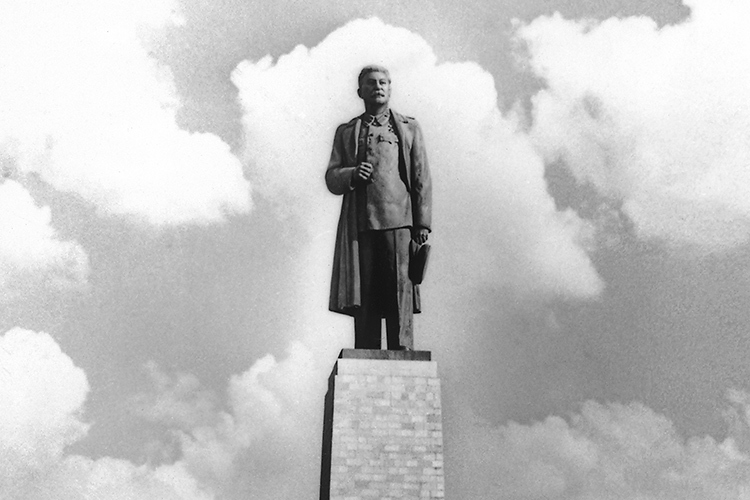
Now, in 2017, it is easily possible to introduce the Stalin Museum in Moscow. There is little to separate us from this. Books rehabilitating the Stalinist butchers, published by the mass circulation in the HUZL series, were transferred to the first channel this year as cognitive programs. The images of Stalin are built into the state celebration on May 9. Putin himself, as the great organizer of the state, is increasingly associated not with Peter the first and even more not with the founder of the post -Soviet state, namely with Stalin. The other day, the data of the hundredths were published, showing that the positive rating of Stalinist repressions is more than ever. Already 25% believe that they were justified. Thus, the main line is overcome, separating Stalinism from the final inclusion in the new state doctrine.
* * *
The question arises: why did this restoralization occur? There are two main answers. One of them-the frustrated society failed with the post-Soviet transition in the 90s and retreated to the archaic under the pressure of injury. The second entirely imposes responsibility to Putin and his environment, which technologically uses any - including non -stop - topics to withhold power and manipulating mass consciousness. Both are true.
The new “PR-patriotism” will undoubtedly further expand Stalin's presence in all forms of official discourse. The end of the life reign of Vladimir Putin can hardly think for yourself outside the perception of “Putin - Stalin”. The burial of Lenin and the liquidation of the mausoleum on Red Square are possible and, most likely, will occur in the remaining period of Putin's reign. But, of course, in exchange for the creation of another necropolis, in which Putin and Stalin will be in the central position surrounded by their late effective managers.
This is the prospect, growing from the ten -year process of this transition of restalinization from marginal political discourse to the official one.
Read the previous issues of Morozov's Diary:
What to do residents of political Chernobyl
Scared, iron lumberjack and lion in search of himself
Diary about the soil going from under the legs. Berlin.
Records on March 4-7
Diary about the soil going from under the legs.
Records on February 20-26