
Translated material
Morten Trovik: "Turn the Laibach language against the Laibach themselves"
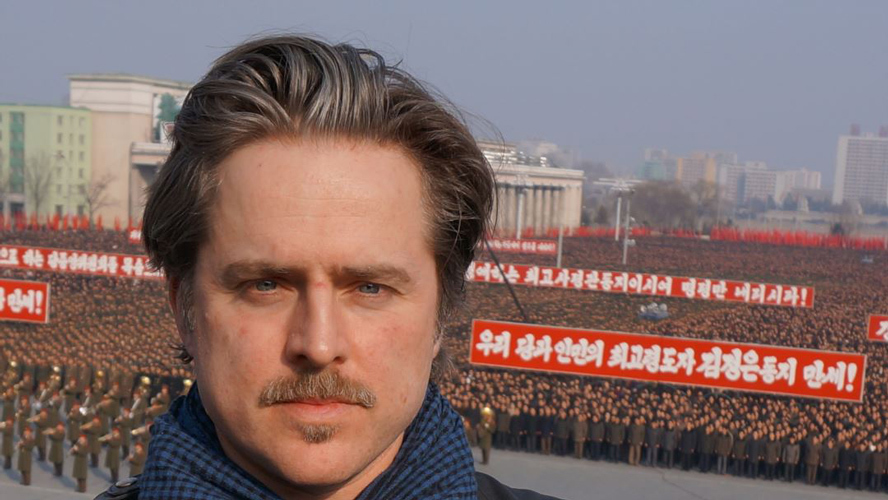
-You were 17 times in the DPRK, made several joint art projects with the Koreans. What is the reason for your so close interest in North Korea that you emotionally - or intellectually - hurts in this society?
- My interest in North Korea arose out of curiosity. It is common that this is a place where it is very difficult to get, a place that is somewhere outside the rest of the world, such a white point on the map. But when I arrived in the country for the first time, it became completely clear to me that the reality there was very different from the image created by the media. Of course, I wanted to deeperly study the country that is surrounded by so many myths, so many propaganda - from all sides, and outside and inside. I mean the state propaganda of the DPRK - while in the country, you see it everywhere. Internal propaganda says that this is the best place on Earth. And the external claims that this is the worst place on Earth. And these narratives are so far from each other, between them - and the real state of things - such a abyss ... and I was fascinated by its depth. First of all, I am an artist, and my projects are often inspired by politics, social circumstances, in short, processes that occur outside the art space. In Korea, I met a lot of absolutely normal people who were engaged in normal things - and this was even more fueled by my interest. By the way, the most reasonable and subtle things that outside observers wrote about the DPRK belong to Russian researchers. Probably because in Russia many still remember what it feels like to coexist with the state ideological performance, to lead a normal life in parallel to him.
And, of course, I used North Korea as an instrument, as an indicator of any garbage in our society (laughs) .
If we say more specifically, then in Korea I was fascinated by several points. The first: somehow I was present at the military parade-I stood there next to the platform, on which Kim Jong Ir took the parades, and kept a disco-chart under his arm; But about the ball later, first the parade. I note that this was a very important date-the 60th anniversary of the DPRK. In short, as a spectator, of course, is amazed by this incredible level of synchronization of all participants, the degree of control and totalitarian discipline, without which it is impossible to organize a mass spectacle of this scale. But all this at the same time was very similar to a masquerade, to retro-spots. Most of the weapons, from rifles to guns, was obviously outdated, the uniform was also in the style of Soviet form of the 50-60s. It was obvious to me that this state could not be a threat to the world, even if it really wanted. They are so far from modern, high -tech military power! North Korea is a third world state, but with the manners of the country of the first world. And it infuriates everyone. They do not play according to the rules according to which a small country should be servile. No! They boldly say: “ Fuck You ! "
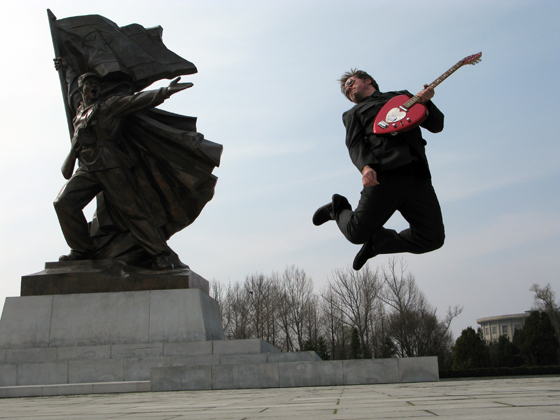
And, being an artist, more precisely, an interventionist artist, I decided that I had to do something artistic in the DPRK. I decided to conduct tests-it was nine to ten years ago. Flying away in Pyongyang, he took with him a small disco-char. It was just interesting to me whether they would allow me to import this symbol of the Western pop culture, the western decadence-there is a stereotypical idea that no foreign culture is allowed to the DPRK.
I unhindered him into the country and everywhere went with him. At the same time, I was dressed in a suit with a tie, such a stereotypical image of a Western capitalist. And with this ball, I took pictures against the background of various objects of the state cult - the mausoleum of Kim Il Sen, opposite the monument to the ideas of Chuchhe, well, and against the background of the parade.
After that, I realized that there is a certain space for maneuver, where you can do something more serious. So the Laibach concert grew out of this mirror ball like a seed flower.
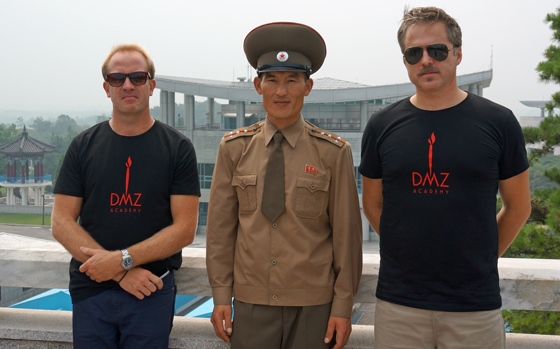 © DMZ Academy
- Tell us about your creative method, about the hypertor. What is it at all?
- This is the artistic method of organizing performances in public discourse, in public life and public spaces. At the same time, the direction of the event is in a constant dialogue with events taking place in external reality. That is, it is, as it were, the creation of a controlled reality, in which all unforeseen circumstances that accompany the preparation and conduct of the performance itself are also part of it. It seems to me that the Russian public should have an instinctive understanding of this kind of representation.
- Yes, this is quite close to what our contemporary artists, Oleg Kulik, for example.
- But there is one thing that distinguishes my method from the methods of other socially or politically oriented artists: I have no problem in order to work inside the existing structures of power.
- But at the same time, you do not resort to a direct political statement, preferring the “suspended” meaning. Thus, you try to avoid a trap of any ideology and demonstrate the limitations of any ideologically determined look, whether it is “progressive” or “reactionary”?
- Absolutely! It seems to me more productive - to give a voice to the voice itself.
- Yes, but such a strategy may not always be winning. Take the example of Vitaly Mansky. You probably saw his film "In the Rays of the Sun." Mansky tried to do this particular - to make a film according to all the canons of North Korean documentary, following all the rules and formulas of the Korean side, hoping that the voice of power will sound quite self -disclositive. But he ran into direct sabotage, and what his project became was already dictated, rather, the desire to avenge the Koreans.
- Like many documentaries who shot North Korea, Mansky creates his own myth - not about the country, but about himself. It can be seen that he gets scores with them and therefore draws a portrait of such a brave underground activist who risks everyone, revealing the secrets of North Korea. This is a fairly standard position, another similar example is John Suini, who made the news plot “Underground Pyongyang” for the BBC . He also resorted to the practice of demonizing the whole society in order to look cool against this background. And ending the conversation about Mansky: he is a powerful documentary, but with regard to the truth, he is not too different from Donald Trump.
- Well, it seems to me that the tendential can only be called his personal interpretation of what is happening in the film; As for the material itself, it quite clearly demonstrates the so -called performative shift in modern North Korean society ...
- Ah, you also read this book - "It was forever until it ended!" In my opinion, Yurchak-so, it seems, the name of this scientist is-very insightfully and accurately describes the system of relations between the posttotalitarian state and its population. And the situation in the DPRK is increasingly reminiscent of the one described by Yurchak. But in fairness I want to note that North Korea is still a very totalitarian state. Probably like the USSR under Stalin. The degree of demonstration of the subordination that the state requires from the population is very high, you need to constantly bow to the statues, constantly pronounce the formulas of loyalty to the regime. Still, in the USSR of the 70s and 80s, it was not necessary to bow to Lenin’s busts or repeat through the word when talking with foreigners: “Thanks to Comrade Brezhnev for bread on our table.”
 © Morten Travik
- How did you manage to slip the Laibach Koreans?
-After the story with a disco shar, I began to suspect that behind this totalitarian facade there is a certain space for movement. So after a couple of years I established contacts with the Korean Committee on Cultural Relations - an organization with which I have been constantly working since then. At the same time, which is very important, I managed to establish personal contacts with several people from the committee, a certain “chemistry” and mutual understanding arose between us. I made them understand that I can do something for them: help to take out Korean artists and musicians on tour abroad (of course, under my artistic leadership, this is an indispensable part of the transaction). For employees of the committee, this is very important - they really want to integrate into the international community, are looking for their place there. And I began to bring Western artists to the DPRK.
In general, we have reached a certain level of mutual understanding. And most importantly, they realized that the inconsistency - but I am a rather controversial artist, in Norway it came to discuss my projects in parliament - this is not always bad. Sometimes this is good advertising.
So the fact that Laibach often served the subject of debate and criticism, did not scare my people in Korea. They just know very well what Western criticism is; The image created by North Korea by the media abroad is very well known to them. So I said: if you invite Laibach , it will be such a sensation that the picture of the North Korean society that many will be destroyed will be destroyed. And, in addition, this will arouse the interest of various cultural institutions in the world to invite Korean artists.
- And, agreeing to the concert, were they familiar with music and visual aesthetics Laibach ?
- Absolutely unfamiliar!
- And what was their reaction to what they saw?
- They were wildly nervous all the way, it was visible. And the rest ... being within the country, you can never solve that the Koreans actually think about things like Laibach . It is assumed that you cannot rejoice at anything that comes from the outside, from abroad, no one will say about it: “Oh, it's great!” It would be simply dangerous. Whatever people really think, you will never see enthusiasm in their answers.
- What was the composition of the Korean public at the concert? Are these some officials of the middle and highest ranks?
- Most of the public are members of all kinds of Pyongyang trade unions of cultural workers, or rather - musicians, members of their families and friends.
- It is also interesting to learn about the financial side of the project. Have you earned something at the concert? Or, conversely, only spent? And who paid for everything - the Korean side?
- Koreans did not spend anything, the concert was completely funded by me, more precisely, my company, which, in turn, is funded by the Norwegian Ministry of Culture. So in the end it was Norwegian oil money (laughs) .
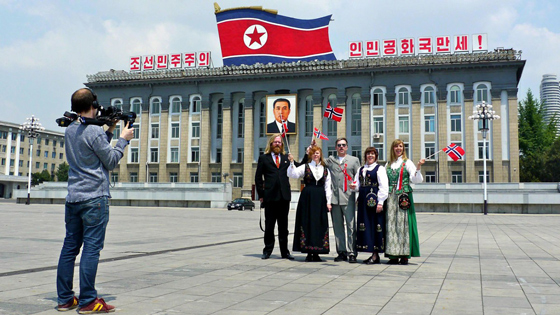 © Morten Travik
-At the beginning of the film, you promisingly compare the reaction of the European public on the rock concert and ecstasy of the North Korean masses on demonstrations. However, the final concert looks quite dull - a thousand people sits quietly in chairs ...
- Well, to be honest, no one expected that there would be a dance stall. And you will keep in mind that this was the first performance of this kind in the country. Koreans simply have no idea how they behave at such concerts. What you see in the film is the usual behavior of the northern Koreans, there all concerts go this way: everyone sits in chairs and listens. No ecstasy-unless, of course, the orchestra plays something patriotic, one of the thousands of songs composed for the leaders-or by themselves. If we take into account that these people did not see anything like “funny guys”, not to mention Bill Haley’s performances, and, so to speak, lost innocence with Laibach , their behavior seems absolutely natural. They were simply paralyzed from cultural shock.
- And the musicians, their reaction?
- You know, they were so nervous all the time that, I think, only one thing took care of them - as if not to forget the words of the songs. It seems to me that the beauty of everything that happened was precisely that none of the parties had any specific expectations - everything was so unprecedented that there was simply nothing to compare it.
- One of the most wonderful moments in the film is a feast during which the Korean official pronounces a witty toast where Laibach and the DPRK compares as two outsiders. Admit it: did you write this speech to him?
- Look: it is this phrase that I say behind the scenes immediately after his performance - in fact, this is the main argument that I used to convince the Koreans to invite Laibach . But he could have pronounced it himself. Moreover, his very speech was an incredible performance, he really carried out the brain to musicians. When he began by starting-without quotes-to quote the most monstrous accusations that have ever put forward against the tabloid group, they all literally paralyzed with horror-I saw it. And this was a speech absolutely in the spirit of my performances, in the spirit of Laibach themselves - undermining the language of power (in this case, the media authorities). This official took all the yellow headlines of Western news about the upcoming concert (of course, he received them from me) and mixed them with all the objections that he himself heard from his superiors (and inside the State Machine there was a fairly serious opposition to the event, we fought with them every day until the performance). I was completely fascinated by this speech: he outplayed us and at the same time made it clear that he understands us very well. It seems to me that this was the main result of all these years of my work with the DPRK - the appearance of people who learned our ideas and were able to turn the imperious language inside out, turning it against himself. And moreover - turn the Laibach language against the Laibach themselves!