
Translated material
"We are still very far from technological singularity"
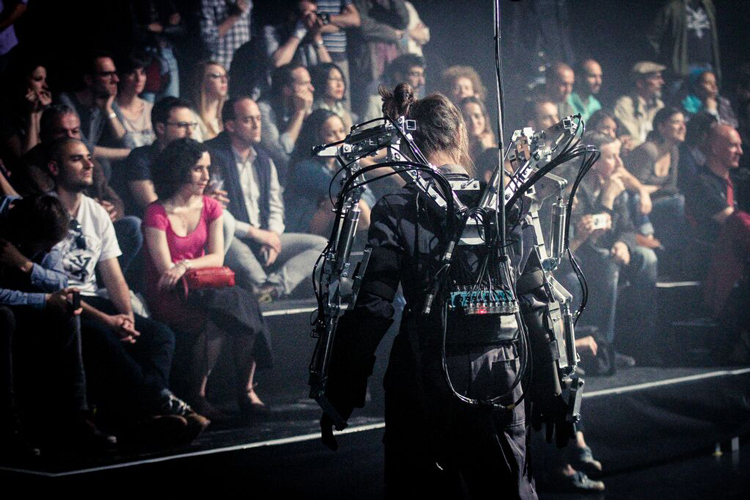
This interview was taken last year at the ARS Electronica festival, where you could see part of the performance Bill Vorn and Louis-Philippa Demera “Inferno”, and had been waiting for a long time to be published with the arrival of artists in Moscow. And finally this happened - the performance will be shown at the Polytechnic festival within two days, May 27 and 28.
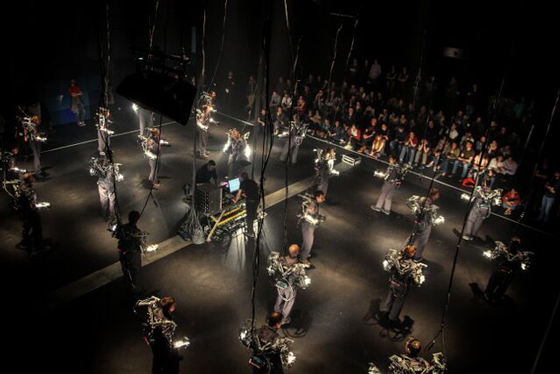
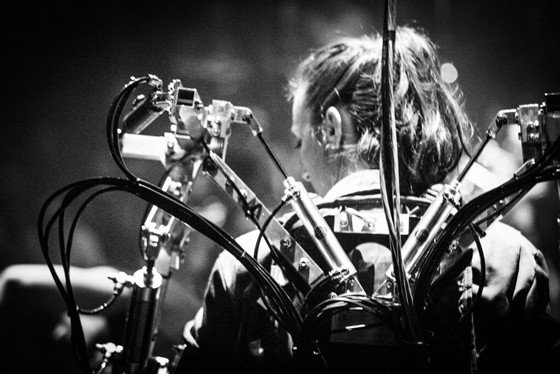
“Inferno” is a robotized guideline, which refers to the image of the circles of hell from the “divine comedy” Dante. In its original version, it is designed for 24 participants who put on exoskeletons and find themselves in the power of mechanisms that make them raise their hands and move to the beat of the show for an hour. This is a breathtaking action in which the figure of a person is completely merged with an exoskeleton, and the ecstatic dance in the light of stroboscopes and smoke erases the border between a person and a robot.
Anna Titovets talked with Bill Vorn and Louis-Philipp Demer about the performance, which is actually not about what they usually think about; about the difficult share of artists who are engaged in robotics art; The fact that it is not fantastic, but the classic inspires cyber art projects, that bacteria are much cooler than robots, and technological singularity will not occur.
- Let's start from the very beginning. How did it happen that you began to engage in robots and associated art? Where does such a passionate passion for robotics come from, should something push something to this? Maybe you read a lot of fiction in childhood or your parents were engineers?
Bill Vorn : For a long time I was a musician (Bill was a participant in the rather famous Sint-Pop Group of Rational YouTH . - A.T. ), and I was quite satisfied with such a career development. I liked to engage in electronic music, music for films, etc. But at some point, I realized that it would be interesting to try something more experimental and radical, and in the early 1990s we met Philip by a happy chance. And we had the idea to experiment, based on the completely traditional media that we owned at that time: Philip worked with light and theatrical technologies, and I - with sound.
Things that really inspire us is reality.
Louis-Philipp Demer: And the fact that we began to engage in robots is a complete chance, in fact. As for science fiction (and in general any fiction) - no, of course, I can read it, but it in no way inspires me when I do arts. Everything is much simpler. Things that really inspire us is reality. For example, I am very fascinated by the idea of socially oriented science fiction in art. We must know the world through fictional ecosystems. In our works, we always create an artificially modeled microcosm, in which we can study the behavior of robots, new roles of robots and people when they face each other. Our installations almost always have a performive form, and this is very important for us.
Vorn: If we talk about what literary works inspire us, then many of our projects were inspired by the classics: Hugo, Dante, Kafka.
- How do you come up with the names for your work? Most of your projects with robots have quite poetic names - “Lake of the Frenchman”, “pre -artricial ( Prehysterical ) ,“ on the verge of chaos ”.
Demer: Many names appeared by chance. Inferno happened in the same way. In this case, this is a very successful name, it gives this work another, additional, layer of meanings, provides a cultural background, which we can no longer develop specifically.
 © Anna Titovets Bill Vorn and Louis-Filipp Demer
-How do you work together, how much the distance affects your work (Bill Vorn lives in Montreal, and Louis-Philipp Demer-in Singapore. - Ed .)? After all, you have both joint and personal projects; How do your ego get along when you work together?
Vorn: by and large, the distance is not a problem for us. We work a lot on our own, and then we meet online and discuss ideas and results.
- Did you quarrel with each other?
Demer : Rather, no than yes. I think that we complement each other well, this is the lion's share of the success of our cooperation.
Vorn : In addition, we are very pragmatic people.
Demer : We are working on rather specific projects. We are not engaged in visual arts ( Visual Arts ) . For us, the appearance is not so important. No, of course, we pay some attention to this, but in fact, work with programming, algorithmization, prototypes and testing of electronics is always so much that it occupies the bulk of our time and attention. Usually our work happens like this: a new idea comes to my mind, we drink, discuss it, then it passes for some time, and if after this time the idea did not die, we decide that we will embody it.
We are not engaged in fine art.
- How do you distribute the “zones of responsibility” in your tandem?
Vorn : Naturally, we cannot afford to engage in the same way and the same things. And often it all ends with the fact that Philip is engaged in electronics and programming, and I make a sound. But it is clear that in the end everything is mixed, and we bring the project to mind we are already jointly. We literally hang out in the “black box” of the studio for days on end, finishing the installation in the “black box”.
- How did work on Inferno go ? Do you attract external specialists?
Vorn : We deliberately elected Montreal by the headquarters of the project, it turns out much cheaper from the point of view of both labor and further transportation of the project. First of all, we are focused on Europe.
Demer : We spent almost a month in the workshop, programming and making prototypes. Sometimes we turned to external specialists for help, but basically we did everything ourselves. The difficulty was that we had to make an exoskeleton that would fit in size to a medium -sized person and at the same time would be made of inexpensive materials that we could afford. Of course, we could make much more cool exoskeletons than those that are, but then each of them would cost at least 25 thousand dollars.
 © Magalie Fonteneau / Kontejner.org Inferno, 2015
Vorn : In general, initially we wanted to do much more than 24 exoskeletons. But, as usual, we had to reckon with reality.
- And how much? A hundred pieces?
Vorn (laughs) : Well, no, not so much, but generally close.
Demer : Yes, and when the prototypes were tested, we began to make the remarks of the resulting prototype. And this means a huge amount of repeating work, which we did mainly ourselves. And if you compress the clean time of work on the project - this is not so much, but there were a lot of small actions, each of which had to be performed 24 times.
- Do you attract students in your projects?
Vorn : Yes, they often work our assistants.
Demer : But if students are talented, they very quickly leave us and begin to do independent things.
For a long time we give fees from the show on which we show our projects, in the expense of repaying debts for their implementation.
- A complex question, which is especially relevant for Russian reality and for Russian artists engaged in technological art. How do you find money for your rather expensive projects? Do you have a manager who is engaged in the financial side of the issue and organizes your tour?
Demer : Despite the fact that our art is priceless (laughs) , we have to constantly look for money for it. We do everything ourselves, we do not have an agent who would help us submit applications for grants or organize further tour. And, I must say, we were lucky: we have quite a few different funds, both federal and local, where we can submit applications. And, of course, unfortunately, we do not win far from every grant we serve. This is most of our daily routine. At Inferno , we received several grants, but even they did not cover the general budget of the project. But in general, we did not hope that we would find all the money.
Vorn : For a long time we give fees from the show on which we show our projects, in the expense of repaying debts for their implementation. With Inferno , for example , we had to repay 25% of the cost of the project due to the fees that were received during tours in 2015. This would be impossible in another way. And when we applied for research grants, we were told: “Why do you need to do as many as 25 exoskeletons? Make one! "
 © Magalie Fonteneau / Kontejner.org Inferno, 2015
Demer : Another big problem in our area is that we, in fact, are tied to our projects for life: they must constantly be repaired, invested in service, replacement of parts, repair, etc. For this reason, the more we go with the project to tours, the more expensive it becomes for us.
- Quite a lot of your work before Inferno was associated with an attempt to imitate the robotics systems of the human psyche or his movements, a kind of algorithmic humanization, when robotic systems at the algorithm level try to decipher and reproduce states characteristic of people . For example: “graceful machines”, where the robots tried to repeat the movements of the performers; DSM - VI , modeling the occurrence of collective hysteria in a flock of robots; "Disteric machines" and "Tiller Girls", etc. In the case of Inferno , the opposite is true - a person is a subordinate robot and algorithmic movements. Not neural networks learn from a person, but a person, devoid of his own will, is from robots. Is this work associated with anti -utopias about machines that will receive control of people?
Demer : First of all, we wanted to convey to people a robotic experience at as close as possible, at the level of direct contact. This is a performance in which a person puts on an exoskeleton, but then begins to move like a robot. This is the starting point of the project. The rest of the discussion field regarding utopias or anti -utopias, cyborgized the future, post -member, power of machines and other things - we leave all this for media interpretations. Inferno is not about that. We do not want boring discussion about the whole conceptual field in which they like to put this project. Of course, there is such a meaning there, we cannot avoid it, but our first mission in this project is to create a performance, experience, a moment in a person’s life, when he experiences certain feelings, being inside an exoskeleton. And all. And attempts to comprehend “Inferno” outside this experience is not that bad, but they are not too interested in us. There is no narrative component in the performance, you just put on a suit. No one says what you should do or what will happen during the show.
Our worst mission in this project is to create a performance, experience, a moment in a person’s life, when he experiences certain feelings, being inside an exoskeleton.
- But at the same time, in the description of the project (and in its name) there are quite a lot of references to various kinds of concepts, in particular, to Dante circles of hell. There is also a great temptation to connect your work with the theory of technological singularity.
Vorn : At the beginning of all this, there was no. We simply developed a performance as we wanted, and then people began to persistently ask what all this means and whether this has this attitude to a particular concept, and we decided to take such a name. But for us it does not matter at all whether the audience see the connection with the circles of hell, just with hell or something like that. For many people, this is generally similar to a party. In fact, this is not so important - hell or the power of cars. If we could, we would probably prefer to avoid all these additional connotations.
Demer : We have already written our doctoral dissertations, and we are no longer interested in talking about concepts. Of course, if I had to publish an article about this performance, I would also write about the post-member, cybergization and other things, I would also mention, of course, the staler and other cyber art-classics. But this work has nothing to do with the theory of technological singularity, and, to be completely frank, I do not believe in the quickly on the onset of singularity. Because absolutely all artificial systems created by man at the moment, and in the outbones are not suitable for those complex systems that are in nature and biology. These are just incomparable things.
Vorn : Yes, it really only sounds exciting. We talked about artificial intelligence back in the 1970s. Then it seemed that in 10 years artificial intelligence and smart environment would be everywhere. And what do we have? After 30 years, we are still forced to fight our gadgets, trying to force them to work and perform elementary tasks.
 © Magalie Fonteneau / Kontejner.org Inferno, 2015
Demer : The return of various “global” trends in technologies is constantly taking place. The fashion for artificial intelligence is experiencing a third or fourth wave, also VR returned after 20 years and, I am sure, will return more than once. Robots, of course, are already able to do amazing things, but when someone is trying to model the physical world, it is very difficult, even at the software level. We are proud that we are trying to create autonomous systems that have self -awareness (laughs) , but bacteria and viruses have succeeded in this much better than us!
Vorn : When you are shown a robot that has some incredible abilities, this is just a video. And no one knows how things really are with this robot and what he is capable of.
Demer : We are observing progress in various fields, but we are not able to create rather subtle systems that would successfully imitate nature. The gap between what we are doing, and what has already been created by us, is still very great. We are still very far from technological singularity. We will all die long before it appears at least on the horizon. But, of course, we love to speculate about it.
When you are shown a robot that has some incredible abilities, this is just a video.
* * *
The curator of the Polytechnic festival Olga Vad spoke about the performance Bill Vorna and Louis-Philippa Demera:
“Inferno is a project in which the viewer is given the opportunity to survive a completely unique experience. Firstly, few people put on an exoskeleton-and in itself it is an exciting experience. Secondly, unlike the classic theater, the so-called fourth wall is removed here, the viewer is in the center of the production. Thirdly, the atmosphere of the technogenic underworld, in which your body is controlled by an invisible force standing behind a pile of iron, is enhanced by light effects and immersing in the Soundtrac trans. It was important for the authors of the performance of Louis Filipp Demher and Bill Wrn to reduce the distance between a person and a robotic structure, to create a situation in which a participant can not only reflect-in a utopian or anti-utopian vein-about the cyborgization of a person and the nature of control, but also feel everything empirically. The project was not only an important event in an artistic environment, but also a spectator hit - and it’s great that it was the Polytechnic Museum that was the first to bring it to Russia. ”