
Translated material
Life after media
“ The consequences of the media ” is one of our favorite programs of the upcoming Beat Film Festival . Four films at different angles consider the issue of the role of information in society, the structural features of modern media, their significance in the political struggle and the question of the responsibility of the media. We talk about the two most interesting films of the program - “ American Anarchist ” and “ Radicals of the 21st Century ”, and we also advise what you can see on the topic from the recent.
“Who fights the monsters,
It should beware
so that at the same time
Do not become a monster. "
The “American anarchist” to watch very excitingly to everyone who, at a tender age, stumbled upon Bob Black, a series of books “ Hour“ h ”and, of course, the famous“ The cook book of the anarchist ”. Those who are younger may have been unlucky with anarchokulinaria: since 2009, the “cook book” has been removed from VKontaktik, and in 2014 it was completely included in the federal list of extremist materials . In Russian, the book was published in the dashing of 1995, so it may still well wallow with your dad on a shelf; In addition, " this book is what !" So far, it is allowed to read. Of course, they seized the book from the circulation not for the recipes of the soup with the “Rollton” and the sandwiches with the doctoral: it tells about how a small inventor can make explosives, napalm and drugs from improvised means, as well as construct a listening device and cut down the federal from one blow. The book was written in the late sixties with an angry American teenager Michael Powell as a reaction to the war in Vietnam and the cruelty of the police - and in general reflected the radicalization of the mood of young people of the Nixon pore.
 “The Devil is Love” A report on the two -week expedition “The Black Devil's Office”
 So, the film “American Anarchist” shows Michael Powell with an intelligent uncle over sixty, who quickly left anarchist ideas, became a teacher and concentrated on working with children with developmental features, traveling around the world. The author of the film Charlie Siskel explores how the radical rhetoric of the book, which was about 2,000,000 copies, healed a separate life from Michael Powell (directly Gogol's “nose” - or even worse). Together with the historical perspective, the director makes an attempt to create a deep psychological portrait: as an elderly Powell evaluates the young Michael, what he thinks about angry extremist slogans of his own book. But the most important thing: how does Powell live all these years, knowing (or not knowing?) That the “cook book of anarchist” was found in the places of the most high -profile tragedies of the United States? The reprisal at the premiere of the “Dark Knight” at the Oro-Oro cinema in Colorado in 2012, the murder of one hundred and sixty-eight people with an explosion of a federal building in Oklahom in 1995 and the world-famous battle in the Columbine school in 1999-all the instigators of the beg were well familiar with the book. The American anarchist is a very interesting film (especially since this was the last appearance of Powell already deceased in public space), despite the fact that the director could not make him posterior repentance or a portrait of an evil radical retired. It seems that Michael Powell has wisdom, only interfering with Charlie to make a good semantic installation, which he, of course, would like to repeat Michael Murom.
The fact is that in 2002, Charlie Siskel was an intruding producer on the film “ Bowling for Columbine ”, in which a complex, typically Murov investigation leads us from the tragedy of the Columbine through other episodes of shooting children to the foreign policy of the USA and the observance of safety and fear; from agitators for the freedom of weapons of the Republican Party to the disbanded Ku-Klux Clan; From the emotional state of adolescents to the colossal economic stratification of the country's population. It was during the creation of “Bowling” that Siskel became aware that the “sustained book of anarchist” in the move of difficult provincial adolescents and that with a high probability it can always be found in the list of inspiration of outsiders who shoot students at the native school.But Michael Moore, of course, does not surpass. He manages to examine one phenomenon, to compose the social, political and economic image of the whole nation and to arbitrarily build a chain of causes and consequences. America is really a colossus of the twentieth century, and it is extremely useful to study its history (especially for people who live in a country with the same imperial ambitions and a complex of God's chosenness). The Second World War with its enormous volume of arms circulation brought the United States the very Prosperity on which the American idyll of the fifties, and then the cultural flowering of the sixties grew up. It turned out only that the military complex all the time should be “fed” by investments so that it would make a profit. Here, by the way, it is a magic wand Manifest Destiny - the predestination of fate, which assigned to the states the role of a breeder of violent justice around the world. Michael Moore traces how the United States overtakes the power here and there, establishes puppet dictatorships, pushes the Arab world and sells weapons with both sides of the conflict. When your president is ready to blow up a country that does not share his opinions about his domestic policy, why don't you shoot someone who does not share your opinion about yourself? Our country is militarized from year to year, patriotizing and nationalized more and more actively: here and there, children are marching in military uniform, all the most pleasant to infants, from chocolate to the nipple, they are produced in the form of pistols, Orthodox priests consecrate weapons of mass defeat, and the level of education and employment is not particularly growing. In general, if anyone dreamed about this thirty years ago, I congratulate: we finally become like America. We look at Michael Mura and prepare.
Another film of the BFF-“ Radicals of the XXI Century ” program “ The consequences of the media ”-in a sense continues the theme of Michael Moore from a completely different side. The main characters of this film are the inventor of the attachment of weapons on the 3D-printer Anarchist Libertarian Cody Wilson from the United States, which included the fifteen most dangerous people of the Internet according to Wired, and the developer of the British Iranian Amir Taaki , who, with his cryptocurrency, fell into the list of the most promising young entrepreneurs “Forbes”.
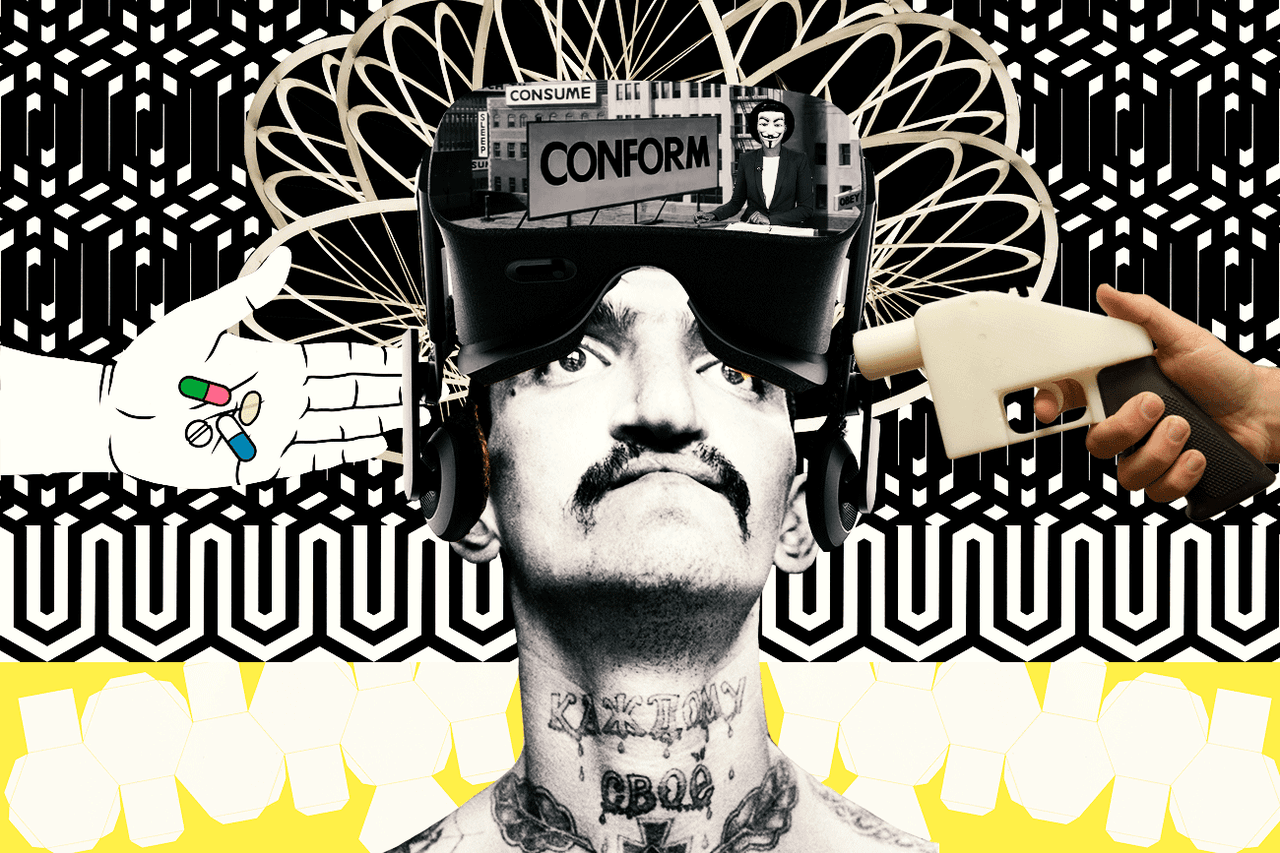
The film by Adam Bala Law draws portraits of a new generation of fighters with a system - radical cryptoanarchists, in whose version freedom is to have an unlicensed plastic gun and the ability to conduct relentless financial transactions in a darknet. It is interesting in the picture that the director is restrained from plasteness, neither ascending the heroes to the pedestal of the struggle - but one could “lead”: formally, Cody Wilson suits the state for the opportunity to use the right of freedom of speech, spreading the instructions for printing weapons - not falling into conspiracyology. Although there is food for paranoid perception: why are the slogans of the “levak” Cody Wilson in the end sound in the same way as the words of a desperate Republican, the carrier of slave -owning ideology and the head of the US National Infantry Association? Why are bitcoins created for freedom of financial transactions of ordinary citizens became the main currency of the black market - they can be paid for everything from drugs to a custom -made murder? Here, the audience will have to think and dig themselves.
The 2015 Film Winter’s film “ Deep web ” can help this investigation, which just considers the Internet environment of cryptoanarchism, the main center of which in previous times was the famous Silk Road store-something like a large underground “Avito” for drug dealers. It was here that at one time the powerful turnover of bitcoins began - and a regularly updated stream of ideological manifestos of “New Freedom”.The “deep web” examines in detail the history of the “silk path ”, tries to understand the role of the Federal Investigation Service in this matter and monitors the arrest and court of who was considered the main organizer of the black online market, Ross Ulbricht . Two years after the conviction of Ulbricht to life support, the money turnover in the darknet grew several times , instead of 12,000 offers 300,000 appeared (of which 240,000 are narcotic substances), and new online stores bred as mushrooms after the rain, breaking the former centralized ideological system. The most interesting thing is the federal trace in drug trafficking. Without going into details, you can express it like this: you never know if your boot has made a huckster or a FSBSHNIK (and if it was a gentleman in a civilian, did he do it to earn money - or to accept you right today)?
But not all is evil that you are in a dark. In fact, users have long lost the war for Internet adoption . How this happened and what harmless products turn out to be the eye of the Mordor, looking at you from your own monitor, you can learn from the 2013 documentary " Terms and conditions may change ." Kallen Hobak in detail explores the legal side of using Internet services and the conditions to which we agreed to a slight click of mouse before we recognized the VPN abbreviation or decided that the government had no approaches to the developed military Torah. This story will force everyone who sealed the laptop camera to finally lose balance.True, in the film it is impossible to find an answer to the question of what should be afraid of those who do nothing illegal and who would not be shy to show their history to other people. I see two theoretical models to resolve this issue. In the first, we see a society of total control , in which an individual can be punished for the idea of reform or the assumption that something in the country does not work or should be changed: in such a society, the riot is not just useless, it cannot arise. On the other hand, a completely transparent society is possible, where human capital will be recruited by honest, transparent actions: the most virtuous will be at the top of the community, and the deceiver and the thief will naturally be at the bottom. In fact, so far any utopias and anti -utopia are too centered on the individual. On the individual, in fact, to everyone to be honor: only the corporate makhina of the production of capital is of importance - and people in it are taken into account only by mass.
If you suddenly have an argument that the personality in the era of social networks has finally gained weight, you will like the 2014 film Frank Coufan and Douglas Rashkoff “ Generation Like ” about a generation that has grown up in social networks, for which the main currency is like.A very detailed study of the marketing strategies of large brands in social networks, mechanisms for creating a mediaheip, ways to construct a popular video blogger and much more ultimately leads to a simple and laconic course of thought. Teenagers spend a huge amount of time in social networks, hoping to become stars. You can become a star through an association with brands and products with a large fan base. Working on the brand, the teenager receives what he wants the most - the social approval of other adolescents. Corporations in return receive a diligent, motivated, working overtime smoke. Millions of small smokers. And you know what? They cost the corporations for free.
By this point, you are ready to go to the classics and, perhaps, even want to attach to the books of Walter Lippman and Edward Bernis , which came up with propaganda mechanisms for the “free” capitalist world. These gentlemen openly considered consumers a herd of rams, and all that we are so cute in our cozy life is compound for cattle. But in order to finally go to the texts, you can see the classic opus “ Manuapacturn Consent ” based on the book of the same book by Edward Herman and Noam Khomsky about how “free” media in the United States of the twentieth century turned out to be a powerful weapon of propaganda, which created a new type of man-consumer that could not critically think of a concormist.