
Translated material
“Wait! State border! "
Lithuania, following Latvia and Estonia, builds a fence on the border with Russia
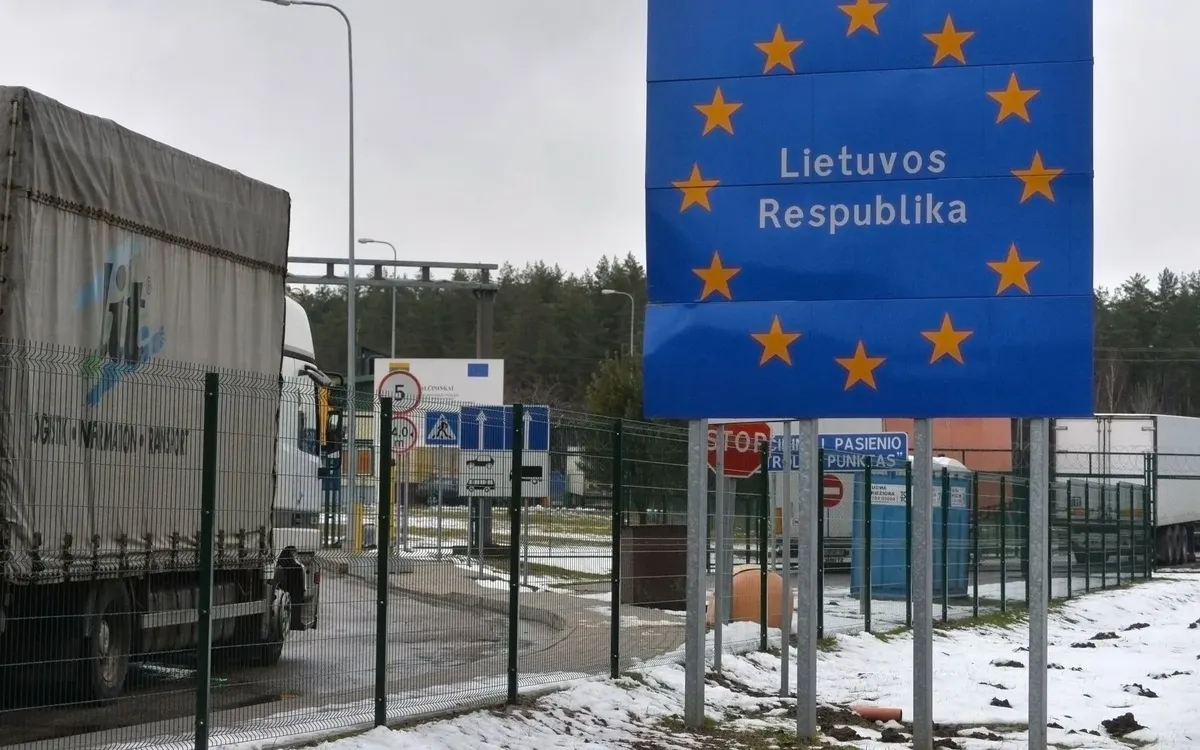
In the coming weeks, Lithuania begins a large -scale construction - the construction of a fence with a length of 44.6 kilometers along the land border with the Kaliningrad region. The future fence has several tasks: to stop the flow of smuggling, reduce the number of illegal migrants crossing the border, and play a symbolic role - to serve as a reminder of the sovereignty of Lithuania in difficult geopolitical conditions.
Lithuania was not the first to strengthen the boundaries: both Latvia and Estonia are already in the process of building a fence in the territories bordering Russia.
The other day, the Lithuanian state security service entered into an agreement with the Gintrėja contractor, which will engage in construction. The preliminary price of the project is 1.3 million euros. Dedine - December 20, 2017, but the Ministry of Internal Affairs expect that they will work out in an even shorter time. “I think that in two or three months the fence will already be built,” the Minister of Internal Affairs of Lithuania Eimuntas Misunas shared with the New Gazeta. The length of the fence is relatively small - less than 50 kilometers, but the ministry says that this is enough, since the border line runs mainly along lakes and rivers, so there is physically not to build a fence.
The fence, according to the project, will be low - 2 meters, but a metal and equipped with the latest technology: cameras, night vision devices and motion sensors.
The Lithuanian government made the final decision to start the construction of the fence in the winter - among the very first decisions of the Cabinet of Ministers formed after the October elections. “We are obliged to ensure the proper control of the eastern border of the European Union,” said Lithuanian Prime Minister Saulus Snowalis.
According to the Minister of Internal Affairs, Emuntas Misunas, the fence will help to solve several problems at once: “The first is the fight against smuggling, we want to stop a stream of illegal cigarettes and alcohol. The second is illegal migration. The third is the geopolitical situation. ”
The smuggling of tobacco and alcohol is indeed a big problem for Lithuania. So, in early May, customs officers detained on the border of a resident of Kaliningrad, who tried to transport 1800 packs of cigarettes in his car - and such news appear every month. This is understandable: in neighboring Belarus and Russia, a pack of cigarettes costs two to three times cheaper. As a result, the share of illegal tobacco in the Lithuanian market exceeds 15%.
The Lithuanian authorities emphasize: until 2020, it is planned to build the same fence along the Lithuanian-Belarusian border. Fences on the border with Russia and Belarus are called upon, in addition to illegal goods, to stop illegal migrants. Now, for example, in Lithuania there is a trial of a citizen of Russia, who was engaged in transporting people - mainly, citizens of Vietnam - through Belarus to Lithuania and Poland.
It is clear that, in addition to resolving issues of economic and social security, a fence is a policy. The Minister of Internal Affairs of Lithuania in January, answering questions from journalists, asked not to compare the fence with the Great Chinese wall, but he admits: Russia is a dangerous neighbor. “We know that a couple of years ago, Estonia accused Russia of abducting her special services employee from Estonian territory,” the minister says. - We do not want to allow this. Although, of course, this fence will not stop Russian tanks. ”
The Lithuanian Minister recalled the case of Eston Kokhver: according to the Estonian side, in September 2014, Kokhver, a security officer, was abducted by the Russian FSB in the “transaction to prevent crime”. According to the Russian side, Kokhver illegally crossed the border and was detained in the Pskov region. A year later, Kokhver was exchanged for Alexei Dressen, who was accused of the Estonian authorities of espionage in favor of Russia.
After this incident, Estonia thought about the construction of a fence - it is expected that the structure is 2.5 meters high and 90 kilometers long will be built by February 2018. On the remaining 50-kilometer section of the border, which goes along the swampy and lake areas, buoys with a sign “Stop! The state border of Estonia! ”
Similar works are carried out in Latvia, where the longest fence on the border with Russia is built - 193 kilometers. While the first 23 kilometers are ready, another 60 should be built this year. The height of the fence is 2.7 meters.
According to the Lithuanian Minister of the Interior, all these are the necessary measures: “If we want the Schengen zone to function well, then first of all we must ensure effective control over the external boundaries of the European Union.”