
Translated material
Napoleon, Stalin and bomber are building the future
Five books about the restructuring of cities
Gorky continues a series of publications about Moscow renovation. We have already published a text about the architecture of Khrushchevs and about how old houses in Mumbai are demolished . Now Yegor Sennikov specifically read five books for us about how in different years Paris, Moscow, Vienna, German cities and Miluoi were redone.STEPHANE KIRKland. Paris Reborn: Napoléon III, Baron Haussmann, and Quest To Build a Modern City. London: MacMillan, 2013
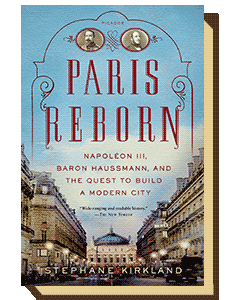 The reconstruction of Paris by Baron Osman comes to mind the first in any conversation about the restructuring of cities. And it is not surprising: the renovation of Paris, which took place from the 1850s to the 1870s (and actually ended only in 1927), became one of the largest projects in radical alteration of the city space. A lot has been written about her articles and books over the past 150 years - it was all the more unexpected that Stephen Kirkland managed to find a little -studied aspect in a long -known history. The main character of his book is not Osman himself, but Emperor Napoleon III. According to Kirkland, Bonaparte skillfully used the talent of Osman as an organizer and as a person who can realize even very unpopular decisions. But it was the emperor who himself determined the image of the city into which Paris was supposed to turn.
Napoleon III was a politician of a new type, the forerunner of the dictators of the 20th century, who come to power democratically, and then turn into tyrants. He wanted to direct the city to the future, saving it from the stains and heritage of the medieval city layout. However, Kirkland not only extols the urban visionary of the emperor, combined with the executive talent of Osman, but also indicates obvious mistakes and negative changes. For example, it was the Ottoman layout, clearly aimed at supporting the middle class and the bourgeoisie, which squeezed out numerous Parisian workers to the outskirts, and indeed I put up the places of residence of various classes from each other. Even the boulevards had a political purpose - perestroika pursued its goal to make the street so wide that it could not be built there barricades. But despite the fact that the end of the era of Napoleon and Osman turned out to be minor-the emperor was captured during the Franco-Prussian war and did not return to France, and Osman was shifted from the post by political opponents-the image of the French capital, which they created, still exists.
Alexey Rogachev. Moscow. The great construction sites of socialism. M.: Center Polygraph, 2014
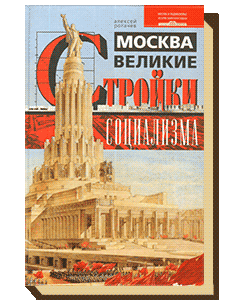 The book of the famous Moskvoyad Alexei Rogachev is also noteworthy in that it proposes a fresh look at the events about which there is already a well -established public consensus. Rogachev writes about the well -known “Stalinist” general plan for the reconstruction of Moscow and the construction of those buildings that became the personification of the new, already Soviet capital. But the author emphasizes that he does not set himself the task of criticizing and discrediting the Stalinist transformation of Moscow. First of all, he wants to describe the real rebirth of the city that Moscow has been experiencing since the beginning of the 1930s-the process is so large-scale that we can even talk about the creation of a completely new city.
Rogachev decided to show that era, describing the history of the construction of the most striking architectural facilities: Moscow Hotels, an unrealized project of the Palace of Soviets, a complex of buildings of the All -Union Institute of Experimental Medicine, VDNH. But first of all, Rogachev proves that architectural construction under socialism was able to solve the tasks that were impossible in Moscow before the revolution, and as decades of training architects and city planners, converted into a qualitatively different approach to understanding the city. Rogachev read is easy and interesting regardless of whether he writes about the urban sewage system or the causes of the asymmetry of the facade of the Moscow Hotel. Despite the author’s obviously readable dislike for pre -revolutionary authors, he remains objective - and this is what makes him believe in his own arguments.
Karl Shorsk. Vienna at the turn of the century. Politics and culture. St. Petersburg: Publishing House named after N. I. Novikova, 2001. Translation from English Mikhail Reazin
 The work of the American culture historian Karl Emil Shorsk about Vienna in the period of the FIN-de-Siècle, published in 1979, has long been a classic who received approval from contemporaries, colleagues and the Pulitzer Prize Committee. But even with such a radiance, the book still remains relevant, and its significance has not faded at all. In fact, the book is a collection of scientific articles published by Shorsk in different years. There he describes the capital of the Gabsburg Empire as a place of interweaving of numerous political interests, the bohemian life of artists, as well as permeating all this of the ubiquitous psychoanalysis. One of the key chapters of the book of Shorsk talks about the famous project for the construction of Vienna Boulevard - Ringstrasse.
And again, the politics here was tightly connected with aesthetics: the demolition of the old walls, encircling the city from the 13th century, was both a way to expand the city space, and the first step into the new liberal-constitutional era of the Habsburg empire. As in Ottoman Paris, the boundaries between work and life were erected in Vienna. The new Boulevard was supposed to serve as a border between the new bourgeois center of the capital and Viennese workers. Ringstrasse became a symbol of human individualism in the capitalist era and set a new standard for the behavior of a citizen in a modern and developed city. Two key architects of Boulevard - Otto Wagner and Camillo Zitt - managed to create not only a utilitarian, but also aesthetically verified project of a modern city.
Jeffry Dielendorf. In the Wake of War: The Reconstruction of German Cits After World War II. Oxford: Oxford University Press, 1993
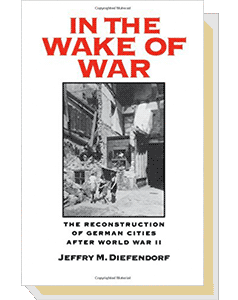 Cities reconstruction are not always planned. Often they turn out to be a forced measure, which cannot be dispensed with. The most famous example of such forced perestroika was the reconstruction of German cities after the Second World War - Berlin, Cologne and Munich. Showing how German architects and city builders were engaged in the restoration of urban space, Dylendorf speaks of the evolution of their views-at some point they abandoned the term “reconstruction”, proceeding to the “construction of the new”. And this is a very important point: despite the fact that 1945 in German historiography is usually considered a “zero year”, the moment when completely new Germany began, the author, on the example of the post -war German urbanism, shows that in fact this “new” was the thousands of threads associated with a historical past. Many architects took post -war devastation as a tragedy and at the same time as a unique opportunity to realize those ideas that would certainly be rejected in the normal course of events. In this case, the reconstruction of cities was not only a way to heal the wounds inflicted by the war, but also the opportunity to edit their own past, getting rid of outdated political and social heritage.
John Norquist. The Wealth of Cits: Revitalizing the Centers of American Life. - DA Capo Press, 1998
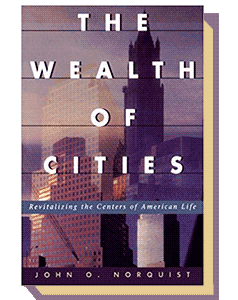 An interesting example of the urban work written by a politician: John Norvist for 15 years was the mayor of Miluoka. He writes not so much about the architectural reconstruction of the city as about infrastructure. Norkvist gives specific tips on how to revive the entrepreneurial environment, increase the training camp and lower crime. And also important: the Norkvist explains how, in his opinion, American cities should be revived and revived. This is his political manifesto. Norkvist acts here as a fierce supporter of the free market, recalling that American cities have been for decades for the monetary assistance of the federal center, forgetting that trade and services are the key to the prosperity of any city.