
Translated material
Strong mode jamb
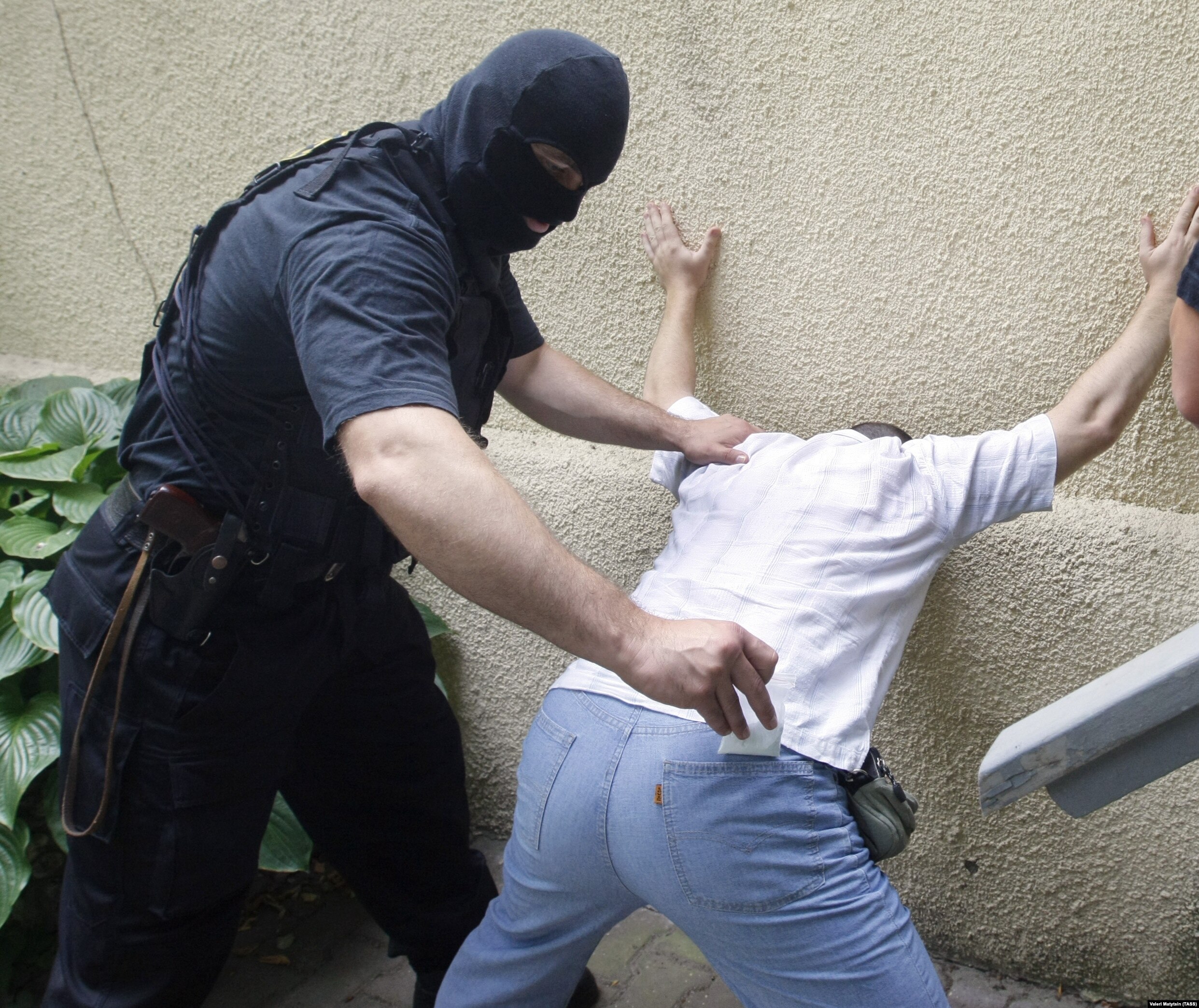
Drug consumer, their friends and just random people receive long terms for the sale of drugs.
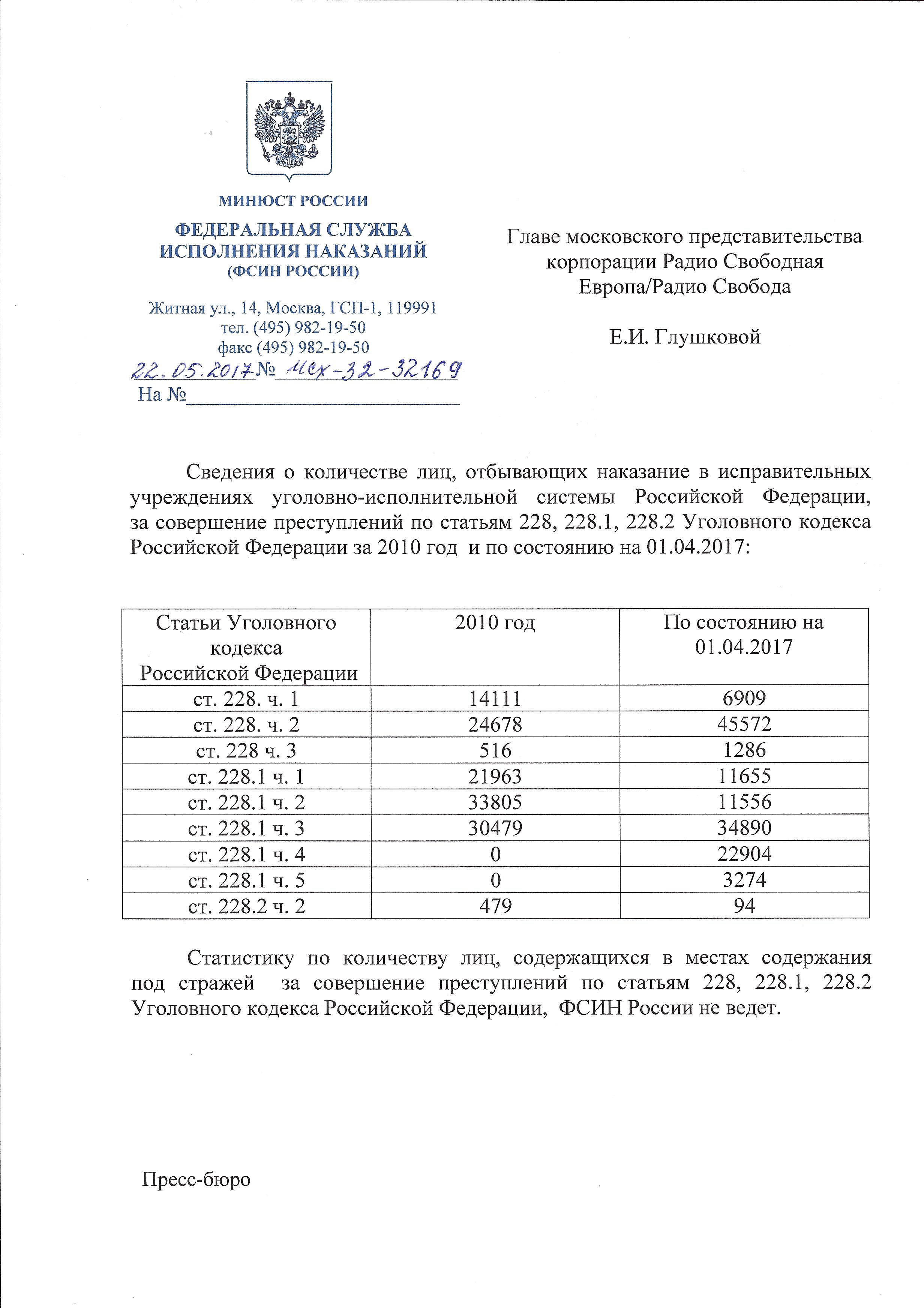
According to the statistics of the FSIN, provided in response to a request from Radio Liberty, the places of imprisonment contain 138 thousand people convicted of the storage and sale of drugs, which is 26.5% of 523 thousand prisoners throughout the country. However, these figures include only those convicts whose drugs are the most severe article in the sentence, and lawyers and former Sidelski interviewed by RS argue that in some pre-trial detention centers and colonies up to 70% of the contingent are held precisely according to the “popular” 228th. At the same time, the pursuit of statistics and corruption led to the fact that the organizers of large drug carters remain free under the roof of law enforcement agencies, and lower -level sales or even consumers are sent to prison.
November 2015. The Krasnokutsk District Court of the Saratov Region is considering an unusual case: three operatives of the Federal Penitentiary Service of the Federal Penitentiary Service in the Saratov region - the police of the police RAS Maseev, Vasily Tatyanan and Sergey Yatsenko, accused of the production and distribution of drugs, exceeding the official powers and falsification of criminal cases in order to fulfill the plan for the opening of crimes.
From the materials of the case it follows that after the meeting, the head of the Krasnokutsk department of the FSKN Urazgaliev, who asked the detectives to intensify the work of capturing drug trafficking (the office listened to the FSB), Maseev, Tatyanin and Yatsenko decided to go along a simple path: to falsify the affairs against the drug users known, some of which even cooperated with them as agents. On February 18, 2014, Rais Maseev met with the drug consumer Arsen Salavatov and, threatening a real time for sales, invited him to take the storage of marijuana. "Salavatov was forced to agree in this situation," the verdict said. Salavatov did not have drugs, but he was given the police themselves who kept marijuana and hash oil in their office. On the same day, Salavatov was brought to the FSKN department, where they “seized” 6.9 g of marijuana, signing pre -prepared documents (according to the official version, the police received operational information that the Salavatov was part of the Kannabis, installed surveillance and detained him after he purchased drugs “from unfortunate persons”). It is interesting that one of the operatives, Sergei Yatsenko, suggested that they call the witnesses “from the street”, but this was done: one was understood by a neighbor and a longtime acquaintance of Moseev, the signature of the second was simply forged.
Yatsenko gave Adai more marijuana to smoke her at home, after which he again took the hospital
Less than a week after the “capture” of Salavatov, a group of operas in the same way covered a whole tributary, located in the apartment of Sergey Zherzenko, who “abused alcohol”. The 232nd article of the Criminal Code (organization or content of brothels) provides for the provision of premises for drug use at least twice. To collect the evidence base, Major Yatsenko attracted Dmitry Adai, who was previously convicted under the 228th article, who was working with him. On February 24, he met with Adai, handed him marijuana and a plastic bottle, which he was then going to seize in order to fix the residual traces of drugs on it. Adai went up to Zear Vozhenko, smoked grass and returned to Yatsenko, who immediately took him to the hospital for examination, but for some reason the doctors did not reveal drug intoxication from Adai. Then Yatsenko gave Adai to the marijuana to smoke her at home, after which he again took her to the hospital, where he received the desired result, paying the agent of 250 rubles. The next day, Yatsenko filed a report on the discovery of a brothel and established observing the apartment of nothing suspecting Deryseenko. On February 26, he again brought Adai there, gave him marijuana and a bottle of vodka, but Drazyenko was not at home, Yatsenko did not want to wait for him, so he asked Adai to smoke the grass right in the car, after which he again took him to the hospital, paying a hundred rubles. For the third time, Yatsenko brought Adai to Zherzorenko on March 3, and after they smoked and drank vodka, he himself appeared in the “Pruton”, seized a plastic bottle, letting Besesenko sign three protocols on the inspection of his dwelling - for February 24 and 26 and March 3. Zherzenko himself was obviously in such a state that he did not really understand what was happening: “After Adai left the apartment, people came from the police, they took the bottle that remained after Adai, made up some documents, and I signed them,” he said in court. The signatures of all witnesses on three acts of the inspection of the dwelling were forged, while some witnesses previously worked in the same department of the FSKN, while others were previously convicted of narcotic articles, so that the operatives had their personal data in the hands. A week later, the same police officers “seized” 382 g of hash oil already at the Adai himself - also by prior “agreement” and under the threat of a real term.
All three episodes were documented by Sergey Afonin, who worked in the FSKN department as a driver, recording audio with police officers' negotiations on falsification of evidence and even a video on which Vasily Tatyanan makes hash oil in the garage. According to Afonin, he conducted the observation on his own initiative, “since there were suspicions that he could be drawn into something bad,” but a source familiar with the course of the investigation assures the RS that the shooting was conducted on the instructions of the FSB, which at the same time began to listen to the phones of drug police and their leadership. It is interesting that all the episodes examined by the court turned out to be quite “light”-criminal cases were only terminated against the victims, the courts did not have to revise the already issued sentences and appoint compensation unjustly convicted, who could well be taken into account that Maseev and Tatyana have worked in the Krasnokutsk FSKN since 2008, and Yatsenko since 2010. The operatives did not admit their guilt of their episode, Maseev and Tatyanen were sentenced to 5 years old, and Yatsenko - to 6.5 years in prison in a general regime colony.
Deadline for help from the investigation
“I dragged on and handed over to my friend. And I dragged on and handed it over to my friend” - here is the sales for you. There are many such stories. And give more terms than for murder
According to Alexei Fedyarov , the coordinator of the charity fund for assistance to convicts and their families “Rus Sitting”, an employee of the prosecutor's office in 1996-2007, pure falsification of criminal cases is only one way to increase statistics. “The second option is that the point where a person sells drugs is monitored, it is determined who goes there. They worked for a month, they took everyone and made sales from consumers,” says Fedyarov. At the same time, police often do not even carry out operational-search measures (ORM), simply include one of the members of the “group” to conclude a pre-trial agreement, using his testimony as evidence of the guilt of the rest, regardless of whether they were engaged in sales or acquired for themselves. At the same time, during the substitution of the 228th article (storage, punishment from a fine of up to 10 years in prison) at 228.1 (sales, punishment from 4 to 20 years in prison), criminal liability occurs regardless of the amount of drugs seized. “Usually, if there is no control purchase, then they try to spend through the attempt on sale,” says Dmitry Petrov , the coordinator of “Russia sitting” in Novosibirsk, explaining that everything can go in the case. “Well, he has a drug in a packaged bag or, God forbid, in two bags, it means that he was going to marry. Or they find people, for example, people, I had people, I got people, I got people. which were old scales with such aluminum cups, they used to be weighed sugar on them when the jam was cooked - they are also used as evidence that he weighed drugs on them. " Often the detainees themselves give indications convenient for the investigation of law enforcement practice: “Here is the story when the two guys sat smoked a jamb - in principle, this is an administrative woman,” says Olga Romanova, director of Rus Sitting. “And how did they smoke?” Well, I dragged on and handed over to a comrade. And I dragged on and handed over to a comrade " - here you have a lot. There are many such stories. And they give more terms than for murder."
The pre -trial agreement does not at all mean mitigation of the sentence (by law, the person who has concluded the pre -trial agreement is sentenced to no more than half of the maximum term under this article). Sometimes, having received the necessary indications, the investigator refuses to conclude an agreement, and sometimes the courts ignore the law. So, for example, a resident of Novosibirsk, Mikhail Leibovich, concluded a pre -trial agreement on November 3, 2015, was sentenced by the Leninsky District Court of Novosibirsk by 10.5 years in prison for the sale of drugs, while the accomplices did not plead guilty, received 11 and the same 10.5 years of the colony. A similar case in the verdict of the Dzerzhinsky District Court from the same Novosibirsk: Nikolai Shcherbuk, which concluded the pre -trial agreement, received 12.5 years in prison, while both of his partners, who did not admit guilt, received 12 years.
In order to hold a drug sender in 2001-2002, it was just necessary to lick the matter
Alexei Fedyarov assures: the situation when the prisons are crowded with drug consumers, while things are quite rare with the organizers of the drug cards, is a consequence of the evolution that the FSK has passed since their creation in 2003: “In the beginning, they calmly took the acquirers: the opera has some point, he takes one, second, and closed the plan for the quarter. Well, let's say, 10 acquirers should take one At the same time, the purchaser was planted for storage. According to Fedyarov, with the disbandment of the FSKN and the transfer of cases of combating the drug trafficking of the Ministry of Internal Affairs, the situation only worsened: their agent network left along with the FSKN employees, and the requirements for statistics remained the same. However, it is not difficult to falsify cases today: since the beginning of the 2000s, the attitude of the vessels to the materials provided has changed: “In order to conduct drugs on drugs in 2001–2002, it was necessary to just lick the matter, it was necessary to forward the observation materials, prove that people have been familiar with each other for many years, prove the distribution of roles, the stability of ties, now this is not necessary. Even things are not completely investigated: he acquired from unidentified persons in an unidentified place and was going to sell - this is enough, ”says Alexey Fedyarov.
Press for 9 years
To become a member of an organized group is simple - enough for your friends to mention you during interrogation. So, in 2012, the employees of the Novosibirsk FSKN covered a whole cartel. During a search in an apartment rented by a 19-year-old Roman, Jacks, operatives seized several kilograms of various synthetic drugs-salts and spies, as well as 4 million rubles. The joint was proposed to conclude a pre -trial agreement, passing the accomplices, which he did, pointing to his peers Ruslan Ponomarev, Stepan Shestakov and Vladislav Shubin.

According to the version of the investigation, based only on the testimony of witnesses, the joint group was the "structural unit" of the cartel, which was engaged in the supply of synthetics from China. Another unit of the same syndicate was allegedly a group under the leadership of the head of the traffic police of the Toguchinsky district of the Novosibirsk Region Alexander Sleptsov, in the car in which 14.5 kg of amphetamine were found. The cells were led by certain “Other Persons” under numbers 1 and 2. These number-number acquired narcotic drugs in an “unidentified place from unidentified persons” and handed them to the heads of cells for packaging and retail sale. The head of one of the cells was recognized as joints, behind which observation was established and 31 control purchase was carried out. All episodes are identical: in an unidentified place he received drugs from the leaders that were not indicated in the case, brought them by unidentified transport to the apartment, and Shubin, Shestakov, Ponomarev and “other unidentified persons” bearing them and hid them in the cache indicated by the joint. The drug users who cooperate with the police were written off with the joint, transferred him money to the phone and found their doses, which the police immediately handed over. Moreover, if the joint of the joint in terms of sales is confirmed by the materials of the case, the participation of other young people is based only on the testimony of the joint himself and the operatives who "saw more than once," like Ponomarev, Shubin and Shestakov came to an unfortunate apartment, but did not provide the court with either the audio or video materials that would prove it.
When asked by the investigator, how often he met with the joint and the company, Shubin replied: 2-3 times [in total], but the investigator Larisa Cherkasova wrote down "2-3 times a week"
The investigation deceived the joint: having received the necessary testimonies, no one began to conclude a pre -trial agreement with him (he received as a result of 13 years of the colony). At the trial, he refused to make a reservation of his acquaintances, of which only Shestakov admitted that he actually made “bookmarks”. Ponomarev and Shubin were denied guilt, moreover, Shubin was completely absent in Novosibirsk at the time of crime-he worked as a tile-decay on the repair of a sanatorium in the city of Belokurikh 400 km from Novosibirsk. As the Freedom of Shubin Nikolai told Radio Freedom, the first interrogation was fatal for his son, which he came on the agenda 10 days after his acquaintances: to the investigator’s question, how often he met with the joint and the company, Shubin replied: 2-3 times [in total], but the investigator Larisa Cherkasova wrote down “2-3 times a week”, and Vladislav signed the protocol without reading. Judge of the Pervomaisky District Court of Novosibirsk Julia Zueva sentenced Shubin to 9 years, and Ponomarev and Shestakova to 10 years in prison, only the verdict was already canceled by cassation courts, so the whole "structural unit" has been in the pre -trial detention center of Novosibirsk.
Particularly dangerous stroke
The "trailer" often go to the affairs of drug dealers. So, another inhabitant of the Novosibirsk pre-trial detention center No. 1, 30-year-old Anastasia Pestrikova, arrested in February 2016 in Barnaul and transferred to Novosibirsk in May last year, also takes place in the drug Cartel. Several episodes of Pestrikova are accused of taking synthetic drugs from the "bookmarks", packaged them and hid them into new cache. The accusations are built exclusively on the testimonies of other members of the group, moreover, in some episodes, Pestrikova hired exactly the same amount of the drug that she found, and the volumes sane do not exceed 1-2 g. During the interrogations of Pestrikov, she said that she bought a drug for personal consumption. During a search at her house, 0.68 g of the so -called “screw” was found, as well as plastic bags for packing drugs and scales - all this, according to the girl, belonged to her former boyfriend, which the investigation did not interrogate.
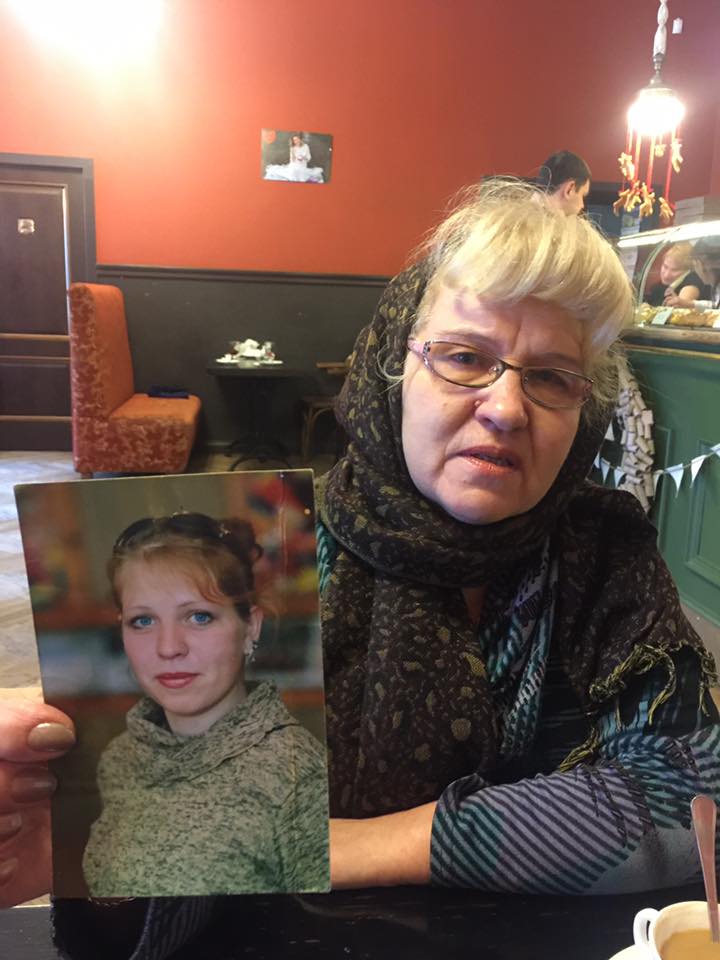
In July 2016, Pestrikova had a spinal stroke, she could not go to court, she was worn in her arms, however, according to her mother Tatyana Pestrikova, Nastya was not released for a long time for examination in the city hospital, and when they still sent, they lost her medical history. “In September, she began to faint and opened to me that she had HIV,” says Tatyana Pestrikova. “And she was not prescribed any treatment. In Barnaul, there was a treatment in the pre -trial detention center, but there was no treatment in Novosibirsk, they explained this because the medical history did not receive. I went to Barnaul, they gave me a certificate that they sent the medical history after.” According to Tatyana, they could not make the necessary tests in the pre -trial detention center to prescribe antiretroviral therapy, so she had to run to the Novosibirsk Center for AIDS with a test tube herself. In April, Pestrikov was recognized as a disabled person of the 1st group, but the preventive measure was still not changed, despite the fact that she cannot even reach the toilet on his own: “We were provided with a wheelchair three days ago.” Says Tatyana Pestrikova. “There is not even tire, just iron rims.”
Bought for 5, sold for 3
According to a similar scheme for 9 years, a 30-year-old resident of Kaluga Denis Vitokhin got into the colony: he was unlucky to be in the same car with a friend who was followed by employees of the control department with the illegal trafficking of drugs (renewal) of the Ministry of Internal Affairs. On August 15, 2013, the police conducted a control purchase from Kaluzhanin Andrei Nikolaev, who handed over 0.79 g of methadone under investigation under the 228th article to Agent Oreon, received money from him, got into the car to Vitokhin, where they were detained by the police. В самой машине при этом ничего запрещенного не нашли, с Николаева и Витохина взяли объяснения и отпустили, против Николаева возбудили уголовное дело. Николаев оформил явку с повинной и оговорил Витохина, которого объявили в розыск в конце октября того же года. Согласно версии следствия, именно Витохин покупал наркотики в Москве у неустановленных лиц, привозил их в Калугу и сбывал вместе с Николаевым. Николаева осудили на 3,5 года, а Витохина особо и не искали, пока он сам не попался в руки полиции из-за драки с таксистом в октябре 2015-го (драка, впрочем, переросла в грабеж, поскольку таксист заявил о том, что у него пропали деньги).
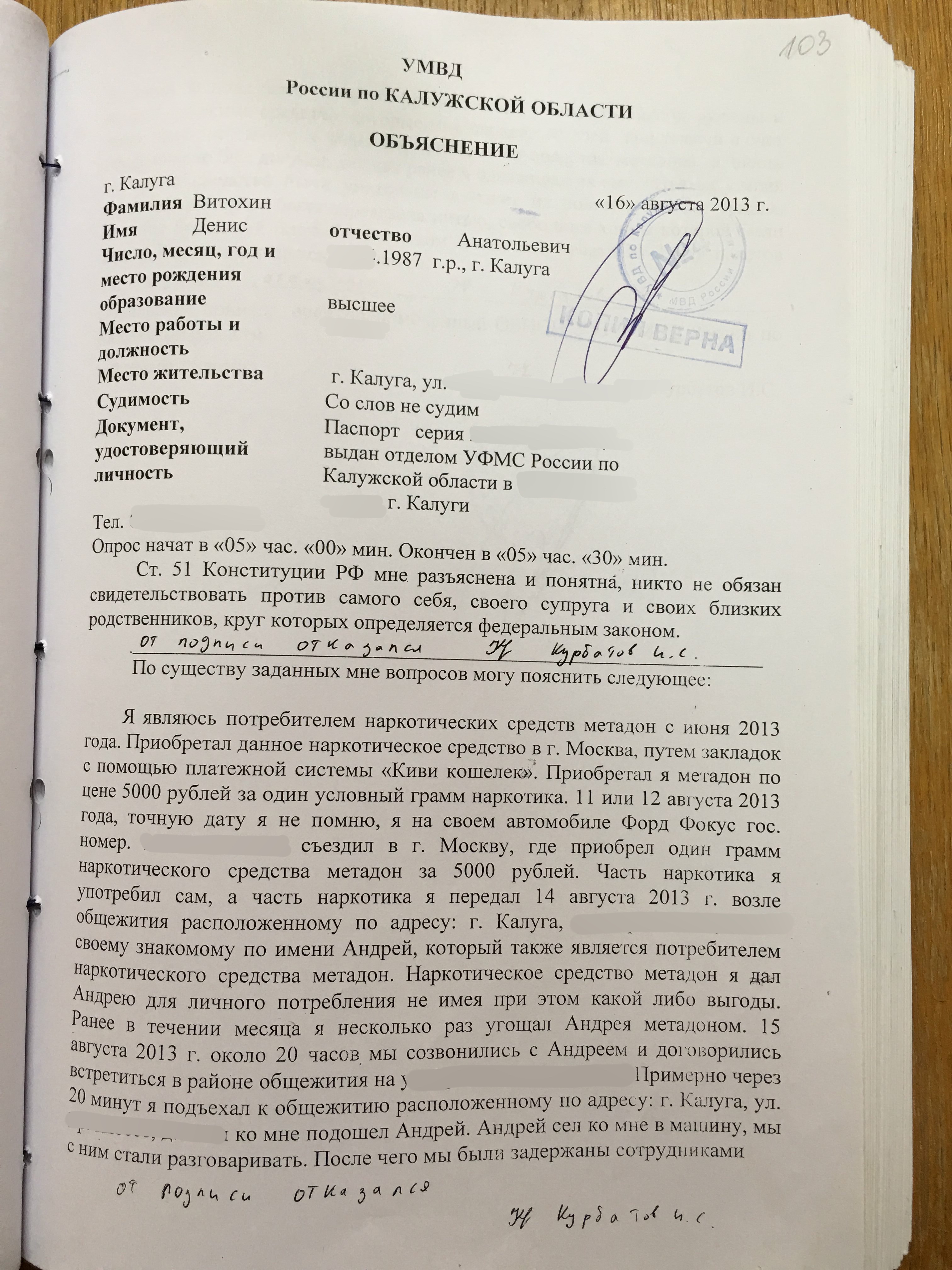
Дело Витохина полно обычных нестыковок: в объяснении, которое он якобы дал в августе 2013-го, он зачем-то признается, что употребляет метадон, покупает его "путем закладок" в Москве и делится со своим другом Андреем. Вот только подписи самого Витохина на документе нет, зато есть подпись оперуполномоченного Курбатова: "Это у них новая схема такая – сами пишут, сами подписывают, а потом на суде говорят, что подсудимый так сказал, – говорит адвокат Витохина Дмитрий Динзе . – На ровном месте можно из любого сделать подозреваемого". В том же объяснении указано, что Витохин покупал метадон в Москве по 5000 рублей за грамм, в то время как из материалов контрольной закупки следует, что агент ОБНОН приобрел наркотик по 3000: "В убыток ребята, видимо, работали", – иронизирует Дмитрий Динзе.

Ни обыск дома у Витохина, ни биллинг его телефона не добавили доказательств его вины. Приговор судьи Калужского районного суда Эдуарда Власова основан лишь на свидетельствах полицейских и Андрея Николаева, причем последний к суду успел выйти по УДО и отказаться от первоначальных показаний, пояснив, что оговорил Витохина в обмен на меньший срок. Витохин вину не признал и, по словам Дмитрия Динзе, поэтому сел так надолго: "Судья прямо в суде при взятии под стражу ему сказал, что если бы признал вину, получил бы 4, а так 9 – чтобы неповадно было", – говорит Динзе.
Дох Хуан из Сибири
Признание вины тоже не гарантирует мягкий приговор. Так, в апреле 2016 года Заельцовский районный суд Новосибирска приговорил двух молодых людей, Александра Кушнера и Алексея Педченко, к 8 годам лишения свободы за сбыт марихуаны. Оба они признали вину, впрочем, по словам Кушнера, если сбыт они не отрицали, то профессиональными наркоторговцами вовсе не были. В материалах дела, как водится, расписаны роли организованной группы: Педченко занимался поиском поставщиков (на самом деле поставщик был один – другой житель Новосибирска, выращивавший траву у себя дома), а Кушнер якобы расширял клиентскую базу "с целью получения материальной выгоды". По словам самого Кушнера, деньги они на марихуане не зарабатывали: у Педченко была своя дизайнерская фирма, а Кушнер учился в университете и работал менеджером в одном из новосибирских баров. "Тут гораздо большую роль играли эзотерические мотивы, – говорит Кушнер. – Я был увлечен Кастанедой. Вот отсюда все".

Приобретая марихуану небольшими партиями, молодые люди перепродавали ее в узком кругу своих знакомых. По словам Кушнера, поставщик попал в руки ФСКН и сдал своих клиентов, остальное было делом техники: при обыске у Кушнера нашли 17 г наркотика, у Педченко – всего 0,354 г, никаких контрольных закупок не проводилось, все обвинение строится на признании самих обвиняемых и их знакомых. "Одного из свидетелей били при допросе, пытали электрошокером. Я сам это слышал, сидел в соседнем кабинете, – говорит Кушнер. – А меня когда задержали, привезли мою девушку и сказали, что, если не сознаюсь, она за мной пойдет. Я таких последствий не хотел".
Начиная с 2020–2025 года мы ежегодно будем получать сотни тысяч молодых людей, не подготовленных ни к чему другому, кроме как к совершению преступлений
По словам Дмитрия Петрова из "Руси сидящей", стремление увеличить статистику по сбыту приводит к тому, что за решеткой оказывается масса молодых людей: средний возраст вхождения на рынок потребления наркотиков – 18–25 лет. "В начале 2010 годов произошла тихая правоприменительная революция, – говорит Петров, – раньше в колониях сидели так называемые профессиональные преступники, для которых это был привычный образ жизни. Ты поработал год-два, тебя взяли, ты два года посидел. Это была замкнутая структура. Но потом система начала захватывать людей, далеких от уголовной тематики. Ну вот студент учился, решил подзаработать и попал. Дай ты ему три года, отпусти его через два, он все поймет, и мы через два года получим законопослушного гражданина. А сейчас они садятся на 10 лет и проходят весь процесс тюремной социализации. У них не будет профессии, но они получат всю базу знаний уголовного мира, обрастут связями. Начиная с 2020–2025 года мы ежегодно будем получать сотни тысяч молодых людей, не подготовленных ни к чему другому, кроме как к совершению преступлений. Наркотиков тем временем меньше не становится, а вот к взлету преступности можно готовиться уже сейчас".