
Translated material
How to make a terrible exhibition
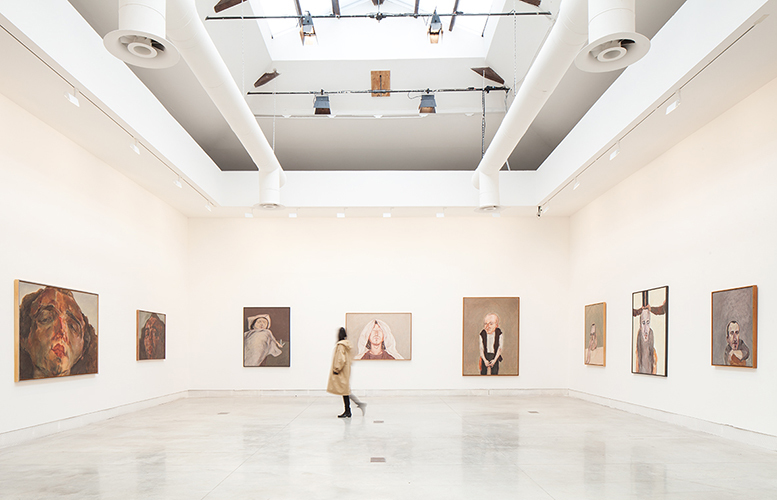
In mid-May, the 57th Venice Biennale called "Long live living art!" ("Viva Arte Viva!") . Her artistic director Kristin Masel is not the first time working in Venice: in 2013, she oversee the French pavilion (Henri Sala) and earlier, in 2007, Belgian (Eric Dukerts).
"Viva Arte Viva!" -The main project of the 57th Venetian Biennale of Contemporary Art, according to the intention of the curator, was supposed to sound as “a passionate scream about the art and state of the artist” , to appeal to the inhabitants of the world full of disasters and violence. Only the scream that turns out at the butter is more like a slurred mumble and a spoiled phone. The exhibition is an example of a very poor curatorial work and a textbook example of how you can make a huge terrible exhibition with 120 magnificent artists and a generous budget. Using the fashionable formula “A few stars, a little young artists, slightly repressed communities (for example, Indians)” and asking for a timely question of what an art can be done for the world mired in violence and capitalism, the curator categorized (the exhibition consists of the so-called trans-pavilions) and depolitized works, simplified and filmed them up to sterility. The exposition turned out to be dry and empty.
The exhibition is an example of a very poor curatorial work and a textbook example of how you can make a huge terrible exhibition with 120 magnificent artists and a generous budget.
The works of artists are occupied by niches isolated from each other (as in a supermarket), they are not able to enter into a dialogue, to create an environment for the viewer's imagination. Just a month ago, I wrote about the “Document-14” , which left a huge number of questions, but, no doubt, will remain one of the key exhibitions in the history of art. Speaking about the current Venetian Biennale, I want to scold, with the exception of artists, everything is from the stinginess of the curatorial plan to too low and inconveniently hanging headlines for work and texts in the doorways.
Like the book, the halls of the central pavilion of Jardini and Arsenal are divided into nine chapters (those same “trans-pavilions”): the pavilion of artists and books, a pavilion of joys and fears, a community pavilion, a pavilion of traditions, a pavilion of traditions, a pavilion shamanov, a dionysian pavilion, a pavilion of Coloria, and the pavilion of time and the time of the time and the time Infinity. Masel distributed artists in these categories, hanging labels at the work and depriving them of the statement of complexity and multi -layer. Recently, I saw a similar way to structure the project - on the Triennal in the Garage , but in this case the goal of the curators was to conditionally structure knowledge about Russian contemporary art. Masel speaks of the role of an artist in society, but already the format of building an exposition neutralizes and depolitizes his statement.
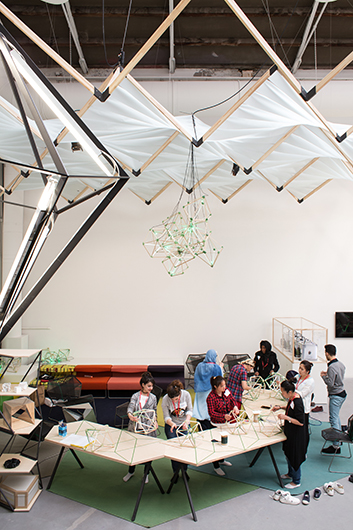 © Francesco Galli / La Biennale di Venezia Olafur Eliasson. Green light. Artistic workshop. 2016–2017
The pavilion of artists and books focuses on society, that is, in space outside the artist’s studio and practices “between inaction and action”. The curator reflects on what it means to be an artist and how the artistic process is happening, how the artist is included in the process of accumulating knowledge about the world. For some reason, the Green Light project Olafur Eliasson, which for me, embodies everything that neither an artist nor the curator for me, in this pavilion was. The idea of the project is to stimulate donations and provide refugees with the opportunity to integrate into Italian society, learn a language, work. It sounds right, and as proof we see cleanly dressed pretty young black guys and girls who make these very flashlights before our eyes. We see refugees as an exhibition exhibit. We are mistaken, thinking that we live in a civilized society, and the times of the “human zoos” have passed - the white Western man is still in a privileged position.
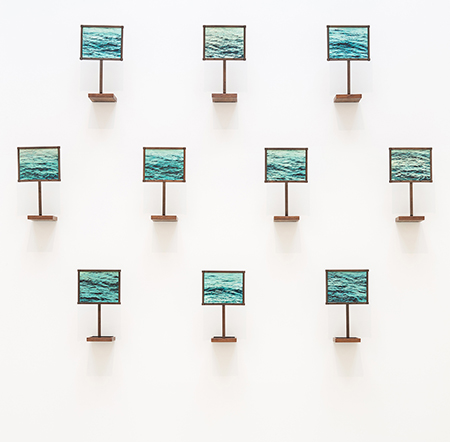 © Francesco Galli / La Biennale di Venezia Hajra Wahid. Works of 2014-2017
The pavilion of joys and fears returns us to the idea of the identity of personal and political. In my opinion, this is the most balanced part of the main project. For example, Hajra Wahid from Canada introduced the installation of “Sea changes” (2011 - present). Over the past few years, the sea has gained a political context, it is impossible to admire it without thoughts about the people who disappear daily in it . The starting point of the project is the disappearance of 166 pilgrims from Calcutta in 2011. The expressive painting of Marvan, who recently passed away from the life of the Berlin artist of Syrian origin, is based on his memoirs and, like a dream, seems to arise in the subconscious of the author, penetrates into the subconscious of the viewer. Tibor Khaias is a poet, a cornist, a performer, a movie and video director, one of the most significant figures of the Hungarian Andegrand of the 1960-1970s, whose work was associated with a risk to health and even for the life of an artist. The exhibition presents the joint work of Tibor Haias and photographer Janos Veto called “Painting of the Flesh” and “Superficial torture”. Love, the Czech-Autsider, whose anatomical collages with Indian ink draws are carried away into the mysterious world of the human body. Sung Khwan Kim tells the story of two people who have never met, thus connecting the policy of alienation, the history of the two countries - the country in which he was born (South Korea), and the countries where he lives (USA).
In the community pavilion, all kinds of practices of creating communities are listed, mainly in the form of documentation of various artistic practices based on self -organization. The Pavilion of the Earth is already clear from the name-united artists working with the theme of the ecology, and the pavilion of Shamanov-artists interested in ritual practices and post-colonial context, artists, “missionaries”, by definition, given Duchan, moved by an internal vision.
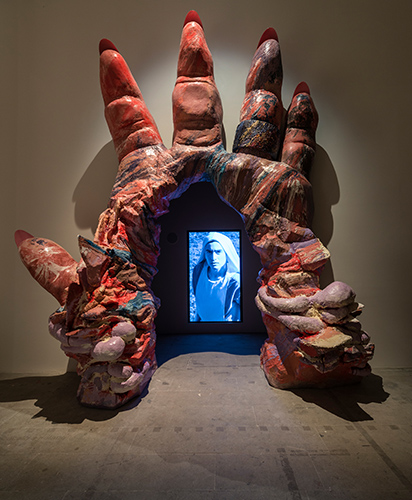 © andrea avezzù / la Biennale di Venezia Polin Kurnya-Jardan. Deep cave. 2011. Video
Indignation is caused by the so-called Dionysian pavilion, which contains women artists. Artists here, like Dionysus priestesses - bacchanks, embody sensuality and sexuality. That is, there are artists who work with the topic of ecology, there are activists, and there are women. Seriously? The curator of the center of Pompida allocates women artists into a separate group, reducing their art to cliche about a woman-artist? For example, the magnificent “deep cave” (2011) Polin Kurnya-Jardan is one of the most beautiful, absurd and mystical works of the exhibition. But is it possible to reduce the works of this artist only to sensuality? She has no less strong works about the Second World War, memory, religion. If there is a pavilion about the female body and sexuality, where is the pavilion about the male body and the artist man? How can you in a world where women still fight for their rights, so thoughtlessly emphasize the stereotypes about the art created by a woman, highlighting it in a separate group?
That is, there are artists who work with the topic of ecology, there are activists, and there are women. Seriously?
The Pavilion Colorite tells of the banality of the curator's thought. “Color does not exist in itself, but is the result of the cognitive function of the eyes and brain. Thus, the color is a particularly subjective source of emotions and offers to reconsider the phenomenological approach to art, ”the pavilion in the press release says. The theme of the artist and color is banal, so Pavilion Coloria is one of the most didactic and fresh. However, in this pavilion it is worth paying attention to the objects of Judith Scott.
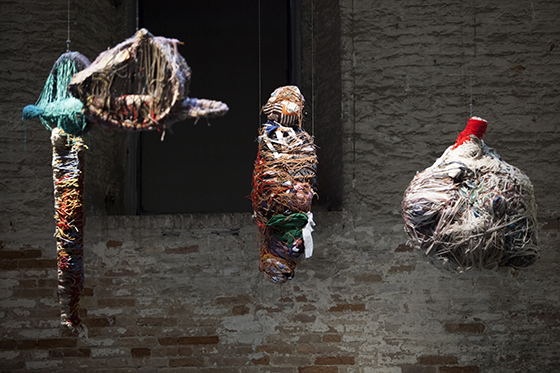 © Italo Rondinella / La Biennale di Venezia Judith Scott. Without the name. Works of 1988-2004
Only the pavilion of time and infinity can be more banal than the pavilion of color. According to the curator, here we are talking about "time as a stream of continuing mutations and inconsistencies, eventually leading to death." Thus, death, time and infinity are the topics of the work collected in this department of the exhibition. Among others, the excellent works of Alicia Cvada, Lilian Porter and Edith Decindt are presented.
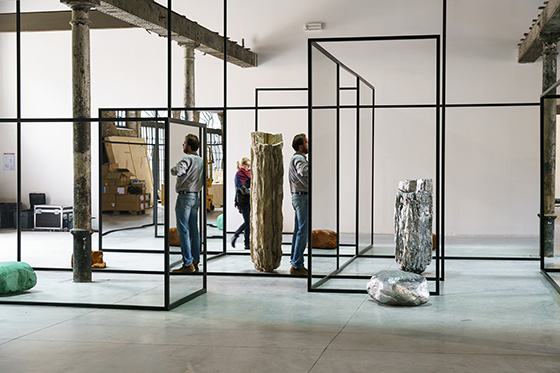 © andrea avezzù / la Biennale di Venezia Alisia Quadade. Weltenlinie. 2017
The fresh and disappointing main exhibition is compensated by a large number of magnificent national presentations. This year, the Golden Leo received the German pavilion , which was presented by the artist Anna Imhof with her exciting performance Faust . In it, minimalism and monumentalism of the aesthetics of the Third Reich echo with futuristic aesthetics. The topics of individualism and mass, freedom and stiffness, tenderness and cruelty, power and slavery in the modern post -industrial capitalist society affect the emotional level, through sensory sensations, through movement, music, voice, fire.
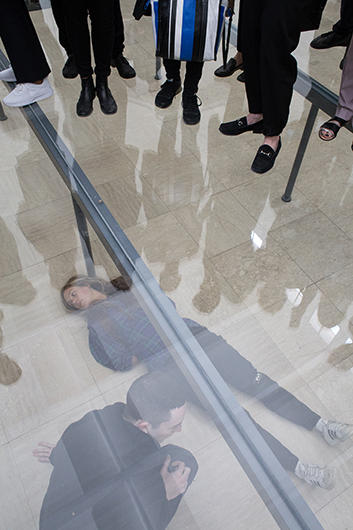 © Francesco Galli / La Biennale di Venezia Anna IMHOF. Faust. 2017. Performance in the German pavilion
The installation of “Love Story”, created by Candice Brights ( South African Pavilion ), pushes the viewer face to face with his own stereotypes of perception of someone else's pain. In the first hall, Hollywood actors Alek Baldwin and Julianna Moore play the roles of six refugees from conflict zones or states with authoritarian regimes living in the West. Professional actors are able to cause the viewer the deepest empathy and even tears, they depict defenselessness, pain, excitement. In the second hall, six screens were installed with the same stories, but told by real people who survived them. And suddenly you find that it is disappointed. People on monitors are strong and confident, they do not need pity or tears. The work of Brights reveals the entire palette of complex relationships of cultures and cliches. A clash with oneself and own reactions is not always the most pleasant, but undoubtedly useful experience.
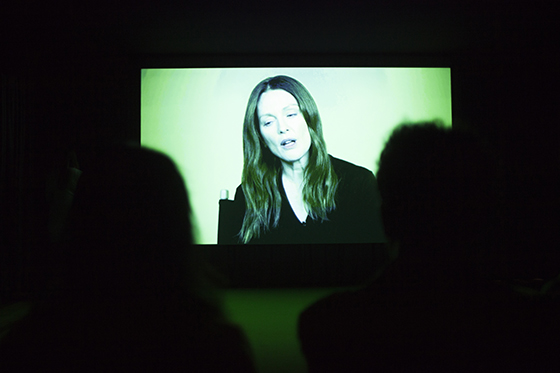 © Italo Rondinella / La Biennale di Venezia Kandis Brian and Mohau Modisakeng. Love story. 2017. Pavilion of South Africa
The unexpected discovery was the Malta pavilion entitled “Maltese man: incomplete meeting in 19 chapters” , where anthropological, historical, political, cartographic, ritual and social comments about the Maltese national identity were collected as part of the group exhibition. Here, the genres of a comic book, video, animations, sculptures, contemporary art are adjacent to objects from historical and scientific museums, a sense of humor - with criticism, reality - with fiction.
The Romania pavilion presented the retrospective of Geta Braescu , entitled "Ghosts". The central figure of the Romanian avant-garde, since 1960-x, Braescu has been working in the field of performance, drawing, collage, engravings, sculptures, photographs and videos. Many works are exhibited for the first time. And this is the first time in the history of the Romanian pavilion, when the country is represented by a personal exhibition of a woman.
This year, it is worth going to Venice only to look at the national pavilions.
The Estonian pavilion introduced the artist Katya Novitskova , the key figure of the post-anti-art. Her installation “If you could only see that I see your eyes” was created at the junction of science and art in the genre of science fiction. Novitskov is interested in biophysics and genetics, various - not only humanoid - forms of life, relationships of science, technology and civilization.
Mexico pavilion is one of my favorite artists Carlos Amorales . He demonstrates a unique alphabet of sounds, each “letter” of which is a musical instrument and sound emanating from it. On the basis of these “letters”, Amorales composed poems that can be read both in the form of text and in the form of music. All these elements are connected in the film "Damned Village", telling the story of the family of migrants and linching by their inhabitants of the village.
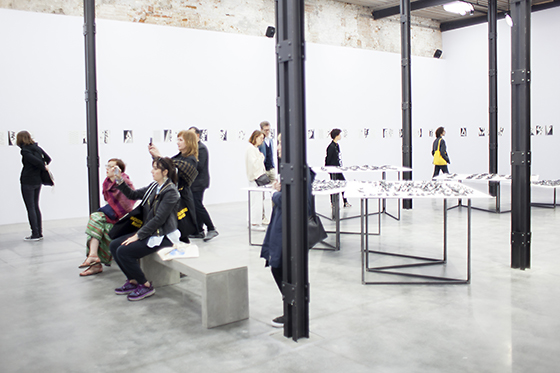 © Italo Rondinella / La Biennale di Venezia Carlos Amorales. Life in folds. 2017. View of the exposition in the Mexico pavilion
It is also worth paying attention to the pavilions of Croatia, Switzerland, Serbia, Greece, Bosnia and Herzegovina, Kosovo, Latvia, Slovenia and Georgia.
The 57th Venetian Biennale returns me four years ago, to the 55th release of Biennale, the curator of which was Massimiliano Johni . Then I criticized him for the lack of a political position. Experience of visiting "Viva Arte Viva!" I made me revise my opinion and mark the exhibition of Joni as a deeply worked out, meaningfully structured and, most importantly, not discriminating artists either by gender or legal attribute. This year, it is worth going to Venice only to look at the national pavilions. Inaccurately, but the oil still made Biennale for artists and artists, since most of the work of the main exhibition is more and deeper than the framework into which their curator imprisoned.