
Translated material
Excerpt from the book "Citizen"
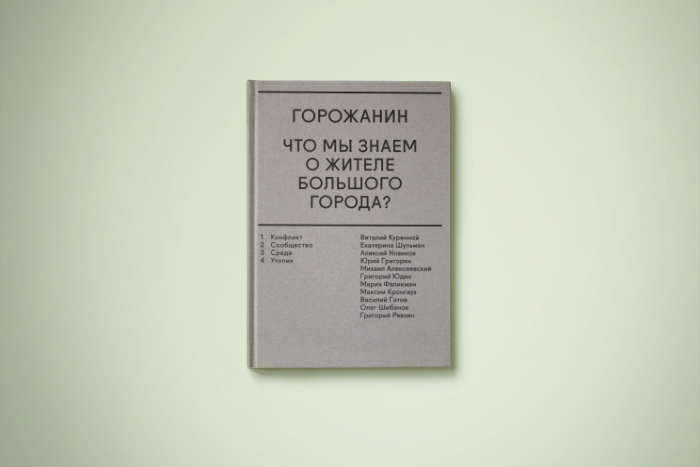
© Institute of Meda, Architecture and Dizila "Strelka", 2017
How with the development of technology the city’s structure changes, why the family is no longer economic necessity, why are rallies on the streets become less effective and in which cases the city is a “death machine”?
“Paper” publishes an excerpt from the article by political scientist Ekaterina Shulman for the collection of the publishing program Strelka Press “Citizen: What do we know about the resident of the big city?”.
From the city - to the Internet
Our cities are the fruits of the industrial revolution. We are not fully aware of what extent the entire structure of the city and the entire lifestyle of citizens are built around industrial production. All our cities are designed that people who receive a regular salary live in them, while people are so poor that women are also forced to work. These are nuclear families, consisting of a couple of adults and some number of children and who are in rupture with the older generation of their relatives who live separately, in another of the same apartment, and not all together in one large house (or hut), as was the case in a traditional agrarian society. Mass housing construction with its cheap buildings arose from the need to settle workers who work in large industries. The public transport system, the radial-ring system of roads and passing public and private transport is due to the fact that large masses of people at the same time go to several key jobs by call. Our education system, the child care system have the need to look after children, while parents spend all day at work.
But the post -industrial economy, which is slowly stepping on all of us, ceases to need this kind of mass production. The plants are robotic, go to the third world, generally cease to need people's hands or at least stop taking squares in cities. What we see now is the conclusion of production from cities and the emergence of new free spaces, former factories and factories where exhibitions are now being held, shops are opened, art space is organized. The city ceased to be the city of workers, it has become a city of office workers, but still continues to be the city of poor people who go to work every day. New means of communication and new technologies may change this. Then people will work more and more remotely, remotely, the very concept of “working day” will be blurred.
All our cities are designed that people who receive a regular salary live in them, while these are so poor that women are also forced to work
There is an optimistic scenario for the development of cities: in it the well -being of people is growing, they receive a basic civil income and, suppose, can afford a more free lifestyle. For example, many will want to leave cities, live in a house in a suburb. Then the culture of subourbies, suburban settlements, consisting of small houses, in which people live, who are not necessary to go to work are not necessary. There are quite a lot of journalistic articles and scientific research on this suburban lifestyle and its features - how children are brought up there, how families live, how leisure is carried out, how this way of life affects the structure of expenses, the level of divorces or crime.
You can also find rather gloomy predictions that people there grow non -socialized, they are deprived of vaccination with urban political culture, live in some artificial, too non -conflict, applied space, in which you need to go by car to the nearest focus of life. The children do not see a living person there, but see only in specially designated places where they were delivered in a special way. You can also talk a lot about this - how this suburban life will look if more and more people will plunge into it.
On the other hand, the society arises of those whom sociologists now call Precariat - people without a specific place of work, with unstable employment. These are people who largely prefer not to own property, but to rent an apartment, rent a car or use a taxi and generally use the services of a variety of sherring. The ideological base is brought under this - not to burden the planet, to reduce your Carbonimprint. But the economic basis under this is that people simply do not have such income that allow them to own property or engage in demonstrative consumption characteristic of the bourgeoisie of the twentieth century. These people are increasingly not creating families in the traditional sense of the term. These are Singles, people who have constant or unstable connections, but do not have a common household. Let me remind you that according to our Family Code, the family is determined not by the sexual behavior of its members, but by joint farming. There is no farm - no family.
There is an optimistic scenario for the development of cities: in it the well -being of people is growing, they receive a basic civil income and, suppose, can afford a more free lifestyle
In general, a little distracted from urban themes, we can say that humanity for the first time, at least in the countries of the first world, has reached such a level of well -being that a family is not needed for survival. Let me remind you that the traditional family is being built on the basic general interest not to die of hunger and feed the children who will then feed you. The new post -industrial well -being and the new social security system, which humanity before that did not know, cease to make the family economically necessary.
If you do not fall into conspiracy, then we can say that this is an unconventional and new phenomenon, and by no means the same -sex marriages. And the legalization of same -sex marriages in Europe and in the USA is just not progressive, but a conservative step aimed at supporting the institution of the family, which is at risk. But not from imaginary homosexuals, but from completely heterosexual people who simply do not have the opportunity and the need to create a family that we are used to seeing and which also grows from the agrarian and nipple industrial society. How it will change, we do not fully understand, but this will also be extremely greatly affected by city life. The Soviet thesis about the erosion of borders between a man and a woman, a city and a village, mental and physical labor turned out to be much closer to reality by the end of the twentieth century than one could assume.
Let's get back to the townspeople. A person who moves to a green suburb, like a person leaving for a Thai villa, whom he rents, renting his city apartment, excludes himself from political turnover. On the other hand, progress also changes the conditions of the game. New means of communication not only connect families with each other and help people unite in interests, but change the political machine, perhaps bringing us closer to direct democracy at a new level. Let me remind you that humanity has left direct democracy after all the free men of the city ceased to be placed in one agor. Then we moved to the democracy of representative, where we choose our representatives, and they carry out powerful functions for us.
Perhaps new means of communication will allow us to return direct democracy in the Greek sense of the word. Citizens will vote on endless referenda through their application on smartphones, expressed in the language of today. How it will look tomorrow, we do not know. But in these conditions, the place of residence will no longer be so fundamentally important. Perhaps this somehow compensates for the depolitization to which the departure of people from cities will lead. In Russia, this is not yet very expressed, although traveling through cottage villages is happening, but in richer countries it is much wider. I think that the suburban suburban culture may well be the subject of study, including the subject of political science analysis.
The legalization of same -sex marriages in Europe and in the USA is just not progressive, but a conservative step aimed at supporting the institution of the family, which is at risk
Is it possible to talk about the fact that interest in politics will gradually fade away, as people from the cities left? No: look at how in countries that are much richer than us, political passions boil. You can, of course, say conspiracy that the political system, itself, fearing passivity and loss of interest, fuels interest in itself, throwing new players, provocative candidates, radical parties. In our country, such actions are considered the instruments of the collapse of the democratic mechanism, although in fact they help him to survive. Including cooping those who are dissatisfied with the ongoing changes, do not find places in them, annoyed or depressed - all these angry citizens are also given the opportunity to participate in the democratic process, voting or sympathizing with the radical or pseudo -radical, but in fact the same system candidate as everyone else.
This is not an elite conspiracy, this is the property of a democratic mechanism, it is built for this - so that there is no split in society so that any discontent can express itself with legal political means.
Therefore, it is not worth counting on the full loss of interest in politics. I suspect that political activity will be more like life on social networks. Do you see in social networks the loss of people's interest in being? No, we see an increase in this interest - people want to express their opinion, express their attitude, participate in discussions, curse and cooperate with each other. This causes great passions, and tomorrow’s policy, it may be like that. It will be, conditionally, a global Facebook, in which we will all run for posts and vote for candidates. This is a certain road to the future.
You can't even imagine us
Will we remain the townspeople, living in no matter where and spending most of our active political life on the Internet? We are used to absolutizing the physical presence. We are filled with the expectations that millions of people will go out onto the streets - and the regime will collapse. Or are filled with fears that a million will go out on the streets - and the civil war will begin.
The access to the street as such, direct participation in rallies and processions is a rather primitive way of political participation. It is necessary, and in the countries of developed democracy, people also use this tool. Nevertheless, the unit in the political system, the actor is not an individual who went to the square, but an organization. One of the gloomy laws of democracy, which is not very often indicated, is that an organized minority exists in the political mechanism, and the unorganized majority does not exist. You are represented in the political space if you are organized. If you do not have an organization, then you have no subjectivity, no political life.
Will we remain the townspeople, living in no matter where and spending most of our active political life on the Internet?
In fact, democracy is a way not so much to protect minorities, as we usually believe, how much a way to give political representation to this majority, which is otherwise devoid of. Any organization defeats any mass, because the organization, forgive forgiveness for tautology, is organized. Universal suffrage is a gift to the majority, it allows him to find at least some subjectivity and protect his rights. Therefore, a majority that does not enjoy their right to political existence gives power over themselves to any organized group.
This can have rather serious consequences. So, all those cases when extremists come to power are based exactly on this. In the context of the collapse of a democratic mechanism and the lack of peaceful methods of political representation, power will belong to the one who has an organization.
How does this happen? In undemocratic conditions, when power suppresses any healthy peaceful legal political activity, only those who are ready to confront this press survive, going into a semi -legal or illegal field. Being in this field of illegality, any organization is radicalized, this is known to political science and a pretty well studied phenomenon. Who is not represented in a public political field, he will be radicalized. Who does not have a legal representation, he very quickly begins to consider compliance with laws optional for himself very quickly. This is an iron rule. It makes a dangerous political life in a non -somocratic society, especially after the scrapers and foundations of the power begin to shuffle up - and over time they inevitably loosen.
In the conditions of the collapse of the democratic mechanism and the lack of peaceful methods of political representation, power will belong to the one who has an organization
Only democracy has a secret of constant self -regeneration and is able to overcome crises, absorb dissatisfaction and resolve conflicts peacefully. All types of autocracy can be quite tenacious, but they end, and the more they managed to destroy political institutions inside themselves, the more dangerous the situation that arises after the death of the leader and the physical aging of his associates. This is a rather dangerous moment, and it is dangerous in large cities. I repeat, in the absence of consent, in the absence of mechanisms for achieving and maintaining this consent, the city is a death machine. Because it is designed only for the coordinated work of all its inhabitants. Any interruptions in electricity, connection, water supply, sewage, transport, food supply almost instantly turn it into hell.