
Translated material
"They will talk to Putin together"
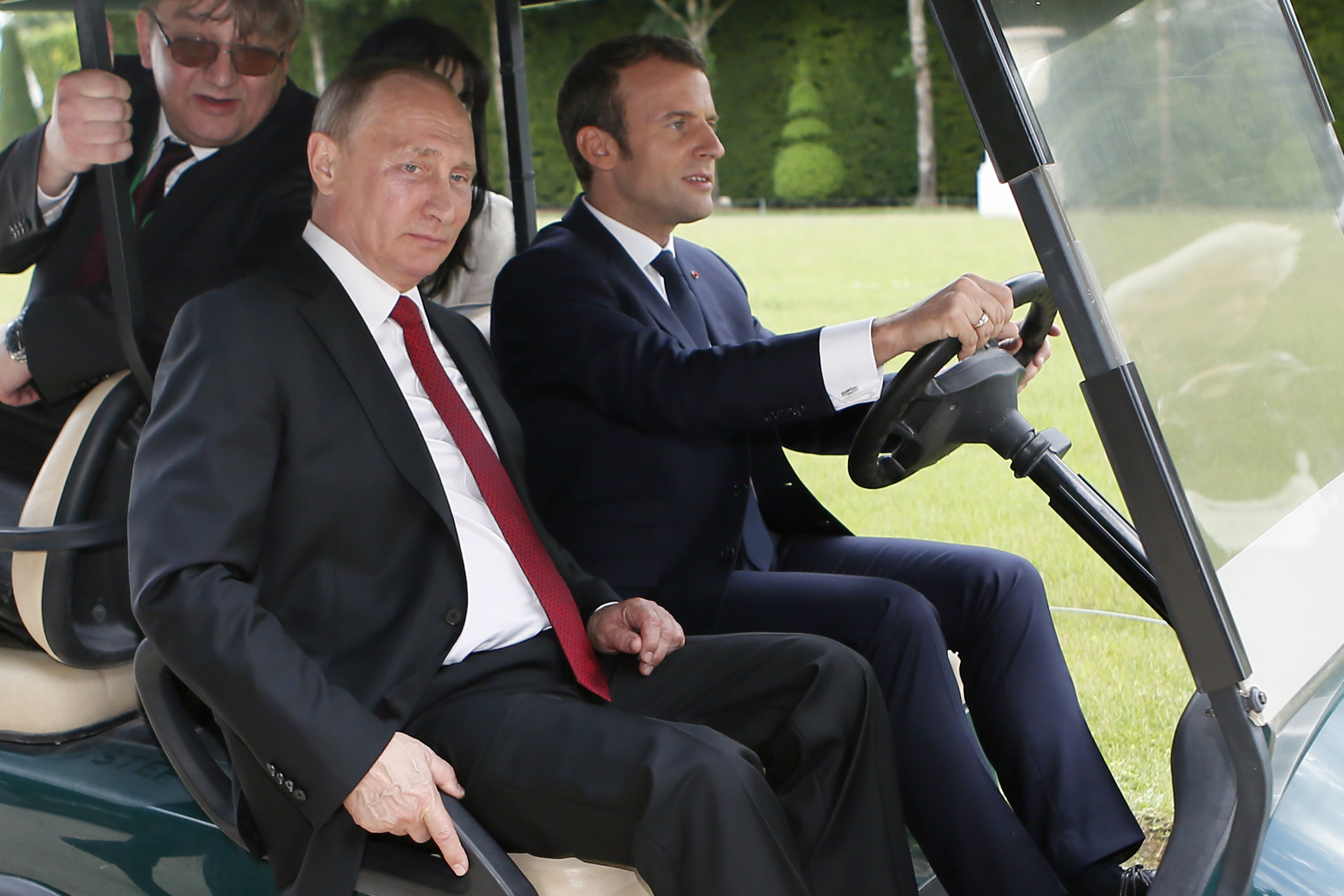
The negotiations of Emmanuel Macron and Vladimir Putin in Versailles turned out to be very cool . The French president did not miss the opportunity to tell the Russian leader a lot of unpleasant things-about the ally of the Kremlin Bashar al-Assade, the " propaganda agents " from the Russian media who tried to influence the outcome of the French elections, and about the persecution of gays in Chechnya. Putin clearly defended himself and felt uncomfortable.
Moreover, on the day of negotiations, Macron with Putin announced the arrival of the first LGBT refugee from Chechnya to France. It is unlikely that this gesture remained unnoticed in Moscow.
" France accepts LGBT refugees from Chechnya on the day of Putin’s visit to Versailles. I am proud of my President Macron! "
The new leader of France, it seems, decided to demonstrate the character at each of his meetings with those politicians whose relations with his country and Europe look ambiguous. Prior to this, the press wrote a lot about the "battle of the handshakes" between Macron and US President Donald Trump. When the presidents gave each other at the NATO summit in Brussels, their handshake looked like a duel.
Macron Say Trump Handshake Was No Accident: “One Must Show You Wonm Make Small Concessions, Even Symbolic Ones.” https://t.co/bylqlhrtrd pic.twitter.com/amjqqcbmai
- Jim Roberts (@nycjim) May 28, 2017
" Macron says that [such] handshake with Trump was not an accident: you need to show that you do not even go to small, symbolic concessions . "
Therefore, many carefully watched what the handshake of Macron and Putin would be.
TRUMP MUST%27VE LEAKED to Putin ABOUT MACRON%27S Handshake! 😎 pic.twitter.com/baizz3a8ae
- Dudishe (@Mdudishe) May 29, 2017
" Trump must have talked about Putin about the handshake of Macron! "
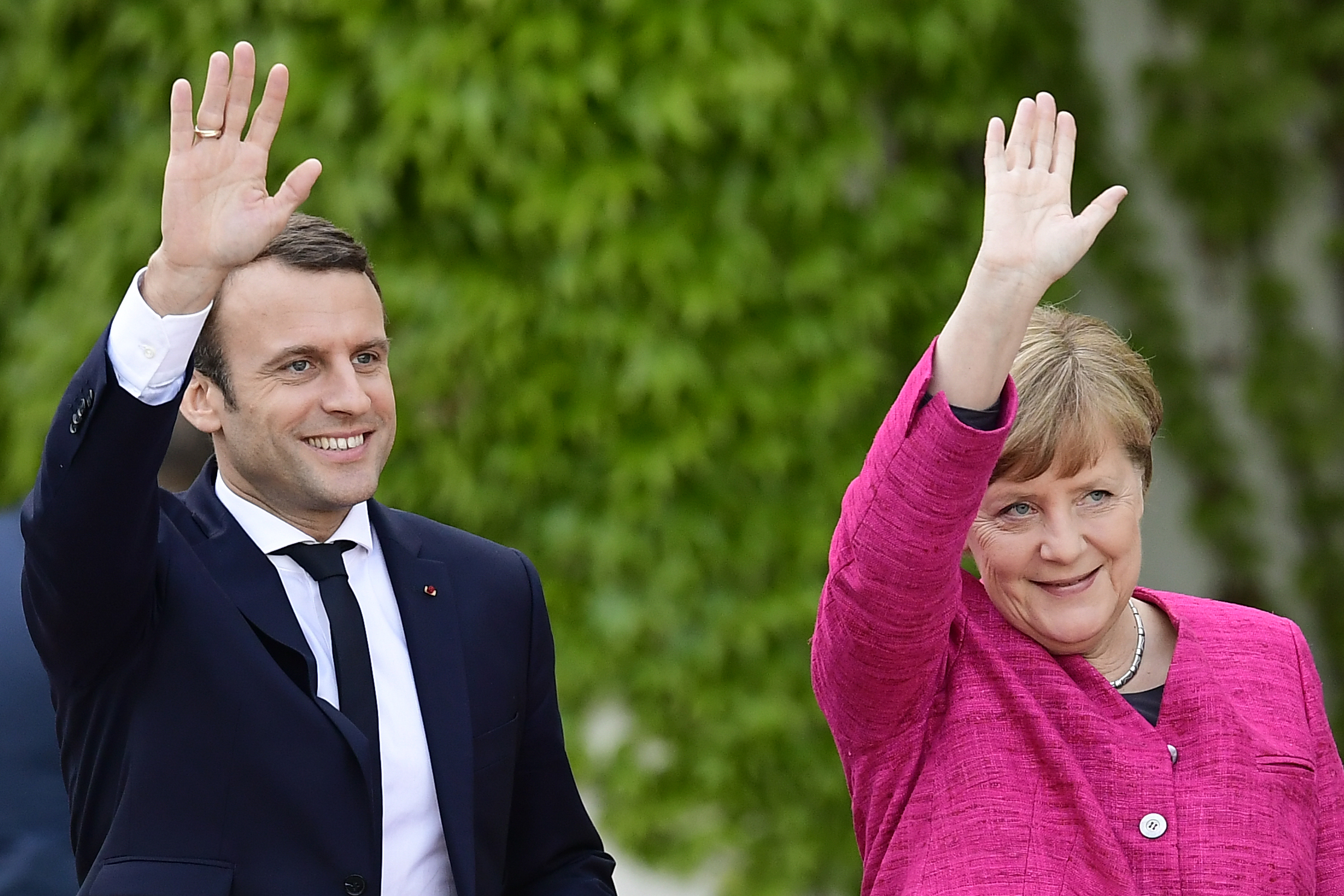
But the relations of the new president of France and Chancellor of Germany Angels Merkel, apparently, are developing very well. The first foreign visit of Macron after taking office was a trip to Berlin. Several ministers entering the new government of France are known for their close ties with Germany. At the same time, the warm conversations of Macron and Merkel are accompanied by the German side with the Chancellor’s hard statements that after Brexit and the election of Donald Trump, the European Union “cannot more depend on the US and the UK. According to Merkel, Europe should "take its future in its own hands - of course, remaining friends with the United States and Great Britain and good neighbors everywhere, even with Russia."
The West has become less, at least it has become weaker
On Monday, the representative of the Chancellor Steffen Zabibert tried to smooth out the situation, saying that Merkel "simply honestly speaks with the United States," being a "convinced Atlantist." However, on the same day of oil, the German Foreign Minister Sigmar Gabriel , who called the Brideboy, was added to the fire, the policy of the new US administration, primarily in the field of ecology, Donald Trump opposed the participation of his country in international climate change agreements. "The short -sighted policy of the American government is opposed by the interests of the European Union," Gabriel said, noting that "the West has become less, at least it has become weaker."
Why did European leaders suddenly speak in such a strict language and what does the EU desire to “take his fate in their own hands” mean by an angel Merkel mean? This is reported in an interview with Radio Liberty by the former deputy chairman of the European Parliament, a specialist in European integration problems, Czech political scientist and sociologist Libor Rouchk .
-Negotiations of Vladimir Putin with Emmanuel Macron in Versailles-the first Russian-French meeting at the highest level after the election of Macron by the President of France. It was difficult to expect special warmth from these negotiations: the Kremlin actively supported another candidate in the elections - Marin Le Pen, the Macron election headquarters declared the intervention of the Russian media into the election campaign in France and hacker attacks. Why did you need to meet - primarily the French president?
Macron gives Putin a chance if not to “restart” relations, then at least develop them further on a more reasonable basis
- I think Emmanuel Macron wants to show that he is conducting a policy of openness in relation to the outside world, including Russia. Thus, he gives Vladimir Putin a chance if not “reloading” relations-not only Russian-French, but also Russian-European ones, then at least develop them further on a more reasonable basis.
It is interesting to observe what answer Putin will give in practice. If the same as before - the support of politicians like Marin Le Pen, constant attempts to influence politics and public opinion in European countries, etc., then a date in Versailles will remain a single meeting on the occasion of the opening of a large exhibition dedicated to Peter the Great. No more. So it all depends on the further behavior of Vladimir Putin.
And, of course, the problems of Russian intervention in the east of Ukraine and the annexation of Crimea have not gone anywhere either. The French president, before the meeting, emphasized that negotiations would be open, that he intends to talk with Putin on all important issues, without avoiding sharp corners. So it happened.
Macron intended to talk with Putin on important issues, without avoiding sharp corners. So it happened
- Is it possible to say that the new French president coordinates with Germany? After all, he has repeatedly stated that he was seeking to start the European integration motor again, for which he wants closer ties with Berlin. Does this also mean the development of a common position in relation to Russia?
- Undoubtedly. This was demonstrated already on the second day after Macron took office. He immediately went to Berlin for negotiations with Chancellor Angela Merkel. They discussed a variety of issues, and I am sure that relations with Russia were among these issues. Although these relations are in an almost frozen state, do not forget that Chancellor Merkel regularly calls up with Putin - much more often than with the current president of the United States.
- Yes, they recently met in Sochi.
Until now, European foreign policy seemed to have laminated on one leg
- Certainly. And I think that in coordination with Germany the new French president will pursue a similar policy. The point is that France, after some break, would like to play a more noticeable role in basic political issues. This was again shown by the first days of the reign of President Macron. He held quite successful negotiations with Chancellor Merkel, then performed quite vividly at both meetings at the top - both at the NATO summit in Brussels and the meeting of the "Great Seven" in Italy. For example, he established good relations with the equally young Canadian Prime Minister Justin Trudeau. In general, France under Macron wants to be more active in the world arena, and therefore in relations with Russia. I think this is good not only for France itself, but also for the European Union. Until now, the European foreign policy seemed to limp on one leg, the German chancellor resolved all the most important issues, since France under President Hollande showed neither a big desire or skill in this regard. Now France is returning to the Franco-German tandem traditional for the last decades, and Europe will be more political due to this. Including in negotiations with Russia. They will now talk with Putin together.
- Does this mean that Angel Merkel that Europe has made a noise that Europe is now impossible to rely on the United States, but it should “ take its fate in its own hands ” expresses the position of France? Why did Merkel say this? She did not like the communication with Donald Trump on two May summites so much?
-It seems to me, from the point of view of American-European relations, these two summits were not too successful. Merkel said that Europe could not count on the United States in everything - she did not say that it is impossible to count on the United States at all. It must be borne in mind that she said this during the election campaign. It was a couple of phrases, the chancellor did not develop its thought - what exactly in the United States cannot be leaning on, in what matters. It seems to me that this cannot be interpreted as an anti -American statement. These things should be looked at in the context of the past and future relations of the United States and Europe. Now in the White House Donald Trump - maybe for four years, maybe for eight, but in any case this is not the end of transatlantic cooperation. And, say, Trump’s persistent demand for Europe to care more about financing its own defense and security, does not exclude such cooperation at all. This only means strengthening the European component of NATO.
None of the serious politicians are going to act as the Trojan horse of Moscow
Yes, there is a long -formulated obligation of all allies - to strive to bring defense costs to the level of 2% of GDP. But it should not be a mantra. Because if you take, for example, Germany, it spends 38 billion euros on a defense. If we imagine that this country begins to spend 65 billion euros for these purposes, which approximately corresponds to 2% of the German GDP, then it will not be able to spend them reasonably, so that this contributes to the growth of the defense of Germany and all of Europe. First of all, you need to look at the effectiveness of these expenses, at where the money goes. Europe lacks coordination in weapons. Say, in the USA there are two main types of armored vehicles, and in Europe there are 17 of them. So we need coordination of military industry so that the armed forces can act effectively. So that in the event that the United States, for some reasons, do not want to participate in a particular conflict or peacekeeping mission, European countries could do this on their own. This is not anti -Americanism, not the desire to destroy NATO - this is a desire for a greater unification of the efforts of Europeans. There is nothing wrong with that.
Kremlin's desires diverge from the possibilities
- Politically separating Europe from the United States is a long -standing goal of Russian foreign policy under President Putin. We can recall that back in 2003, when the war in Iraq began, there were attempts to create the “A axis of Paris - Berlin - Moscow” just on an anti -American basis. Does Angel Merkel play a too risky game that Vladimir Putin will be very risky now?
- If you take the point of view of the Kremlin, then yes, there they want this: to separate both Europe from the United States and individual countries of the European Union from each other. But I think that in the same Germany, primarily in the ruling party of the CDU, which has good chances of winning the elections in September, they understand this well. There, none of the serious politicians is going to act as the Trojan horse of Moscow. Just as the Versailles negotiations showed, they will hardly be France under President Macron. So here the Kremlin’s desires diverge from the possibilities. Moreover, the effect can be the opposite: European states will become more close.