
Translated material
Sticks are more important than people
The Russian police do not work for people, but for indicators - the so -called sticks. Therefore, she closes her eyes on some crimes, while others even factory herself
What is the policeman
"Is it worth it to contact this?" -Such a question arises in the head of any police officer every time a person turns to him for help, whether it is theft or some kind of household incident. Under this "is it?" It is understood the possibility of easily disclosing a crime or identifying an offense in order to write it down in an asset.
If the application, for example, contains an indication (or at least a hint) of the culprit about theft or hooliganism, then it is worth it to contact: there is where to dig. If there is no such hint - the victim does not know who exactly could rob the apartment, the bully did not get on the camera, then it is immediately clear that it is better not to contact. This crime has weak chances of being disclosed, and therefore will spoil the statistics.
Fans of the series “The cops” may remember how he begins: the operative hero accepts “statements of citizens” and immediately “reacts”-gives orders by phone: “put on the wanted list!”, “To block the airport!” Only now the phone is disconnected.
Neither the open hatch, until no one fell there, no stray dogs, until they bit anyone, are not interested in the police. After all, you will not insert them into the reportingBut citizens do not know about this and leave the department satisfied. The operatives often do approximately the same trick in life: they accept the application, for example, about the theft, and give out a meaningless piece of paper in their hands. They talk extremely politely in the case. The citizen is satisfied. He does not know that his statement remained not registered in the book of accounting for reports about incidents (KUSP). And without this registration, the police will not do anything. The statement with a high degree of probability will fall into the garbage basket or with a probability of less will be put into the daddy to the same-wait, suddenly someone comes across a stranger wallet. Then, perhaps, all similar cases will be needed.
If a citizen is generally “out of topic” - asks, for example, to deal with a neighbor who grabbed part of the garden, or complains that there are many stray dogs in the courtyard, or that hatches on the road are open, then such appeals are perceived as completely “empty” time and effort. In the first case, a person will be advised to apply to the court in private, and in the second and third - to the local administration. Because neither the hatch (until no one has fallen there), nor the dog (until they bit anyone), as a rule, you will not insert into the reporting. There is no crime or offense right there - so who needs it in the police? You can’t keep track of everything.
What are "sticks"
The fact is that the key indicator for which the work of the police is evaluated is the share of disclosed crimes. From year to year, the police are trying to keep it at a level of 53-55 percent (the percentage is calculated from the total number of crimes registered this year). The highest weight when evaluating different departments has indicators that establish, which crimes and in what quantities should be identified-distributed (heavy and especially grave, property, household, etc.).
Read also The police are drowning in papers, the Russian police live in a pre -computer age. She is forced to fix all her actions on paper, and often by hand. The district police officers, for example, spend up to half the working time on this
There are other indicators for each of the police posts. For the patrol, an employee of the traffic police or district police officer, this is the number of compiled administrative liability protocols. For the investigator and the interrogator (simplified - this is the same investigator with cut powers) - this is the number of criminal cases sent to the court, and indicators of compensation for material damage to the victims.
All these indicators in the police are called “sticks”, and the system itself is “stick”. Each policeman or department, or regional administration for a certain period should gain so many sticks of different types.
At the same time, the assessment system is arranged so that the indicators should not change sharply. The comparison is carried out according to the so -called APPG (similar period of last year). This year he opened five thefts - in the next cutting of six. But not ten - otherwise you will have to open at least eleven (and where to get them so much?)
The entire assessment system at the federal level, and we remember that the Ministry of Internal Affairs is a super -centralized structure, is registered in orders. The last of them, from 2013, establishes 27 indicators by which the Russian regions should be reported to the federal authorities of the Ministry of Internal Affairs. This is great progress - during the reform , the list was reduced more than doubled. But nothing prevents the regional authorities from expanding this list for their subordinates - territorial police departments. So, in one of the regions, about 70 indicators are now installed for police officers “on Earth”. Why do they need it? To ensure the balance of all indicators for the federal report.
Following all indicators is a great art. After all, “sticks” are not only positive, but also negative. For example, the number of citizens who died from criminal acts is a negative “stick”, and the number of serious crimes investigated (including murders) is positive. Ideally, of course, all the murders must be disclosed - then the indicators will develop and everything will be “okay”. But this does not happen in life, which means that it is best not to register for the investigation of murder.
Suppose to hide the “criminal corpse” - the task is not easy, but with other crimes this logic works great.
How "sticks" interfere with work
Since the policeman is evaluated by “sticks”, the production of “sticks” becomes the main guideline for him.
Firstly, he will do everything so as not to register a crime, if there is no obvious prospect to disclose this crime. Dozens of ways have been invented here that many who came to the police department, for example, with a statement about the theft. “You leave a statement, if we find a thief, we will call you. And if we register, you will have to hand over all the locks from the apartment for examination. ”
If such an “inconvenient” statement was nevertheless registered in the KUSP, then the police will make the checks so that it is easier to refuse to initiate a criminal case. For example, look for contradictions in the testimony, note the non -obviousness of the event. After all, nobody needs a "capercaillie".
Sometimes the applicant does not mind. For example, when my car was hacked and stolen, I went to the police. I did not hope to return the radio - I needed only paper for an insurance company to fix the lock. In such cases, the police usually issue a decision to refuse to institute criminal proceedings. I received a refusal resolution and left satisfied (and the criminal remained unpunished).
How many such "satisfied"? Only the Ministry of Internal Affairs knows about this, by order of which up to 60 thousand people are interviewed every year - but the ministry does not share the results with the results. At the end of 2016, by order of the Higher School of Economics and the Center for Strategic Development, a large All -Russian survey (6062 people) was conducted, in which, in particular, respondents asked if they were victims of theft or violent actions during the last year, whether they turned to the police on this occasion and whether the police were found guilty.
We see that in half the cases, people simply do not contact the police. And the “villain” finds the police in only every third case - if it is clear where to look (beatings), or in every twentieth - this is not clear where (as with my radio).
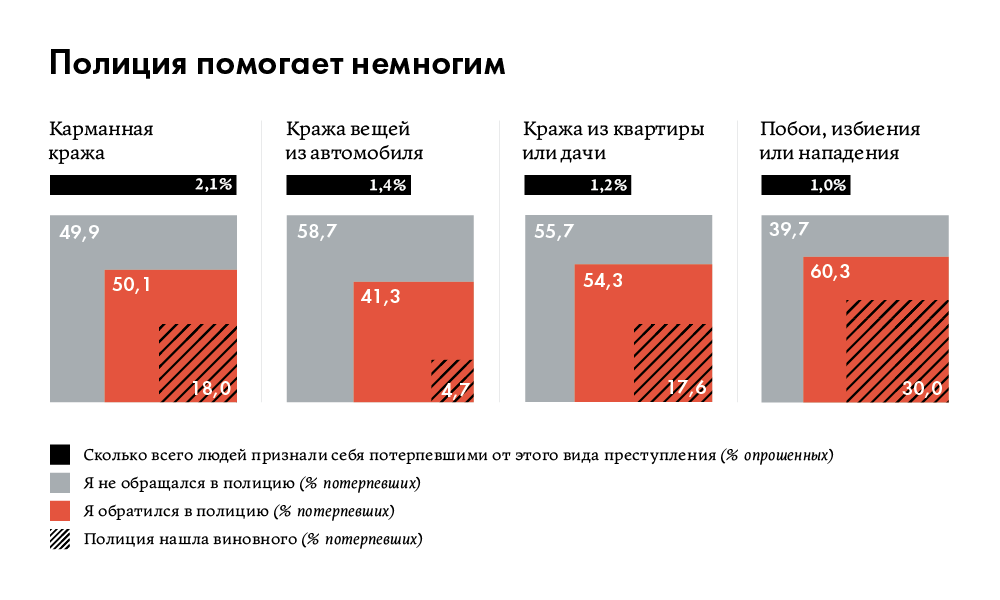 Source: HSE, CSR, 2016
 Secondly, in pursuit of "sticks" the police will be willing to register simple crimes. How the opera is joking, the best crime is when the husband stabbed his wife or drinking companion, sits still - with repentance in the shower, with a knife in his hands - and recognizes everything. This is a finished "stick".
Thirdly, the police will be if not directly fabricated, then they actively look for simple crimes-to reveal them and get a “stick”. Here, district police officers with their “domestic crimes of a preventive orientation” are distinguished here, for example, under Article 119 of the Criminal Code of the Russian Federation (a threat to murder or causing serious harm to health).
Until 2009, it was one of the most “stick” articles. It is formulated as common as possible. It is enough for the victim to perceive the threats expressed at him as real, and the threatening in his hands had an object that can be killed or serious harmful.
The woman asked the district police officer to conduct an educational conversation with her husband. But the district police officer needed a “stick”, so he issued a caseIt happened that as a dangerous gun, the fork was appeared, which was attending her husband who returned drunk from work. The wife made him complaints, and he asked not to bother him - "I will kill otherwise." At the same time, the woman who turned to the district police officer did not assume that her husband would be condemned. She just wanted the district police officer to conduct an educational conversation with her husband. But the district police officer needed a “stick” - therefore, he issued a case under Article 119 of the Criminal Code. By the way, nothing terrible happened to her husband - in such cases, reconciliation in court is possible.
In 2009, the prosecutor's office refused to accept such cases with the inquiry officers without the testimony of witnesses who heard threats. This reduced the flow of fabricated cases, but the chances of protecting those who really received threats also fell.
Here it is worth recalling the massacre in Nizhny Novgorod. The district police officers were convicted of negligence, as they did not respond to the appeals of the future victim. The woman repeatedly declared threats from her husband. However, there were no witnesses, and the district police officers knew that the prosecutor would not miss such a case. They endured the "refusal" until they killed the woman and the children.
This example shows how important the texts of the laws themselves are, but the unwritten rules of their application. But these rules just depend on the incentives created by the assessment system. The prosecutor's office wanted to overcome the falsification of criminal cases to make “sticks”. But the child splashed out - the probability of household murders has increased.
Fourth, the race for sticks makes the police initiate cases on the so-called revealed crimes, where there is no victim who would write a statement to the police. And there is, for example, operational information that such and such preserves drugs or weapons. It remains to detain this person and to arrange everything correctly - this is a ready -made suspect, the accused, and therefore the convicted person.
“Identified” crimes, as it is easy to guess, are almost always revealed. They make up to half of all crimes invested. And it is they that allow you to keep disclosure at such a high level - a little more than half.
Read also 12% of rape is committed by foreigners of savages who repel work from us and raping women - this is how many in Russia relate to migrants. Is there any truth in this?
Finally, fifthly, in pursuit of opening, the police will seek confessions-especially in complex and non-obvious matters. Operational employees, investigators and employees of the pre -trial detention center have many opportunities to persuade the suspect to admit guilt: from threats and torture to promises of an informal transaction with the judge. And the confession of guilt or turnout with a guilty is the “queen of evidence”, it provides a high speed of the case in court (especially if the accused agrees to a special procedure, that is, the case will not be considered on the merits) and good indicators to everyone: the police - for the disclosure, for the accusation, and investigators - for the speed of investigation and compliance with the deadlines.
We will summarize. Conceived as a system of control, accounting and evaluation, “sticks” completely subjugated the actions of the police. Because of them, she is not guided by a public danger of a crime, but his “prospect” from the point of view of obtaining another “stick” in the reporting.
How to defeat "sticks"
The inferiority of the "stick system" has long been obvious to everyone - including the leadership of the Ministry of Internal Affairs. Therefore, during the last reform, the number of “sticks” was reduced, and as a mandatory reporting form, they were preserved only for regional departments. But above I have already said that regional administrations perfectly bring these indicators to the "land", and even increase their number.
And this is natural. The Ministry of Internal Affairs is so arranged that otherwise now and cannot. “Sticks” can not simply be taken and canceled - everything will fall apart. The former head of the city -level Ministry of Internal Affairs told me that in his career there was a short period without “sticks” - immediately after the collapse of the USSR, when the first nine months of 1992 “no one asked anything”. According to his memories, then everyone immediately stopped working. Niza employees, who were forced to work “from under the stick” all their lives, formed a rather indifferent attitude to their duties in response.
“Sticks” can not simply be taken and canceled. if you do not reconstruct the Ministry of Internal Affairs first, everything will fall apartYou need to start not with the "sticks", but with decentralization. Russia is a huge country, with a variety of geography, climate, population, etc. From the point of view of crime, Murmansk is significantly different from Krasnodar, and some district centers in the Arkhangelsk region, where there are many convicted, from Akademgorodok near Novosibirsk. The leadership that sits in Moscow simply cannot take into account all local features. This means that the regions and local authorities should at least participate in this in this.
The ideal solution would be the decentralization of the police function in Russia. The federal center is responsible for serious crimes, for light and household crime - the region, for the protection of public order - local authorities.
This requires a political decision. So far it is not, perhaps, it is worth at least eliminating the monopoly of the Ministry of Internal Affairs for the police assessment system. After all, the fight against crime is only one of the functions of the police, there is at least the prevention and service that the police do not deal with today, if this is not administrative prosecution for offenses. Why not offer regions and local authorities to enter their own indicators to evaluate the work of police? This will make the police take a step towards people.
The author is a sociologist, conducted police research at the Institute of Law Problems at the European University in St. Petersburg.
Traffic police of the Ministry of Internal Affairs Palacers Police Crime Russia