
Translated material
The policeman is above the judge
If in Russia a criminal case is initiated against you, there is no chance of being justified in court. Why so? Are the organs are not mistaken today?
Without a chance of justification
The Russian criminal justice system is arranged so that if you have become the accused, you will be almost necessarily condemned. And before the court, it will not be possible to break out - investigators stop only about 0.2% of cases on rehabilitating grounds . But if the investigator decided to transfer the case to the court, and the prosecution supports the prosecution (these are 95% of cases), then that's all. Until 2016, the courts justified one of 500, that is, the same 0.2%.
This does not mean, of course, that everyone else goes to prison. When choosing a punishment, Russian courts are quite humane: less than 25% of the defendants receive the real term, the rest - other types of punishment or completely termination of the case on non -rehabilitating grounds (due to reconciliation with the victim, amnesty, etc.).
For the bulk of the defendants (among them 60% are unemployed, 20% are engaged in manual labor) it looks like “the court released”. Just think, conditionally: well, there will be a district police officer, well, you can’t go anywhere without coordination (so you don’t need to go anywhere). Just think, a fine: sometimes you can pay, sometimes dodging (there is usually nothing to take from such a person).
But for an ordinary, “decent”, a person is an unpleasant thing. He receives a criminal record or record “was brought to criminal liability” (if his case was terminated on non -rehabilitating grounds). This is not only damage to the reputation. A conditional term is the need to coordinate their trips to the limits of permanent residence with the penal inspection. This means that every business trip is a day killed for visits and approvals. Every departure to relatives, friends, rest is the same. With trips abroad, it is even more difficult.
Think, conditionally: well, the district police officer will go, well, you can’t go anywhere without coordination (so you don’t need to go anywhere)Often a guilty verdict is a limitation of a list of posts that the convicted person can occupy. Here is such a case. The man was in charge of one of the regions by a statearchy. He hired the driver, but did not use the car. A month later it turned out that the driver did not appear at work. And the director of the archive was charged with a waste of budget funds in favor of a third party - a driver (he received a salary for a month). Up to six years in prison. But the “court released”: he gave a conditionally with a ban on holding senior positions for a period of five years.
Let's put yourself in the place of the director of the archive. You went to this position for a long time - and now you have to leave it. You cannot change the trajectory, because it is forbidden to engage in leading activities at all (you can not move to science or in education and become a head of the Creature, for example). And they will not take a criminal record to the university.
Maybe he appropriated these 30 thousand rubles, having agreed with the driver that he would work with a “dead soul”. But this - I emphasize - no one even tried to prove. And it is only proved that he did not keep track of one of his fifty archival employees. A person was destroyed by a career for life - we all understand what is now five years in any “smart” industry.
At such moments, the absolute inability of our judicial system to justify - to let people go completely clean - begins to play a role. This is the indictment.
How crimes are created
Imagine: this is a certain event that can be considered a crime. But you can not count. The police, of course, can always interpret as a crime that they are definitely not. But these are isolated cases in any country. So this is usually some kind of ambiguous event like a story with our head of the archive.
Read also Sticks are more important than people, the Russian police do not work for people, but for indicators - the so -called "sticks". Therefore, she closes her eyes on some crimes, while others even factory herself
Then the police need to find the culprit - the suspect. Again, you can grab the first one that came across, but no one does it either. Usually they find a person in respect of whom there is reason to assume that he committed a crime - there was traces on him, etc. Totally innocent and non -investigated, most likely, will not fall into the criminal car, although exceptions and conscious factories are happening, but, according to my estimates, the average typical investigator or the operative did not participate in such things in his life.
Now you need to prove guilt. When we believe that guilt is proven, we are conducting this suspect to the court. And the court decides whether we have proved well or badly. Because absolute evidence is almost impossible: even when a person pulled a wallet on the camera, you can present some counterarguments.
And so works all over the world.
Then there are two logicians, which are followed by two main world judicial systems.
One of them was adopted, for example, in Russia until the 18th century and in many countries of medieval Europe. If the plaintiff says that the defendant stole or killed, and he is unlocking, then they will compete in the number of witnesses. Simplifying, we can say that the one who has one witness more wins. And if the defendant wins, the prosecutor receives considerable punishment.
A closed apartment, lies stabbed, a drunken person sleeps nearby, in his hands a knife, on the knife of the killed one. common sense tells who the killerAnother logic was developed by the Anglo -Saxon system - Beond Reasonable Doubt, that is, "outside reasonable doubts." At the level of common sense, all versions that deny the event of a crime or the guilt of the defendant are unlikely. Now the whole world works like that. Even the declared “truth” in a socialist legal family is nothing more than the same “outside of reasonable doubts”.
A closed apartment, lies stabbed, a drunken person sleeps nearby, in his hands a knife, on the knife of the killed one. It can be assumed, of course, that the aliens set up this, but common sense tells who the killer is.
So, all over the world, our policeman discovered something similar to a crime, found a suspect and collected evidence (video cameras, data from telephone connections) and testimonies proving his guilt. He brought this to the prosecutor, he approved. In Russia - brought the investigator, he issued this in the form of a criminal case and carried it to the prosecutor who put his visa. And all this is transferred to court.
The court begins the judicial investigation. In the Anglo -Saxon system, this is more like a new investigation, in the continental system - to check the work of a police investigation, but in both cases the court analyzes what happened, essentially.
This means that our prosecutor and investigator risk a little. They decided that their version was outside reasonable doubts, and the court could decide differently - and justify.
Read also Judges despise people, a respectable Russian does not trust the judges, but when he is in court, he feels like an idiot. Both has its own scientific explanation
Of course, the judge always and everywhere more often agrees with the accusation than the other way around. Because people who prepare the charge imagine how the court works. About 40% of the excuses that were in pre -revolutionary Russia are not a sign of humanism, but the lack of a professional preliminary investigation. It is on this that those who say that there is no indictment. The prosecutor and investigator have already eliminated unreliable cases. But then it turns out that they are mental twins with the judge: they always evaluate evidence equally.
A certain number of excuses is logical from the point of view of common sense. Why? Imagine that we showed the same advertisement to three people, and she convinced two, but there is no third. This is a normal situation.
As a result and legal proceedings, evaluation of the sufficiency of evidence is also carried out on the basis of internal belief. And what seems to be a sufficient prosecutor from time to time seems insufficient judge. So there is an acquittal.
But in Russia this does not happen: everything that seems to be a sufficient investigator and the prosecutor always seems to be a sufficient judge. The only thing that is the real dispute in the courtroom is the punishment. There, the judge has a large selection, and he uses this choice rather humanely (more humane than in the USA, for example). But the judge does not have fundamental discrepancies with the accusation. And this contradicts the logic of criminal justice.
Why is the judge at the same time with the prosecutor
Why is this happening in Russia and other countries of the former USSR? Why do professional judges justify 0.2%(and if you take into account cases without a prosecutor-closer to 1%), while in Eastern Europe about 2%, and on average in Europe-5-6%?
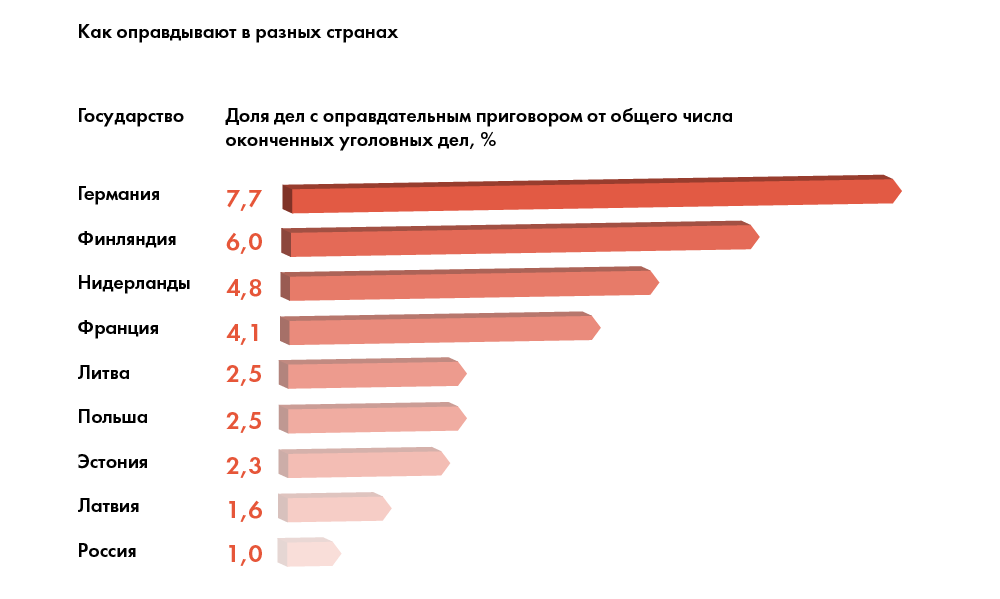 Source: “Accusation and justification in the post -Soviet criminal justice” , Moscow, “Norm”, 2015
 Firstly, we have much weaker protection. Since the main defendants are a marginalized audience, in approximately 90% of cases they will be protected by a lawyer for their intended purpose (for the state account). That is, a lawyer who will meet with this accused three times in his entire life, and with this judge, the prosecutor and investigator meets three times a week . Small cities, small courts - so constant "working groups" from the judge, prosecutor and lawyer arise. And such a lawyer assumes the investigator: admit - you will receive conditionally, but no - you will be worse. And the investigator makes concessions: for him a recognized robber (easier article) is more profitable than an unnecessary robber (heavier). But there are cases when everyone is convinced that a person has committed a crime, but it is impossible to prove it. Then it must be released. Nevertheless, we want the distinction of the guilty and innocent to occur with the help of evidence-otherwise it is not a judicial system, but a club of astrologers.
Read also How the Russian judges are independent of telephone law, by law, works in court and are reliably protected from any pressure from the outside. But the judicial system is arranged so that it constantly presses the judge from the inside
Secondly, the investigation really works much more carefully for us-it sends a lot of cases to court than, say, in Germany. All dubious affairs are postponed, because the system of assessing investigators and prosecutors is such that an excuse in court is a tragedy for both of them.
For the investigator, this is about a year without a bonus, and the prize is from a third to half of his salary. For the head of the investigator, this is a quarter without a bonus. Two excuses for the year for the investigator are incomplete official compliance. That is, they can be expelled for any trifle. And the work of the investigator is not bad for a typical Russian city (salary, social law, early pension).
Thirdly, you need to understand how the judge thinks. In front of him is a person who pleads himself guilty (in more than 90% of cases) and who does not particularly protect himself. And on the other side there is a competently compiled criminal case, the prosecutor familiar to him and, possibly, the investigator known to him. The judge remembers what a blow to the well -being of the prosecutor and investigator can cause an acquittal.
And most importantly - the judge is wildly overloaded . For him, the key to successful work is the lack of conflicts with the prosecutor, due to which failures may arise. He has no motivation to write an acquittal. And if it were, he does not know how to do this: he never studied.
Among the convicts, the myth is popular that there are judges who always justify. No, there are simply judges who are conveying difficult casesI know the courts where there is a special judge who refers the case when it is complex and it is clear that there is a chance of justification. This judge sits and decides acquittal sentences for the whole court. Because she knows how to write them in such a way that they are tired in appeal. And everyone is praying for such a judge. Hence, by the way, the myths that are common among convicts about the fact that there are judges who always justify. No, there are simply judges who convey difficult cases.
Finally, having decided to bear the acquittal, the judge himself risks very much. The main indicator for which his work is evaluated is the number of sentences canceled in higher instances. The prosecutor, following the instructions, in 100% of cases appeals an acquittal, and in 25% of cases it will be canceled (for comparison: the conviction will be appealed in only 25% of cases, and is canceled or changed only in 5% - every fifth of the appealed).
So the indictment appears. When the judge assesses the evidence that we talked about above, he should have a worm of doubt from time to time. But the logic of the institutions of the entire investigative and subsidiary machine works to strangle this worm.
How to give a worm a chance? It is necessary to provide the defendant with a normal lawyer, stop punishing the investigator and prosecutor for acquittal sentences, and the judge - to unload and stop punishing for cancellations. But all this needs a full -fledged reform of the police and judicial system.
The author is a sociologist, a leading researcher at the Institute of Law Problems at the European University in St. Petersburg
Save
Save
defendant police justice crime prosecutor judge judge