
Translated material
Magnus Mills: Arbeit Macht Frei
It seemed that the theme of labor in the novels was somewhat forgotten, if not to say taboo. More and more the literature field is full of loud novels that have not yet graduated from the university with high-butoping authors-students, at which, in particular, Gore Vidil complained so. Where are those writers who conserved anchovies for years, carried mail, delivered bottles of milk and repaired a cardan shaft before sitting down on a printing machine?
The English satirist Magnus Mills is just one of these ennobled diamonds. The Birmingham author built fences for eight years, drove a bus for twelve years, and wrote novels in his free time. Many will immediately recognize Paterson in him, only a few gloomy and not writing poetry.
The author of nine novels and three collections of brief prose Magnus Mills in Britain is widely known. But how are his affairs outside the homeland? Translator Maxim Nemtsov so comments on the translation and further fate of the author in Russia: “Mills is not the most difficult author to translate, although he has his own traps. One of the tasks of the project “ Hidden Gold of the twentieth century ” is to introduce the Russian -speaking reader of interest to some spectrum of underestimated or forgotten authors that are not known to him. In this sense, Mills was more fortunate than many - this is his third novel in Russian. If there is a surge in interest in connection with the release of a new novel, nothing will prevent us from continuing to represent his work. ”
Within the framework of the mentioned series “Hidden Gold of the twentieth century”, the novel “In the Eastern Express without Changes” was released. The plot is simple and Nakazist: in anticipation of travel to Turkey and India, the nameless hero comes to the lake region, and at the same time say goodbye to the vasts of his native Britain. Yes, only the trip is being postponed every now and then, - the householder of camping Mr. Parker asks to help in painting the fence, then paste the roof, then make a new anchor. And with each of his “yes” and an agreement on voluntary arrest, our hard worker increasingly runs the atmosphere, reminiscent of the “process” of Kafka, turned inside out. A nameless tourist is obliged not only to help Mr. Parker, but also to carry out his daughter Gale's homework, visit a local pub and appear for a dartsa competition. All this Uroboros, which is not particularly rich in events, is complemented by the obsessive children's song “Polunt Kisel”, which is coming from the van with milk, which is rather scared and resembles very similar rhymes from the “regulators” of Stephen King. The reader, the inhabitants of the lake region and, lastly, the main character himself understands that no one will go anywhere far.
 “The Devil is Love” A report on the two -week expedition “The Black Devil's Office”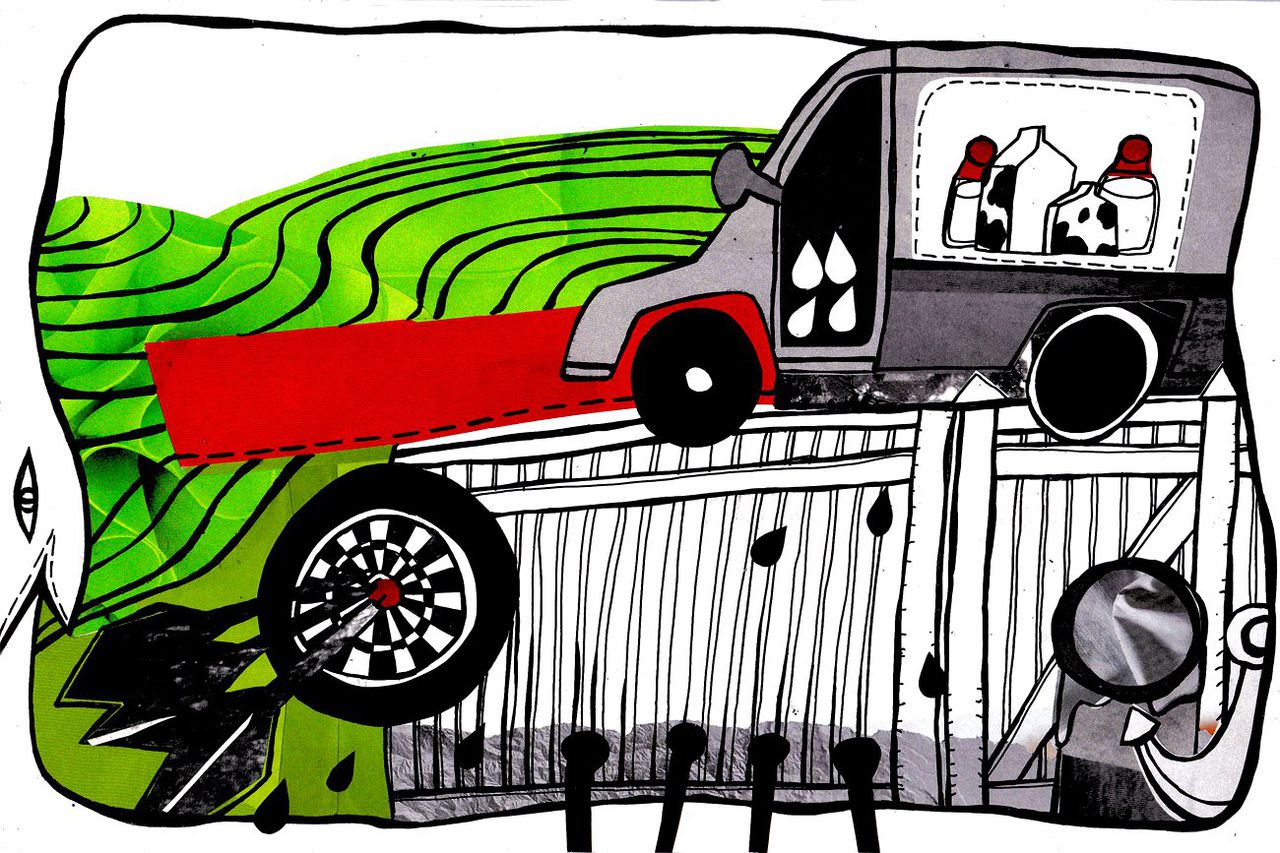
In Russian, the “cattle corral” is also available-the first novel by Millsa (the short list of the Buker Prize, approving Black Pinchon). In short, he is about how two Scots and the Englishman build high -and -carrying fences, and their customers with a supernatural accident are dying, as overseers of the series “Misfits”. Without inventing the best use to the bodies than to “serve the foundation” for the pillar of the gates of those very fences, the British take up the construction of a new, but already in human growth. Such simple metaphors, and the name of the novel itself, of course, hint at the bureaucratic machine, crushing both performers and customers, harnessing the plug with a coarse dragging human cattle. But to be satisfied with this - it means to give this deceptive simple prose to behave.
“Full Employment Scheme” - the fourth novel (second translated) - tells about the organization that its employees ominously calling the scheme. She is clearly structured, uncompromising and uninterrupted. Our nameless (again) narrator is one of the hundreds of Unifur drivers and the carrier of mysterious goods from one depot to others. And everything seems so scrupulously thought out and competent, until we find out that the goods are details to the same “unifura”. Then the scheme turns into a social experiment and the center of absurdity.
The main character warns us: "The scheme can collapse at any time." Its schism can be considered as the development of the topic of entropy (which is related by the British with the aforementioned Pincon), and by allusion to the strike of trade unions and the "milk" policy of Thatcher. At the end of the novel, the depot turns into a “cattle yard”, workers are divided into freedom and full -time, they are a little “fighting”, and then they collect a delegation resembling a meeting of the knights of the round table and a secret evening at the same time.
The skill of the author is not only in minimalism and accurate dialogs, but also in how he moves the plot in which nothing significant happens decisively. For almost all Mills’s novels, Fabula is rudimentary, it can be retold in two or three sentences and not spoil the impressions of the potential reader. Sometimes it is amazing how the monotonous description of the equally monotonous and routine work can be exciting - this, perhaps, is the main advantage of these novels. If Kafka, Becket, Orwell, and Bogumil Grabal sat down to write a collective composition in a close-tough pable-something very similar would have come out.
Heroes of almost all novels are distinguished by an impenetrable emotional stupidity, thickness and blindness. Observing the death of a colleague, the heroes simply return to their duties. Such a reaction of the British literary critic Terry Igalton, reviewing Mills, called "affective flattening." Naive hard workers are ambel, fearful, graze before great changes and themselves.
It is ridiculous and sad to observe the tragedies of little people who have lost themselves in a round dance of absurdity and conformism, lost in the scenery of a macabar comedy.
By the way, only the lazy one did not call the pasta - the black humor of Magnus Mills. However, with the concept of black humor, the Russian -speaking reader is not very good. Maxim Nemtsov clarifies the situation: “Black Humor”-he is like rock and roll: a label invented outside, in order to at least somehow name a phenomenon, which is essentially bizarre and more complicated. This label was invented, as you know, Andre Breton, and Bruce Jay Friedman popularized in the English -speaking space. From there, the concept migrated to the Soviet critical discourse. The only thing is that, as many concepts, when translating into Soviet language, it has undergone some changes. In French and English, Humour meant not only the presence of a sense of humor, but also “Gournch”, “Black bile”, in other words, sarcasm, sarcasm, sarcas, laughter from despair, on the verge of foul, on some dangerous or taboo theme, in particular death. ”
It is impossible to disagree with Maxim Nemtsov that the Russian reader Mills is close, like no one else. In a strange way, his texts echo with Russian classics. Reading the “cattle corral”, you involuntarily recall Kuprin’s “Moloch”, and “in the eastern express without changes” you can take for a kind of retelling of Ionych Chekhov (about how to turn into “his own” from a stranger, thereby abandoning his self).
In general, we have not met a writer for a long time who, with such regret and compassion, would have mocked his characters. However, if you are imbued with the philosophy of the heroes of Mills, you sigh in relief, because the glorious days are still ahead and, in general, rejoice that you are also paid for the pleasure of working.