
Translated material
Gardener Macouen
Why the writer does not need symmetry
Especially for Gorky, Alexei Polyarinov signs the novels of the English writer, the laureate of the Buker Prize and the commander of the Order of the British Empire Ian Macouen and explains that it is not so with his creative method.There is one true way to distinguish a self-taught writer from a graduate of literary courses. Here, for example, Don Delillo and Ian Mcueen.
Delillo is a self -taught. He never studied literature; The son of Italian emigrants, he grew up in the Bronx, worked as a parking lot in childhood, received a diploma in the college with a degree in visual communications, then spent eight years in a boring post in an advertising agency and only then decided to become a writer.
Macouen is different, he is a “certified specialist”. Two higher - both philological: the first is English literature, the second is Creative Writing, elite courses of literary skills at the University of East England.
Elephant and Whale. I would not even compare them if not for one but: in 2003-2005 they wrote novels with a very similar plot. Delillo came out “Cosmopolis”, about one day of a self-propelled billionaire who travels around New York in a luxurious limousine, and sometimes stands in traffic due to the fact that the city center was blocked by the manifestants. Macouen, in turn, in 2005 published Saturday, a novel about one day of a smug surgeon who travels along London in a luxurious Mercedes, and sometimes stands in traffic due to the fact that the city center was blocked by the manifestants.
The speeches of plagiarism here, of course, are not going on: “Saturday” maximum Ommage, although, most likely, this is an accidental coincidence. The novels look like the twins separated in childhood: both respond to the tragedy of September 11, the through topics of both are a society that is bogged down in comfort and a total dependence on technology, turning into technophobia. Still, which is characteristic, both there and there, traffic jams caused by spontaneous rallies play an important role; It seems that the image of a car traffic jam in zero was the main symbol of the crisis of Western values.
But enough about the similarities, what's the difference? And the main difference between novels is the atmosphere. Delillo is a provocateur, McUan - Snob and Estet. The characters of writers are perfectly reflected in their novels. Delillo never holds on to the plot’s frame, and if the storyline interferes with his thoughts, he will be oppressed without regrets and breaks it, because for him the text is just a tool, a way to express a thought. The plug -in part of him is always weakened, and closer to the end, the plot, as a rule, gives way to pure madness: “Cosmopolis” ends with shooting and death, and, for example, the protagonist of his other novel “Mao II” in the end leaves the book, i.e. In fact, metaphysically kills itself.
Delillo never spares the reader: he seems to simply tell an interesting story, and then suddenly Ka-a-Ak will give the truth in the face! And you are standing, trying to stop the blood from the nose, and he shrugs and says: what did you expect?
Macouen is an esthete, bruised by textbooks on the composition, and therefore it is very convenient to analyze his “Saturday” against the background of “Cosmopolis”. All the shortcomings are like in the palm of your hand: McUen, a typical excellent student, everything always does everything according to the rules. For example, he well learned a lesson dedicated to the Chekhov rifle, and uses this technique constantly - in his books, rifles and other symbolic furniture are hung on the walls. Plus, in every novel there are references to mathematics and physics: in Slasten, he mentions the paradox of Monti Hall, in the “time in time” - the theory of relativity; With the texts themselves, these theories/paradoxes are very mediocre, just Mcueen heard somewhere that smart books should have smart thoughts. So on Saturday everything is in place, even put the checkmarks: here is a falling plane that sends by September 11, but the hero looks at the security system in his ultra -graded house, he reflects on Darwin’s theory, but retells Erwin Schrödinger’s mental experiment.
There is no need to be seven spans in the forehead, in order to guess from these “hints” - the savages will burst closer to the end, otherwise what are these Chekhov rifles? Why are these thoughts on evolution and security?
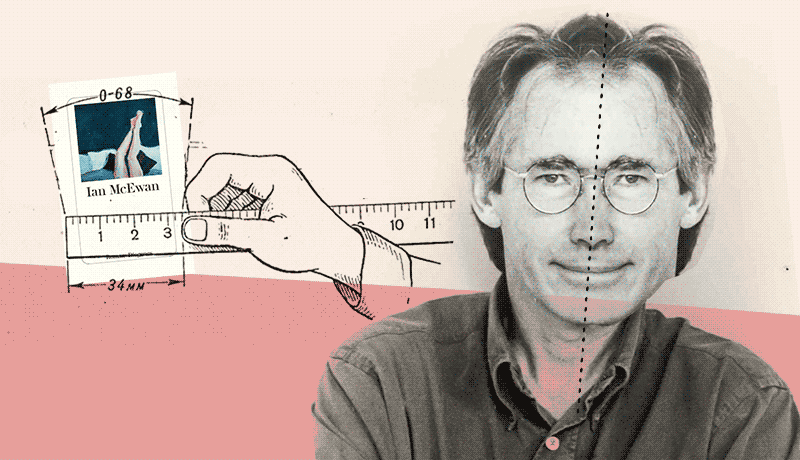 And, of course, this is exactly what happens: criminals burst into the ugly, ultracomfort house “with monkey faces” (hello, Darwin!), And a sweet, successful, wealthy family of Perunes experiences its personal miniature on September 11 in miniature. Hello a plane from the first chapter; And also - the cat Schrödinger, locked in a box alone with the capsule of the poison. Very subtle, Mr. Macouen, very subtle.
And this is the main problem, it seems, all the novels of the Englishman: he is so passionate about the symmetry of his plots that for the sake of her easily sacrifices to everyone else: “child in time” begins with the disappearance of the child and divorce, and ends with birth and reunion. “Amsterdam” begins with the oaths of two heroes, and ends with its performance. The "Law on Children" begins with the departure of the husband, and ends with his return. "Saturday" begins with making love and ends with them. And so - everywhere! Not a step away. Neither cold nor hot. Not an explosion, but a sob.
He sometimes brings this plot symmetry to bizarre fun, while raping the truth to it, treating it like old French gardeners with nature, creating symmetrical alleys, squares and triangles, pyramidal and spherical trees and hedges woven into the right curves.
Macouen’s books are written so neatly that they should be placed in the ward of measures and weights with a sign “An exemplary average romance with a three -shaking structure”. Seriously, any of them (except, perhaps, “sunny”) can be easily marked, find a cloth-clipper-disrespect, each of them has an “encouraging event” and a certain obstacle that the protagonist must overcome, “live”. And he will overcome, and this “struggle”, of course, will change it. Bright examples are “child in time” and “law on children”. Everything is strictly according to the canon. It seems that Mcueen’s literary courses are so much bruised by theory that he himself now subconsciously reproduces the same narrative, and all his novels are ideal textbooks for novice writers and screenwriters, it is very convenient to explain the basics of storitelling to students in the courses.
Well, this is also an achievement to be a master of symmetry. The problem is that this achievement is more likely for a gardener than for a writer.
However, Mcueen also has strengths, moments of clarity and rage; The whole thing is that they appear just when the author puts off his garden scissors, a second -pronounced lea -leer from Ikea. In the first chapter of the novel “Child in Time” - where the main character in the supermarket disappears - there is more nightmare than in all the toy monsters of Stephen King combined. The fear that the author presses is real, parental. Or “Sunny” is one of the few texts where the Englishman seems to be frankly clogging on the rules for the first time in his career and simply watches his moron-protagonist-and he himself is transformed from the bitch into a cheerful, witty writer.
And this is significant: it is worth forgetting about symmetry, literature immediately begins. Therefore, in fact, next to the “Cosmopolis” filled with the madness and paranoia, the neatly trimmed “Saturday” looks like a Chinese fake.
A good lesson for all beginner authors: the desire for symmetry is one of the stages of the formation of the writer; But it is its overcoming that is a sign of maturity.
In the most famous novel by Cazuo Ishiguro, “The Rest of the Day”, the main character is the butler, and he serves the owner so devotedly that for the sake of this service, everything human. As a result, closer to the end of the novel, the butler realizes that life passed by, he rammed it, exchanged for the perfect setting of the table in a strange house. So with McUan the same story - he refers to his novels as a hereditary butler in order in the house of the owner: he quietly wipes the silver metaphors and carefully arranges symmetrical candelabra of plots. He is not one of those who change habits. At least once I would build a fortress from sofa pillows or, I don’t know, admitted love to that charming maid! But no, he is not capable of this. Indeed, at the courses of the butler-writers they do not teach this.