
Translated material
The shore of skeletons
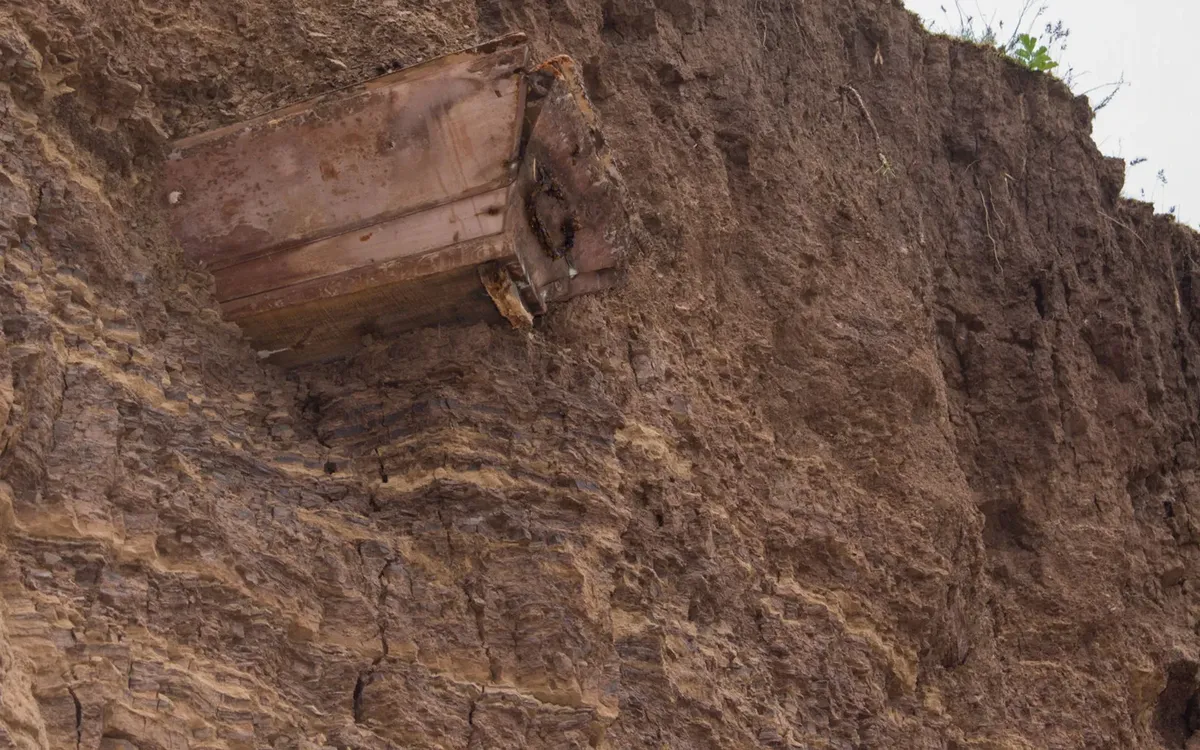
In the Saratov region, the great Russian river Volga blurred the old cemetery of the Volga Germans, the coffins stick out above the water
The Russian government submitted a priority project “Holy of Help”. According to the Ministry of Natural Resources, about 200 billion rubles will be allocated to improve the ecological condition of the river until 2025, half should draw up private investments.
Not sour shores
In the Rivne district of the Saratov region, every spring a “shore of skeletons” appears from under the snow-the Volga reservoir is eroding here the old German cemetery and dilapidated coffins in the most literal sense sticking out above the water. There is no money is not allocated to strengthen the shores and transfer of burials. Susha retreats three to five meters a year. Officials, apparently, are waiting for the problem to leak in the Caspian Sea.
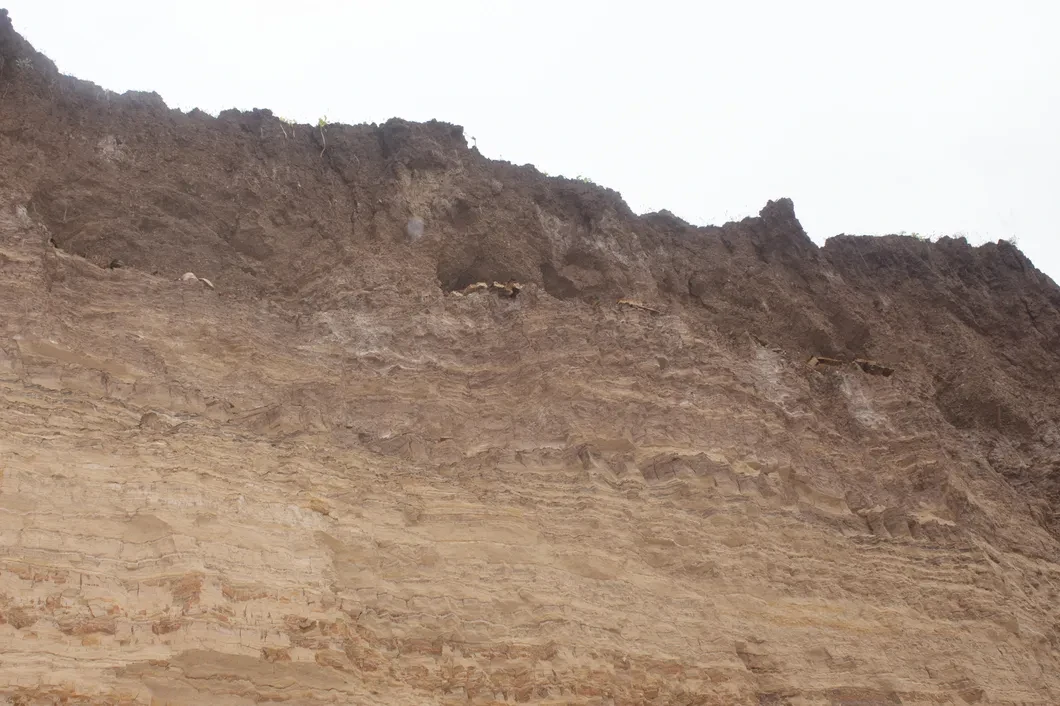
If you look to the shore from above, nothing reminding the old cemetery in Chkalovsky, you will not notice - neither the remnants of the tombstones, nor the hills. On the ravine we go down to the water itself. Under the coastal cliff is terribly and very quiet. The eight -meter clay wall hanging on the left dramates all sounds. Only the rustle of rain is heard. It seems that tons of wet clay is about to settle at us. Highly above the head, coffins stick out of the earthen wall. Some are flattened, bones are visible in the cracks between the boards. Others are preserved almost entirely, even metal pens in place. Some graves collapsed recently, fragments of boards and bones lie in fresh talus, they are slowly eroded by yellow waves.
"New" has already talked about the destroyed cemetery in 2010. Since then, nothing has changed here, except that the cliff has become higher, since every year the reservoir burns deeper into the shore, destroying the subsequent rows of burials. How many more graves are left, it is not known, local authorities know nothing about the boundaries of the cemetery.
With the “Skeleton Shore”, a dilapidated pigsty remaining from the advanced state farm is adjacent. Now there is a farmer stable, a man with a whip drives a huge herd on Levada. We talk through the fence. The villagers of the villagers are not interested in other people's dead, he uses it without fear with water from the river. But if the cemetery is fenced or excavated for reburial, it will be an concern for anxiety: where then are horses to fall? “Come from here,” the farmer ends the conversation, expressively clicking the whip.
The rural club works in an old red brick building. Chkalovskoye (initially the settlement was called Laub) was founded by Lutheran families, the prayer house was located here. Wooden floors from wide boards bend underfoot, rain stains darken under the high ceiling of the auditorium. It is unlikely that the building will wait for repairs in the current century. The annual budget of the Chkalovsky municipality - about a million rubles, this should be enough to clean roads, repair communal networks, improvement and salaries. This year, rural culture was optimized: club workers were transferred to half the bet, this is about 5 thousand rubles.
Nadezhda GUK writes poetry (they are hung on the wall in the corridor of the club) and heads the circle of the artistic word. There is also a circle of decorative and applied creativity (its largest success is a soft-well-bombed Kesha parrot, which propagates the crown of the ceiling) and an amateur collective that has experience in all forms of art. “We can do everything - and the dramatic genre, and we sing, and dance, and we sew the costumes ourselves,” explains Nadezhda Vasilievna and opens the costume treasury (the props is stored behind the curtain in the window niche laid down brick). Fei outfits representing the seasons, sundresses, oriental robes, tunic, a snowman's costume ... The hosts persistently offer to try on and take pictures. It is felt that cultural workers missed public. They themselves assure that at the concerts "the hall is always scored." The entrance is still free, although the district authorities are hinting that you need to earn a crisis. This year they first held a paid Christmas tree. They took 20 rubles for the ticket, "to buy prizes to children."
The wall behind the scene is hung with posters with a German alphabet. In the 1990s, the club led free language courses at the expense of the Russian-German program to help the Volga Germans.
The descendants of the former residents of Laub, who are interested in the history of the German colonies, sometimes come here from Germany, but do not delay - neither a hotel nor sightseeing routes in the village.
A piece of paper with a brief story of the village is glued at the door of the auditorium. As stated in the certificate, a hundred years ago, an oil and two brick plants worked here, the population reached 3750 people. This is almost 15 times more than today.
Now, according to the villagers, there are two places of work left - a club and a store. They closed the mail, the Sberbank department, a bakery, a first -aid post.
Left and did not return
To the right of the club is a one -story building with green swings in the yard. There was a school here. She was closed six years ago. To the left of the club is a house with a peeling sign “Shop No. 26”. At five o’clock in the evening there is already a lock on the doors, but in the morning the store opens early - in bad weather, children waiting for a school bus from a neighboring village are allowed to warm here.
Galina Fedorovna Vlasova for 40 years worked as a teacher of Russian language and literature. The story of the village is written in her thick notebook with a brown cover. The checkered sheets are filled with neat teacher handwriting.
Galina Fedorovna was born in Chkalovsky in 1948, remembers the Volga before the construction of the reservoir. “There was a forest on the shore, there were huge winds with tarzans. In the spring, the river spilled, we rode in boats between the trees. When the water left, potatoes were planted on the flood lands, they collected blackberries in the forest. I studied in the second grade when they drove the equipment and began to bring down the trees. It was sad. Then they let water. Before the construction of the reservoir, our house was three kilometers from the river, and turned out to be fifteen meters. ”
Before launching the hydroelectric power station, the rural cemetery was moved away from the shore. “We carried the graves of relatives ourselves, and the German part was excavated by the tractor. The coffins were still strong, black. They were put in a mass grave in a new cemetery. No names, just a long mound. ” In the 1990s, a cross was installed on the mass grave.
Apple gardens remained from the German republic in Chkalovsky, a oil carrier worked for a long time, where schoolchildren were sent to wash cheese. The cheese turned out to be excellent, once a week a helicopter flew into the village and took the delicacy to Saratov. In the teacher's rural school stood an old closet, a table and a mirror in a carved frame, transferred from an old German seven -year -old. Once an unfamiliar elderly woman appeared at school. She asked for permission to go to the teacher’s room, looked in the mirror - and burst into tears. It turned out, before the deportation conducted in 1941, Erna Fedorovna Gummel worked at the Lauba Pioner -Wi Lauba school.
According to Galina Fedorovna, the inhabitants hoped that the return of the Germans would help Chkalovsky survive. According to the Russian-German program, eleven houses were built here for the Germans traveling to the Volga from Central Asia. But most immigrants, having drawn up documents in the Saratov region, went further to Germany.
From afar for a long time
According to the Nizhne-Volga Basin Directorate of the Aquarius of Water Resources, in the Rivne district in the first years of the reservoir, "maximum processing of coasts exceeding 10-15 meters per year" was observed. Until now, "in a number of sites, very high coastal retreating speeds are preserved, reaching three to five meters."
As explained in the regional Ministry of Natural Resources, the procedure for obtaining budget money for work to strengthen river shores is almost as long as the Volga. The municipality is obliged to prepare a package of documents from 16 positions (including design estimates for coastal structures, and this is quite expensive for the poor Volga areas). The regional authorities should allocate 10% of the necessary funds, which with a scarce regional budget is unlikely. The application takes place in preliminary protection in the regional department of water resources of the Nizhne-Volga basin administration in Saratov, then in the BVA itself in Volgograd, then goes to Moscow for consideration by the agency of water resources. “Many areas submit documents for coastal, but do not take a selection,” says Irina Tyukina, head of the economic department of the regional Ministry of Natural Resources. “This year we do not have funding from the federal budget.”