
Translated material
Readers The New Times
Our dear readers,
You hold in your hands the last paper magazine The New Times/New Time - in any case, for the coming months. The money is over, we are forced to suspend the journal’s exit - until we solve financial problems, or - we will not close at all.
While we will continue to work on Newtimes.ru - it will be in the public domain.
It is bitter to write these words: 10 years The New Times worked for you, trying to provide you with information, analyst, reports, and investigations. For 10 years, despite all the difficulties, problems, threats, we remained an absolutely independent media, independent of any interests - state, oligarchic, local, from lobbying of various kinds.
We wrote about politics, economics, about the back of the authorities and the life of the opposition, for us there were no forbidden topics and we did not have internal censorship. Our main censor was our lawyer Vadim Prokhorov, who tried to protect us from potential lawsuits and the punishing sword of government agencies.
However, there were cases when it was impossible not to print the material - as in the case of the material “from Kaluga with jihad”; It would not be a violation of what, for which, in fact, the media exist, to exercise the right of fellow citizens for the fullness of information, as guarantees, our constitution; It was a risk, we deliberately went to him and received for it in full - ahead of the courts and other pleasures.
***
For the last 4 years, The New Times has not been the owner - the magazine belongs to the NGO, The New Times Foundation, which states that the magazine is the property of the Russian Civil Society, its readers and subscribers. This has its obvious advantages - look what is happening with one well -known media holding and its wonderful journalistic team, which has been transmitted from one loyal hands to another, even more loyal for the second year in a row; or with a famous magazine in which the names of the oligarchs close to power are deleted from those who have a negative connotation of ratings; Or with a newspaper that was once a symbol of new journalism, but became an epitaph over it ...
The media are mentioned by state, quasi -state or winding apartment, where everyone has their own “double continuous”, which cannot be crossed, surnames that cannot be called, state corporations that should not be hurt.
We did not know these problems.
But independence had the opposite side. Journalism costs money, good journalism costs a lot of money.
We could not earn on the advertising market: advertisers - from the leaders of agencies (who were almost all of our readers and subscribers) to the leaders of companies and banks - explained to us that giving us an advertisement is "publicly declare that you support the opposition to Putin." Although I do not know a person who would suffer for giving us advertising, interviews or contributed in some other form.
“You have an enemy magazine,” one major state official told me, explaining why to speak with me for two hours face to face - maybe, but say the same in an interview. But the perption is reality - the idea of reality often becomes a reality itself, we could not interrupt this prejudice, we could not convince that we are simply independent, non -certificate media - it did not work out, advertisers and those who are behind them, especially in today's falling and bored market, did not want to hear.
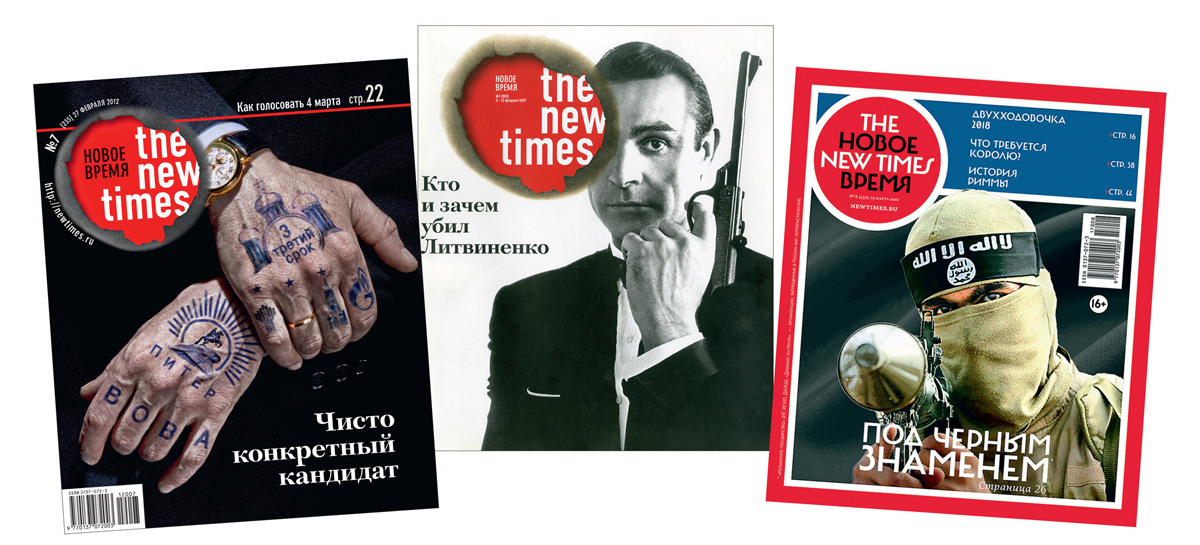
In the center - the cover of the very first room of The New Times - February 12, 2007. On the left - the cover of the number that was released on the eve of the presidential election, February 27, 2012. On the right is the same number of March 13, 2017, for which we flew a “letter of happiness” from Roskomnadzor
A heavy blow to our financial situation was inflicted by a policy of eliminating or reformatting kiosks, including press kiosks in the most lively places in Moscow and a number of other cities: entire distribution networks either went bankrupt or closed, and those that remained are interrupted from bread to water. Therefore, they often solve their problems at the expense of us publishers. The distributor offices owe us millions of rubles, we win the courts, the bailiffs come with the performing sheets and - they get into the iron doors closed to the castle. We submitted applications to law enforcement agencies, investigators came, asked questions, nodded his head with understandingly and refused to institute criminal proceedings. By the way, these problems are also known for pro-government print media: some of them have the presence of an administrative resource helped to cope with unscrupulous counterparties, someone-no. But their problems are solved by the budget or banks and oligarchs appointed to help. We, by definition, could not have such an option.
As for the regions, there is a hit in the kiosks or on store stands is directly dependent on the position of the governor and its administration. There was in the city of the X Governor of liberal views - the magazine was in kiosks, changed - there was no magazine. Meanwhile, readers continued to ask, then the stalls began to hang out the ads: “New Times” is prohibited by the government ”-this was, for example, in St. Petersburg.
“This is a policy of slow strangulation of the magazine,” one qualified reader wrote to me and was absolutely right.
That's exactly why in January 2017 we left retail - expensive, dreary, and at the exit - Shish.
We hoped for you, our subscribers.
I honestly wrote in November last year, during a signature campaign for 2017: “20 thousand subscriptions would practically provide us with the next year, 15 thousand - they will force us to go with an outstretched hand to the sponsors, but this is tolerant. 10 thousand - life becomes much more complicated. Less than 10 thousand-I'm afraid we will not reach the end of 2017. ”
We scored nearly 6 thousand paid subscribers, of which 3 thousand - for a paper publication, the rest - for the electronic version of the plus magazine - hundreds of subscribers to the version for tablets and through various electronic systems.
And this despite the fact that the studies show: more than 100 thousand people read each issue of the magazine, and our group on the same Facebook is 118 thousand people. But, unfortunately, there are a lot of options, including channels in messengers that allow you to distribute and read the magazine for free.
Someone says that the “paper is dying”, but all high-quality journalism in the world continues to go out on paper-from The New York Times in the USA to The Guardian in the UK (by the way, the newspaper is unprofitable) from Le Monde in France to Süddeutsche Zeitung, etc. Moreover, in recent months, the New York Times and The Washington Post are growing, and they are growing, including due to subscriptions to paper versions.
We want this or do not want it, but the output of the publication on paper is a kind of quality mark: it is printed - to correct, “you can’t“ take care ”. It is no accident that they return to paper media and publications that they tried to go out exclusively in electronic form - for example, Newsweek. Although, of course, a full-fledged publication of the media on paper and on the Internet requires significantly large journalistic and other resources-hence the tendency to set Pay-Wall to access the sites of high-quality publications. Yes, the information should be publicly available, but someone must pay salaries, finance business trips to hot spots, pay for phones, Internet, servers, etc., so on, which spills in tens of millions of rubles every year.
Who?
In addition to advertising (and it is not - see above - and it will not be), it is either the owner, or - subscribers and sponsors.
Master - everything is clear here. The owners of high -quality media today are: Alisher Usmanov (Kommersant Publishing House), Putin's friend Yuri Kovalchuk (packages in many television channels plus the Izvestia newspaper), oil industryman Grigory Berezkin (Komsomolskaya Pravda and soon, apparently, RBC holding, including a newspaper, a magazine, a magazine and, which is very important, which is very important. The news feed; for RBC, it is possible that Forbes will follow), as well as those who prefer to stay in the shadows, but who has their own media attachment - from Metallurg Dmitry Bosov to the head of the state corporation Sergei Chemezov. Of course, there are exceptional cases - Alexander Vinokurov and Natalya Sindeeva (“rain”, republic.ru), before which there is only something to remove the hat.
As for the sponsors ... We are very grateful to those who have helped the magazine for the past four years - first of all, Dmitry and Boris Zimin.
However, the most persistent supporters of the freedom of word come in fatigue and disappointment, many go abroad, many sell their businesses and prefer less dumb life where taxes are higher, the norm of profit is lower, but where there is no fear that the day will begin with a search, and the day after tomorrow you will find yourself in a cell without hot water and an extra linque.
Life abroad shifts interests, information about the fact that they came to Serebrennikov today, they decided to check the teachers tomorrow, they arrested the governor, then they took custody of the head of the company, and all this, coupled with scrapers, state religion and a mockery of private property under the name “renovation” - such information begins to bore over time. Especially when there is another - about, for example, how journalists monitor every step, every word, every sneeze of the president, and for that they do not change the owner.
In the end, how much you can wait for the desired tomorrow.
As a result, in Russia, the vast majority of media projects were under the control of the hosts appointed on the old square and in the Kremlin: they are not fools in the power, they understand that in the elected year some decency should be observed, not to be required to sing health, especially since the resource pie is in a landfill, and players will be in the vastness of high -quality, but dependent media.
Units remain independent, and their circle narrows.
So supporters of the liberal, democratic development of Russia step by step all these 17 years gave the space of freedom and the space of freedom of speech in particular.
We held on as much as we could. But you can’t make a magazine without money.
While we will continue to work on the Internet - on Newtimes.ru.
If you manage to raise funds, we will begin to issue a magazine again, although it is possible, and in a different format. Then the subscription of those who have already paid before the end of the year will be simply prolonged.
Whoever wants us to return the money now - send us a letter with the word “return” in the field “Subject of the letter”.
As compensation, we are ready to offer our subscribers and other options: for example, sets of a magazine for any year you have chosen, or an electronic archive, or our famous covers in a frame with autographs of your favorite journalists. Write to us on [Email Protected]
Sorry that they didn’t pull it out - we are very bitter.
We will be alive - we will see each other.
Sincerely yours
The editor -in -chief and general director of The New Times