
Translated material
Europe-USA: something happened
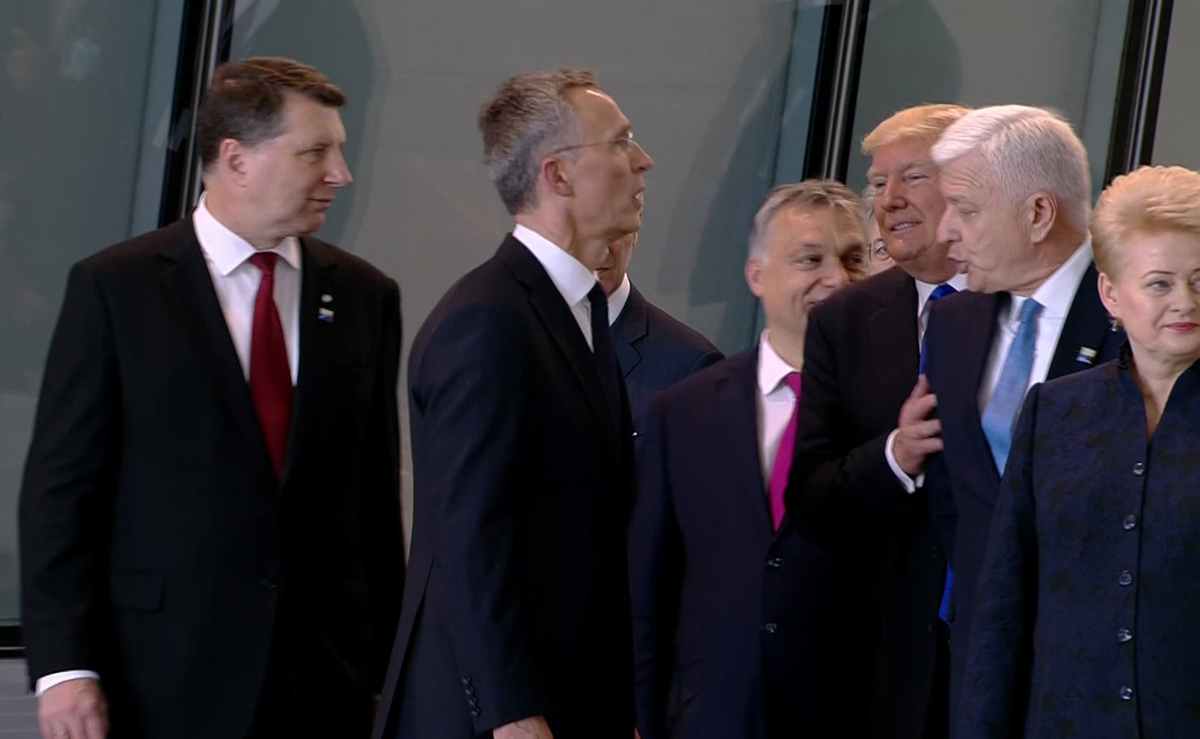
That awkward for the United States the moment when the president of the country easily pushes back the prime minister of Montenegro (second on the right) to be in the focus of television cameras, Brussels, May 25, 2017
After the Maisk of NATO summites in Brussels and the G7 in Taormin (Sicily, Italy), the official Berlin did not skimp on the remarks and tiradeas, indicating its extreme concern with the results of three days of transatlantic meetings. “The times when we could fully rely on others (it is clear to whom in the first place.-NT), in a sense, have passed,” the Chancellor of Germany Angela Merkel said on May 29 in Munich, allowing herself to relax for a beer mug. “This is what I have understood for myself over the past few days ... It’s time to take my fate in my own hands in Europe.”
The coordinator of the Government of the Federal Republic of Germany for transatlantic cooperation Jurgen Hardt made an even more sharp statement to the current team in Washington: “We saw on the NATO and the“ big seven ”do not correspond to either the intellectual or any other potential that we could expect from the United States and the president of this country.”
This is not just unheard of, beyond all the diplomatic framework, frankness, after which in bilateral relations (in this case, Germany and the USA), albeit not immediately, are irreversible consequences. This is a kind of signal that Germany, the most important country in Europe, the locomotive of the European economy, is ready for such consequences.
“It seems that the end of the era comes when the United States played a leading role, and Europe is a driven one,” the ex-chairman of the United States at NATO DAADADER suggests.
Authoritative American political scientist Francis Fukuyama, commenting on the results of the Mayskie Trumpu, states: “We have witnessed the disaster of American foreign policy.
So what, in fact, happened?
Insauntal attitude
There are written rules, there are unwritten ones, but there are - immutable for any serious politician. Alpha and Omega of any military-political union (and NATO, if anyone forgot, is not only a military, but also a political organization)-the principle of collective responsibility. In relation to the military component - collective defense. The fundamental 5th article of the Washington Treaty (the Charter of NATO) states that the attack on one member of the Alliance is an attack on the whole block: one for all and all for one. Actually, for the sake of this, they make their contribution to the general piggy bank all 28 member countries (Montenegro becomes the 29th from June 5). Each new president of the United States, debuting at the NATO headquarters, considered it his duty to declare his commitment to the spirit and letter of the 5th article-they say what we stood on, and we are standing, the Western Union is unshakable. Donald Trump did not do this in Brussels. And this means that Trump's genuine intentions, whose statements during the election campaign that NATO is an outdated organization, already brought confusion to the minds of the European ruling elite, remained a secret behind her seven seven. Before a trip to Brussels, Trump in an interview disavow himself-they say, no, he, of course, considers NATO a very useful block, especially in the fight against terrorism-but he did not say a single word about the 5th article. Everyone waited and hoped that he would do it during the summit. Journalists bombarded the Secretary General of NATO Jens Stoltenberg with questions about this: why is Trump silent? The Secretary General in response assured everyone in the absolute commitment of the new US administration to transatlantic unity: they say, by evidence of this - the proposal of the White House to increase the budget financing of American troops in Europe by 40%at once; Under Trump, as in the last two years of Obama’s reign, there is an increase in defense expenses, and not their decrease, as it was before; And he, Stoltenberg, personal conversations with Vice President Pence and Secretary of State Tillerson convinced that America would not retreat from the principle of collective defense. But such answers, judging by the reaction of the press and experts, did not convince too much. “The argument that American troops in Europe will receive additional funding is weak for Poles or Estonians,” the NATO functionary in Brussels argues in a conversation with NT. - They would like to get oral guarantees from the first person that in the case of Russian invasion, America will protect them. Otherwise, why are they hurrying to increase contributions to a common piggy bank, as Trump now requires. ”
“The argument that American troops in Europe will receive additional funding is weak for Poles or Estonians. They need first -person oral guarantees that America in the case of Russian invasion will protect them "
About contributions - a separate conversation. Trump does not ask - he frankly presses on the allies: stop sitting on America's neck. An annual contribution of 2% of GDP (now 5 countries out of 28 - USA, Great Britain, Greece, Poland, Estonia) is the recommended minimum, ideally it would be good to pay more. Actually, Trump is not new in this. They called for to withstand financial discipline within the framework of NATO and previous American presidents-George Bush Jr. and Barack Obama. But this was done more delicate and with a much higher degree of competence in the issue, the interlocutor NT from among the NATO functionaries notes. “NATO has two budgets-its own, to finance common civilian and military projects, and national, by member countries,” the official explains. - According to the general budget of debts, no one, but according to the national, sorry, each determines the priorities himself, a bar of 2% - just a recommendation. Trump is falling into one pile. And where are his advisers? Are they at all? "
The logic of the businessman
The most discontent to the US pressure on financial issues is expressed by Berlin, who, due to the national defense budget, additionally finances projects under the auspices of NATO, for example in Africa. However, the Trump team refuses to consider these programs to help with a collective defense. “They do not understand that if Germany begins to really expel 2% of GDP to its own defense, it will become a military superpower. They need it? " -It is ironic to one of the interlocutors of NT at the headquarters of NATO.
The allies remained far from delight and from Trump’s proposal to introduce an annual (more precisely - twice a year) monitoring of military expenses for countries. Officially, NATO agreed with this idea. The unofficial reaction was slightly different. In many delegations, a murmur was heard: they say, NATO is not a commercial company, for decades everything has been based on mutual trust and common interests, but here in fact the annual audits have been introduced.
Finally, Trump managed to sell a decision in the Summit in Brussels that NATO officially join the anti -terrorist coalition under the auspices of the United States in Syria and Iraq, despite the fact that many countries are members of the Alliance - and so already participate in it, and NATO as a structure helps the coalition with long -range radar detection aircraft (Avax). France President Emmanuel Macron during a working dinner as if reasonably age was Trump: will the entry of NATO be scared of the coalition of the Arab allies of the West participating in it? But he was adamant. “He has the logic of a businessman in everything, not politics. If NATO is officially present as part of the coalition, he understands what the money of American taxpayers is going on; If NATO helps, as now, in training special forces and security forces in Jordan and Iraq, then this is no longer very clear, ”one NATO official is ironic.
The businessman knows what he needs and what does not need. The politician realizes that he is possible and what is impossible. Trump, speaking at the opening at the NATO headquarters, a memorial dedicated to the victims of the attack on September 11, 2001, urged allies to increase contributions to the NATO piggy bank within two to three minutes. This was crushing many of those who listened to him. “The moment to talk about the money was chosen extremely unsuccessful,” says the NATO functionary.
Charismatic with character
Donald Trump believes due to his own charisma. One of the unspoken agreements with his team, as they say, was this: no matter what happens on summites, the president must be in the focus of television cameras. In particular, the Trump team allegedly insisted that the NATO General Stoltenberg Secretary General conducted a separate tour of the new headquarters for him-under the television cameras. Outwardly, it even looked comical: the 33-meter arches of the central atrium, important to the limit, looks around the Trump, while Stoltenberg explains something incessantly on the move. In its own way, the existence of such an agreement and the sensational episode with the Montenegrin Prime Minister Dushko Markovich, whom Trump unceremoniously pushed back in order to take the most prominent place before the television cameras. The method of standing out against the general background was found on the G7 summit in Italy, where the 70-year-old Trump traveled from the hotel to the place of meeting in the electric car, while the rest went on foot. “In America, such PR techniques probably work, especially when the politician is in a difficult situation, like Trump now-in connection with the investigation of the connections of his team with Russia,” said Christine Monet from the European Center for Transatlantic Studies. “In Europe, they rather produce the opposite effect.”
Many at the NATO summit in Brussels drew attention to Trump’s vocabulary-a businessman vocabulary, which dominate words such as “project”, “result”: “England decided not to stay in the EU, and I know about it, but still I think that Europe is a good project.” Trump speaks in short phrases (he is convinced that this is the most effective way of communication), does not use streamlined formulations, often interrupts, his reactions are spontaneous, he never uses cheat sheets and certificates with numbers (he arrived in Belgium without the slightest concept of the Belgian economy and its trade turnover with the United States), but it appeals too often to his business performance in order to explain some kind of explanation Political invectives: “Every time he is talking about some country, he recalls his business there. Scotland? Yes, he knows about her, there he opened the club. Ireland? But this is another, there he spent 2.5 years there to get a license for some business-and what, the whole European Union works like that? "
Trump's Message to Europeans in Brussels and Italy was concise and uncomplicated: I am a kind, understanding and responsive interlocutor and partner, especially if you accept all my suggestions - and quickly and without unnecessary formalities
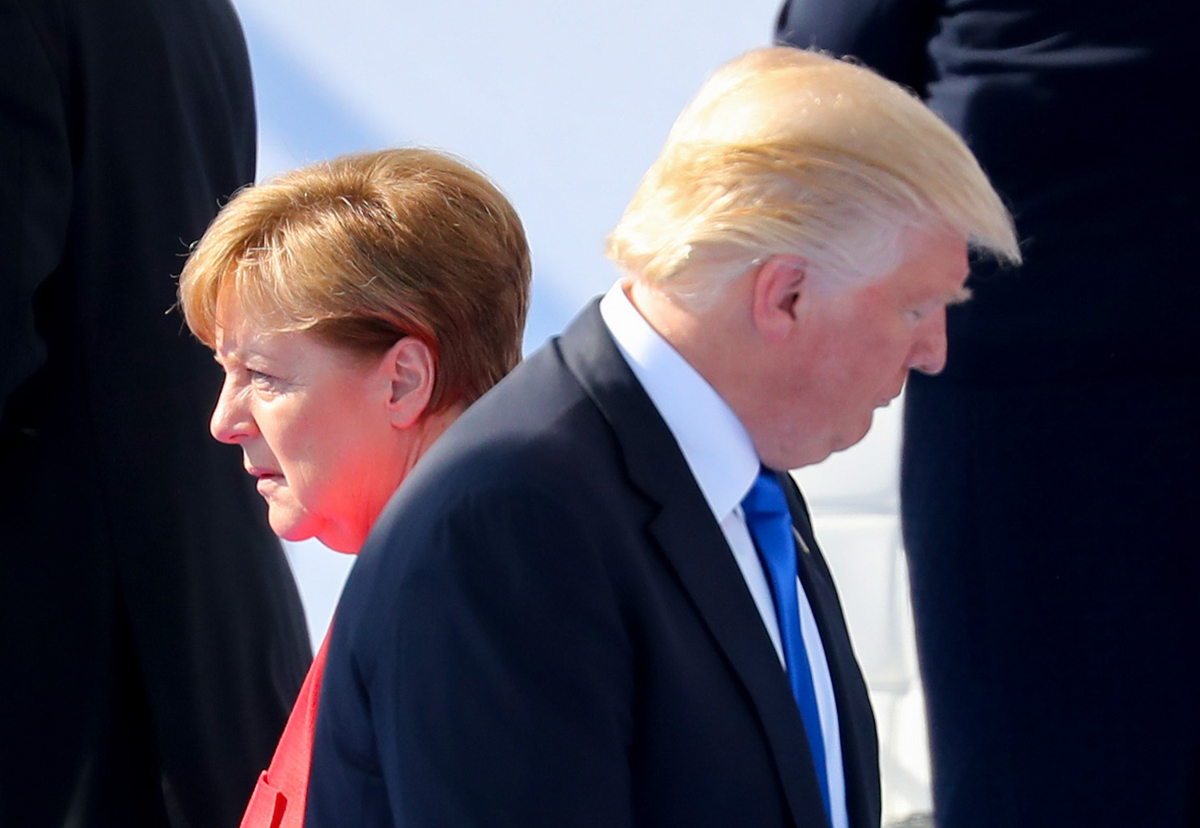
Trump's Message to Europeans in Brussels and Italy was concise and uncomplicated: I am a kind and responsive interlocutor and partner, especially if you accept all my suggestions - and quickly and without unnecessary formalities. For example, he believes that the Paris Climate Agreement on CO2 sampling restrictions inhibits economic growth in the United States, and immediately declares: “We will probably get out of this agreement,” although according to the regulations this procedure requires coordination*. He absolutely reasonably draws attention to the fact that the US deficit of $ 65 billion in trade with Germany is intolerant and the Germans are time to stop creating competitive export advantages due to the rest. But it did not occur to any US president to threaten Chancellor Merkel because America would stop the import of German cars. But Trump, according to German news agencies, threatened and was extremely surprised by Merkel, who left after meeting with Trump in a depressed mood. Later, she will speak out in the spirit that Business As Usual with America Trump is unlikely to be possible.
Donald Trump, judging by the photographs, left Europe quite pleased with himself. It seems that he did not understand anything.
* Officially, Trump announced on June 2 on the US Paris Climate Agreement on Climate.
Photo: NATO TV/AP/East News, Kay Nietfeld/DPA/TASS, Luca Bruno/AP/East News