
Translated material
Agents passed the "office"
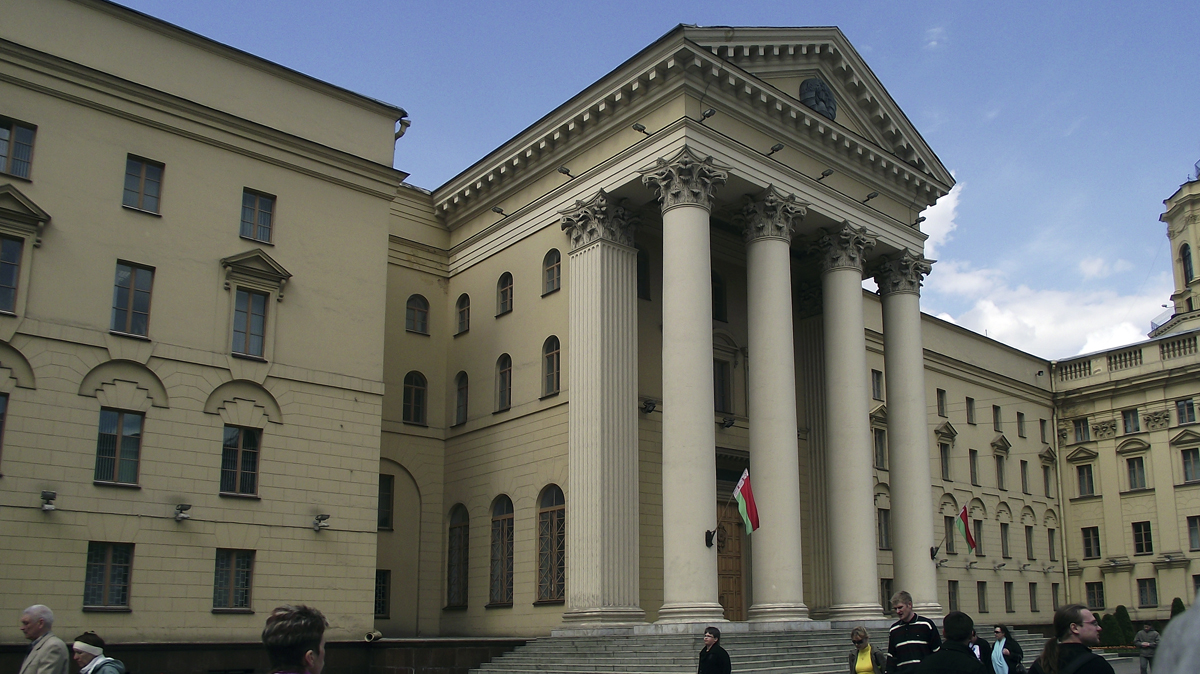
The first recognition in cooperation with the KGB was made by an activist of the young front opposition organization Sergei Palchevsky - one of the suspects in the so -called Patriots case*, whom the Committee of State Security of Belarus accuses of preparing the riots. On April 27, he said that he agreed to become the KGB informant because of blackmail from the committees.
Under the pseudonym "Arthur"
The broad Belarusian public Palchevsky became known after he chained himself to the Bumper of the truck during the promotions in February 2017 against the elimination of the tract of the partridge near Minsk, where mass executions arranged mass executions in the 1930s. The activist was detained on March 22 under Art. 293 h. 3 of the Criminal Code of Belarus (training or other preparation of persons to participate in the riots) and first was put in a pre -trial detention center of the Ministry of Internal Affairs, and then transferred to the "American" - as the KGB pre -trial detention center is called in Belarus. On April 15, he was released on a recognizance not to leave, while he remained the suspect.
A week later, Palchevsky published an open letter on social networks, in which he revealed the details of his recruitment: “At the first interrogation, to which I was brought to the central apparatus of the committee, I had a conversation without a lawyer with two Habeschers. They immediately began to demand that I tell them something in the "case of patriots." I refused. Then they began to blackmail me. <...> I was threatened with criminal prosecution and an additional term for an accident with my participation. <...> The threat of the publication of some intimate details about my personal life was also voiced. <...> In conclusion, I was threatened with "cocks" in the zone. <...> After we talked privately, the Gabeshniki ordered to repeat all this with a lawyer and gave me a signature of cooperation. Under the pseudonym "Arthur" I signed the consent to cooperation with the KGB, thinking that by liberation I admit this to my friends. And today I repent in this act before God and people. If someone condemns me for the deed, I believe that everyone has every right to do so. ”
“When a gun is held at your temple, you have to agree to all requirements. And when you broke free, you can act as you think it is necessary "
The head of the press service of the Belarusian KGB Dmitry Pogarzhin refused to comment on Palchevsky’s statement. And soon similar confessions of other activists followed - for the most part young people who were detained on the streets during the suppression of numerous protests of this year of this year. They also claimed that they agreed to cooperate with the KGB under torture or under threat of torture. From these stories it became clear that the KGB was interested not only in the opposition themselves, but also human rights activists, journalists, businessmen and just students.
Sexs of all shades
Those who, for one reason or another, agreed to cooperate with the bodies, according to political scientist Sergei Marrachev, who also spent several months after the KGB internal prison, can be divided into three categories.
Some of the secret employees (sexots), being free, simply ignore the requirements of the committees to knock “where should”. If a person does not have a serious compromise and he is able to withstand psychological pressure, he has good chances to break off the hook. “In this case, public recognition in forced cooperation is the right exit,” says Sergey Marrasev. Young Belarusians, unlike the older generation, are not afraid of the KGB, the colleague of Marrasev Alexander Fedut agrees: “They are ready to intimidate, blackmail, and recruitment. And they are ready to play along, sign the papers, but having gone free, without the slightest remorse, they betray all this publicity. ”
The second category of informants, having signed papers, regularly provides services to bodies, receiving money and other bonuses for this. Well, Marrasev calls the third sexes the most hypocritical, related to them politicians, leaders of the closed communities of religious and fan’s sense. Gabeshniki politely offer such figures from time to time to meet in order to “mutually exchange opinions” or share an “expert assessment”. The “expert”, as a rule, does not sign any papers, but at the same time it becomes an ordinary informant, plus the bodies merge the information they need to surround the agent’s entourage.
“Unfortunately, there are a lot of such people in the narrow field of Belarusian policy. They forget that the opera cannot be replayed - he is a professional. You can’t play according to the rules of the game that he offers with a smile. Because his smile can disappear from his face at any moment, and the “expert” will sit with a clamped tub - and literally sit, this is not a metaphor, ”says Sergey Marrasev.

"Now the KGB will take revenge"
The current wave of confessions in cooperation is not the first in the latest Belarusian history. After the 2010 presidential elections, about 700 participants in the demonstrations who protested against falsifications when counting votes, seven of the nine competitors of Alexander Lukashenko and employees of their election headquarters were behind bars. Private activists then received 15 days for 15 days, but with the candidates and their associates, the investigators of state security worked hard, inclining to cooperation.
Among the detainees was the presidential candidate Ales Mikhalevich. Two months after the arrest, he was released from the KGB pre -trial detention center on a recognizance not to leave. Mikhalevich gathered a press conference and said that the condition for his release was consent to cooperation with the special services that he gave under torture and which is now breaking.
Many detainees and convicts after the elections spoke about torture and recruitment, including ex-candidates for president Vladimir Neklyaev and Andrey Sannikov, the head of the election campaign, Vladimir Kobets Sannikov, editor of the Hartia-97 website Natalya Radina and other oppositions.
A few days later Mikhalevich fled from Belarus and received a political asylum in the Czech Republic. Commenting on the current recognition of Palchevsky, the political emigrant warns the young activist: “Now the KGB will take revenge,” and strongly recommends that he follow his example: “Temporarily leave Belarus or lie to the bottom, disappear. We must go to where they will not find it and turn off your mobile communications. ”
According to the former rival Lukashenko in the elections, the KGB is interested in the “young front”, the plans and ideas of the organization, because the recruiters wanted Palchevsky to constantly supply information.
“In 2010, Belarus survived the most massive wave of political emigration after 2001, and the special services received“ moles ”, which had to make a choice in the KGB pre-trial detention center-either the deadline for organizing mass shares, or honorary emigration,” says Sergey Marrasev. “These people have become the screws of the agent network of the Belarusian KGB abroad.”
Failure or provocation?
Public opinion in Belarus mainly supported the activists who told about their recruitment. “When a gun is held at your temple, you have to agree to all requirements. And when you escaped to freedom, you can act as you see fit, ”explained the interlocutor NT, who wished to remain an unknown. But, of course, everything is not so simple.
The politically active community regarded the act of self-and-experts in different ways, Sergey Marrasev testifies: "Some in the burning called them informers, while others, on the contrary, saw in public recognition a testimony of fortitude."
Some of the democratically tuned Belarusians perceived the mass caming out of the KGB of activists as a tactical victory of the opposition over the secret police, others do not share this optimism. “The guys, of course, are absolutely sincerely trying to jump off the gabsch hook with the help of public recognition. It is clear that after that the curator is simply not suitable for them, ”the Belarusian political strategist argues, who asked not to give his last name. - But then the question arises: maybe they were recruited in order to talk about it? This is the easiest way to support the image of the omnipotent KGB, which recruits everyone in a row. And people will conclude: the opposition cannot be believed, the young have already confessed to cooperation with the organs, and since the "old people" are silent - it means that they have something to hide. It is possible that this is part of a large campaign to discredit the Belarusian opposition. ”
There are enough such examples in posttototalitarian countries, so the first thing to do after a change in the political regime is to carry out lustration. Especially in power structures and among representatives of the so -called "professions of public trust" - teachers, journalists, etc.
“The facts of cooperation with the organs are not always opened on a political career and interfere with public recognition,” said Sergey Marrasev, citing the example of the ex-president of Poland Lech Valens, who not so long ago admitted that he signed the consent to cooperation with the Polish intelligence services as an “agent of Bolex” **. There are enough such examples in posttototalitarian countries, emphasizes the interlocutor of the magazine. Therefore, the first thing to do after a change in the political regime is to carry out lustration. Especially in power structures and among representatives of the so -called "professions of public trust" - teachers, journalists, etc.: "Otherwise, the shadow of the totalitarian past will follow you on the heels."
REFERENCE
The practice of using freelance informants - the so -called sexots - was very common in the KGB of the USSR. Private Soviet man knew that in every more or less large team, the institution has at least one KGB informant. Often they were personally known in the team, although, of course, officially no one reported to anyone about this. Sexs, in fact, represented the recruited agent apparatus, supplying the Soviet special services to the information that was of operational interest, and involved in the implementation of operational orders. The agents were not included in the personnel of the KGB of the USSR, did not receive from the committee of officer titles and salaries, only sometimes content with one -time material incentives for particularly valuable information.
In 2005, a scandal erupted in Lithuania, when the KGB mobilization reserve published was not only Lithuanian auto-specialists and plumbers, but also the Foreign Minister Antanas Valionis, General Director of the State Security Department Arvidas Potzus and the Vice Speaker of the Sejm Alfredas Pekelunas.
* The “Patriots” in the Belarusian non -governmental media called the CGB, the case against the creation of illegal armed groups in Belarus, allegedly preparing provocations and the change of power in the country by force. In this case, several dozen people are held, mainly former members of the Radical Nationalist organization “White Legion”, which existed in the 1990s, but ceased their activities in the early 2000s. It is believed that the Belarusian special services reanimated the memory of it in order to justify the strict actions of the security forces when suppressing mass protests this spring. Now the case of the “White Legion” is crumbling before our eyes, and the accused one after another is released from the KGB pre -trial detention center. At the moment, 16 people remain behind bars.
** In February 2016, the ex-president of Poland Lech Valens, on his page in the Polish social network, Wykop made that in the period from 1970 to 1976 he had five meetings with counterintelligence officers, however, “he did not do denunciations on any of them” and did not harm anyone. Earlier, among the documents seized by the employees of the Institute of National Memory of Poland and law enforcement officers in the house of the late Ministry of Internal Affairs of Cheslav Kishcheak, a folder signed by Lech Valens was found. Bolek ”, which, according to experts, proves the cooperation of the former president with special services.
Photo: Facebook by Sergeya Palchevsky, AP/TASS, Social Networks