
Translated material
The Rosgvard is crushing the General Staff
At the beginning of the last decade of May, when the society was passionate about the story with a police collision at Gogol-Center and director Kirill Serebrennikov, almost no one noticed the new Decree of President Putin, which approves the “Regulation on the operational-territorial association of the troops of the National Guard of the Russian Federation”. At first glance, this is a common and, moreover, a very boring bureaucratic document. But - only at first glance. In fact, only a few lines in it indicate a real revolution in the military organization of the state. “By decision of the President of the Russian Federation,” the document says, “formations and military units of the Armed Forces of the Russian Federation, other military units and bodies can be transferred to the operational submission of the district commander to fulfill the tasks entrusted to the troops of the National Guard.”
A new type of war
Both in the Soviet and post -Soviet times, it was possible that the internal troops of the Ministry of Internal Affairs, on the basis of which the Russian Guard was created in 2016, can be subordinated to the armed forces. After all, the external enemy could have superiority over the army, and for repulse he needs to concentrate the entire military component into a single fist. In all major military exercises of recent years, units of the internal troops, subordinate to the army command, participated. But so that the army formations were subordinated to the command of the internal troops - this was not supposed.
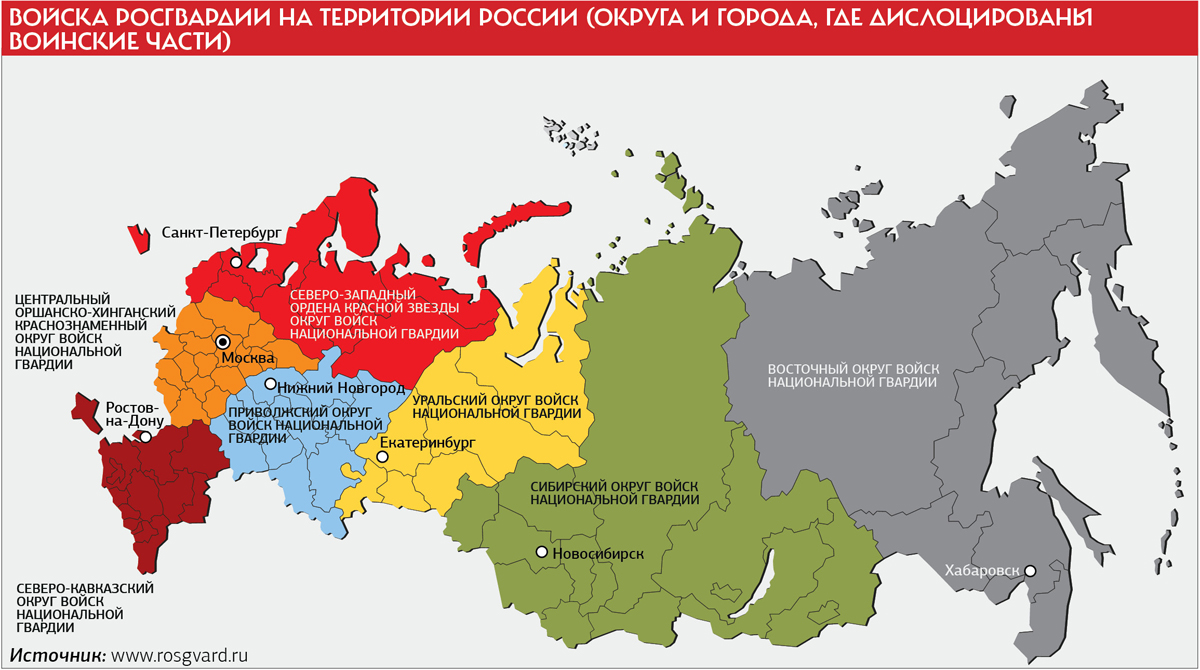
No hints that the army units can be at the disposal of the command of the Russian Guard is also contained in the last year's law on its creation. After all, such submission can only mean one thing: the Kremlin considers the internal threat much more dangerous than external. And this threat is so serious that in order to reflect it at some point may not be enough for the forces of the Russian Guard, whose number, according to its commander-in-chief Viktor Zolotov, doubled compared to internal troops (187 thousand people at the time of retraining), that is, approached 400 thousand military personnel. The presidential decree means: the authorities allow the possibility of large -scale unrest that will cover the entire territory of the country. It is precisely in this situation that all reserves will be involved, and the army will engage in the fulfillment of the notorious “internal function” - the same one from which both the Soviet and post -Soviet times fled as hell from the incense. But in 2014, at a conference arranged by the Ministry of Defense, the generals, wanting to put the Kremlin, came to a stunning conclusion: “Color Revolutions”, it turns out, is a new form of military operations. Therefore, in the new version of the Russian military doctrine, published in December of the same year, it is written that modern military conflicts characterizes the “complex use of military force, political, economic, information and other non -person measures, implemented with the widespread use of the protest potential of the population and the forces of special operations”. As you can see, the “protest potential of the population” is equated with the actions of enemy saboteurs.
The new presidential decree means: the authorities allow the possibility of large -scale unrest that will cover the entire territory of the country. Just in this situation, all reserves will be involved, and the army will engage in the fulfillment of the notorious “internal function” - the same one from which the military previously fled as a devil from incense
The main thing is loyalty
And here, it seemed, it seemed to correspond. Defense Minister Sergei Shoigu several times instructed several military institutions (including, for example, the Academy of Genshatab) to conduct a certain “study” regarding how the armed forces should respond to such threats. But nothing is still known about the results of “research”. Most likely, the officer corps did not want to cherish the planning of the use of troops against their own people. All that they were able to squeeze out, and turned out to be the idea of subjugating the army to the command of the Russian Guard, shifting responsibility to it for the use of force on the streets of our cities. At the same time, the commanders of the Army units attached to the Russian Guard will have to decide at a critical moment, whose orders and how to fulfill.
By the way, last summer in the Volgograd region, joint exercises of the divisions of the Russian Guard and the Airborne Forces have already been held. They were attended by military personnel of the two brigades of the Russian Guard and the Center for Special Purpose, as well as the 56th separate airborne assault brigade of the Airborne Forces-only 4 thousand people. At the same time, the representatives of the Ministry of Defense, the deputy commander of the Airborne Forces, led the maneuvers, Lieutenant General Andrei Kholzakov. The general explained then that the exercises were held for the first time “after the reform of the internal troops. We work out the issues of interaction in order to understand how in the future we have to cooperate. ” The reason why the army generals were appointed at first is obvious: their colleagues from the Russian Guard did not have experience in planning large -scale operations. But now, as follows from the presidential decree, the Kremlin preferred the knowledgeable and skilled loyal. And subjugated the army policeman. Without washing, so they will begin to prepare the army to suppress their own people.
Super -sore organ
The authorities, however, do not hide which state tasks, the most important in their representation, are facing the Russian Guard. Deputy Prime Minister Dmitry Rogozin quite seriously called her "the most fighting military unit solving the problems within the country." And at the same time he emphasized that "the Russian Guard should be armed to the teeth, and not just to the teeth, but the most high -quality weapons."
True, the guard itself is consistently to become a super -sulfur body - a special service with many thousands of military support. Relatively recently it became known, for example, that it creates a service for monitoring social networks on the Internet. “Today we see those areas that we would like to develop. First of all, these are IT technologies ... In the Russian Guard, they plan to train IT specialists and specialists in monitoring social networks, ”said Colonel General Sergei Melikov, deputy commander of the Russian Guard. According to him, “similar training groups” are already working at the Perm Military Institute.
The task of the new unit, said General Melikov, will be exclusively tracking terrorists and preventing their attacks. But it is much more likely that the Cyberg Guards will identify groups of “rebels”, uniting those who are going to participate in protest promotions.
Meanwhile, information about the intention of the Russian Guard was held in the media to achieve permission to conduct operational-search activities, creating its own analogue of Moore. So far, high ranks in the department decisively deny this. However, all the same Colonel General Sergei Melikov said that the Russian Guard would prepare the relevant experts if it is decided to be endowed with the relevant powers.
Finally, the authorities are consistently engaged in the ideological nation of the national guards. And, it seems, there is already the ideal of this nourishing - the NKVD. After all, the authorities did not limit themselves to the return of the operational division of the Russian Federation named after Iron Felix. So, soon the name of Dzerzhinsky will return to the name of the Saratov Institute of the Russian Guard. Parts and compounds are supposed to distribute the orders and honorary titles of glorious predecessors. Historians in uniform have already received an instruction to find something heroic about the troops of the NKVD. It is curious that they will write about the participation of “glorious warriors” in mass deportations and whether they will begin to educate the guards on these “heroic examples”.
Potential enemy
So far, the leadership of the Russian Guard has been pushing that its main task is to withstand the terrorists and armed gangs, not highlighting the task of acceleration of civilians. But just on the day when the presidential decree was published, on May 20, an article was published signed by Yuri Baluevsky, in the recent past, the head of the General Staff of the Armed Forces, later - deputy secretary of the Security Council, and now an adviser to the commander -in -chief of the Russian Guard. The text is notable for its frankness.
The authorities did not limit themselves to the return of the operational division of the Rosguard named after Iron Felix. So, soon the name Dzerzhinsky will return to the name of the Saratov Institute of the Russian Guard
“Like a military man,” writes Baluevsky, “I compare our country with the target. In the center - leadership and political elite. In the second circle - the economy, in the third - infrastructure, in the fourth - the population, in the fifth - the armed forces. Today, the blow is struck not on the armed forces, but by the civilian population, as the least stable compared to the military units of society on the influence of forces and means of psychological war. The scenario of the development of events is known from the experience of color revolutions. The organizers take millions of people chanting "Down!" Power begins to lose control. Further - sanctions, a comprehensive impact on the country's economy. The armed forces do not know what to do. All this leads the country to the collapse. This is how a modern war can develop. The emergence of the National Guard troops is a response to the challenge abandoned to our society, to the threat of the use of technologies of the so-called non-violent resistance, which is nevertheless more accurately called the "color revolution."
Thus, the “least responsible part of society”, the civilian population of their own country, turns into a potential enemy, against which force will be allowed to use force in the Russian Guard and the army. Military power is against their own people.