
Translated material
Mikhail Blinkin: "Russian cities have yet to swallow"
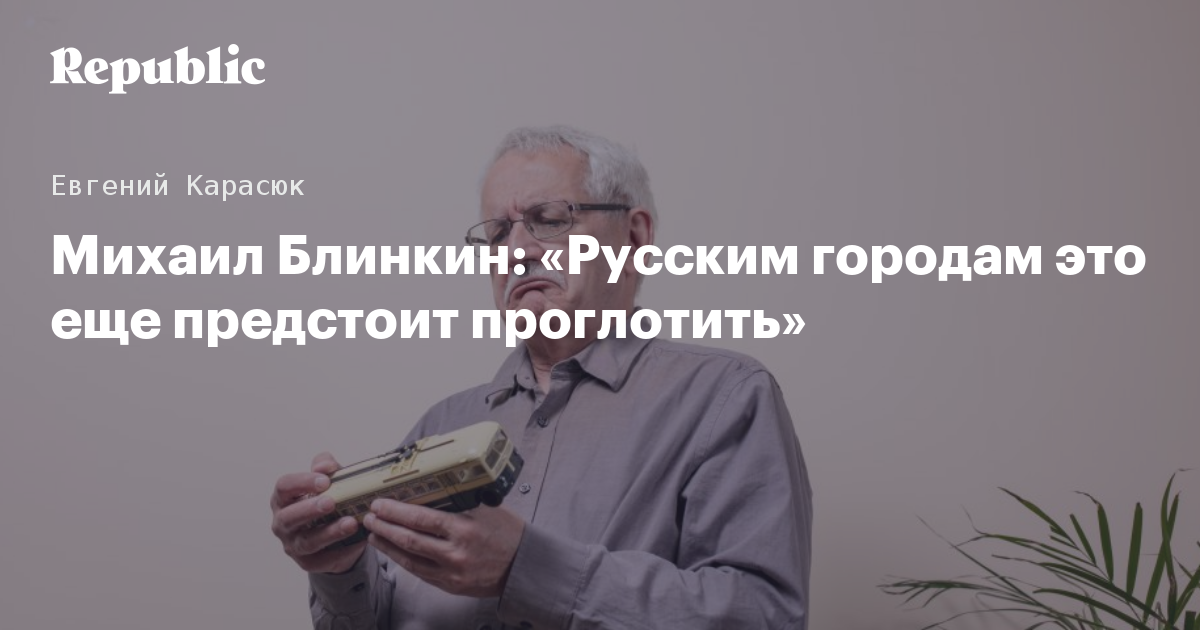
Leading the country's expert in the organization of traffic, the head of the Institute of Transport and Transport Policy of the Higher School of Economics , Mikhail Blinkin says that he understands the objective difficulties of the Moscow government. Officials have to resort to less and less popular measures, raking up the transport problems of the city - these endless Augi stables left by their predecessors. When the mayor, Yuri Luzhkov did not have the habit of listening to independent transporters and urbanists, and Blinkin’s opinion, the consistent critic of his urban planning policy, seemed to be ready to take into account last (“Relations with Luzhkov were very difficult,” he recalls, “was ridiculous, but I was even placed in a stoplist on TVC”). The result is well known: the speed of movement around the city was steadily reduced, and, in the end, the Russian capital was in the upper lines of the rating of world megacities with the most problematic traffic. With the new government, Blinkin’s relationship is not an example better. The city hall orders the expert calculations and as if he is more listening to his opinion. How does the road situation itself change? And is it worth assuming that the worst is already behind?
- I will recall the forecast you made in 2012: after four years, the speed in Moscow will drop to 14 km per hour, the city will finally rise. Moscow is still full of congestion, and yet you got excited, admit.
- A complex of positive measures that I could not expect at Luzhkovs worked against my forecast. Public transport has become fundamentally better, and automobile mobility is fundamentally more expensive, it began to be rigidly suppressed. When my wife and I go to the cinema and my car stands on the corner of Sadovaya and Arbat, it costs me 600 rubles. For that kind of money, you can go by a taxi back and forth.
- Or in the subway, if you want to save.
- I'm talking about the situation comparable in comfort. And in general, you can walk on foot.
- This is just who wants to go to the city hall - so that people go more, get behind the wheel less. True, declaring Moscow to the city for pedestrians, Sobyanin immediately makes Napoleonic plans for the construction of roads. Do you understand the vector?
- Let's discuss the facts, not the texts of PR specialists. Over the past six years, grandiose transport improvements have occurred in Moscow, and this is a fact. We are talking about a new rolling stock, as a rule, with warranty service, which saves transport enterprises from turning into an endless repair workshop. Most Russian cities did not manage to transfer all their public transport to a single contract, and Moscow made this revolution. Here, of course, there are financial risks: the municipality takes all the revenue from private carriers, and the calculation makes under the contract for the flights made. It is clear that no one guarantees stable revenues covering expenses, and even taking into account subsidies, no one guarantees. But Moscow is a rich city and can easily wave his hand on such a trifle. What else of the fundamental? The opening of the MCC (Moscow Central Ring. - Republic ) gave a great effect. Look at the dynamics of the input of new metro stations.
- I hope Sobyanin does not slip fallen statistics. Because of the 52 stations that have been allegedly built with him over the past six years, there are not even half - at least they have not yet been discovered.
- You again about PR, but for a professional it is all garbage. I repeat, I am completely not interested in what they announce there. I just see that the metro network develops significantly faster than it happened historically.
- In one of the fresh interviews [deputy mayor in the construction of Marat] Khusnullin mentioned the calculations of traffic traffic of the third transplant circuit, which your institute makes for the city hall. He considered them promising. It looks like you are satisfied with each other.
Subscribe to read the whole
Make a subscription Redefine.media to read Republic
Subscribe [you can pay for a Russian or foreign card. The subscription is extended automatically. You can unsubscribe at any time.]
Where are the money subscribers going