
Translated material
"Prisoner of conscience" and virtual reality
On the March actions against corruption throughout Russia, 1668 participants were detained . Some, in addition to the fine, were arrested for up to 15 days "for disobedience to the police." "In Russia, there is a tightening of restrictions on freedom of opinions and peaceful assemblies, as well as the persecution of participants in anti -government rallies," the international organization of Amnesty International notes. Her Czech representative office made a technological initiative in the format of virtual reality in order to draw attention to the problem of human rights in Russia of the "new audience".
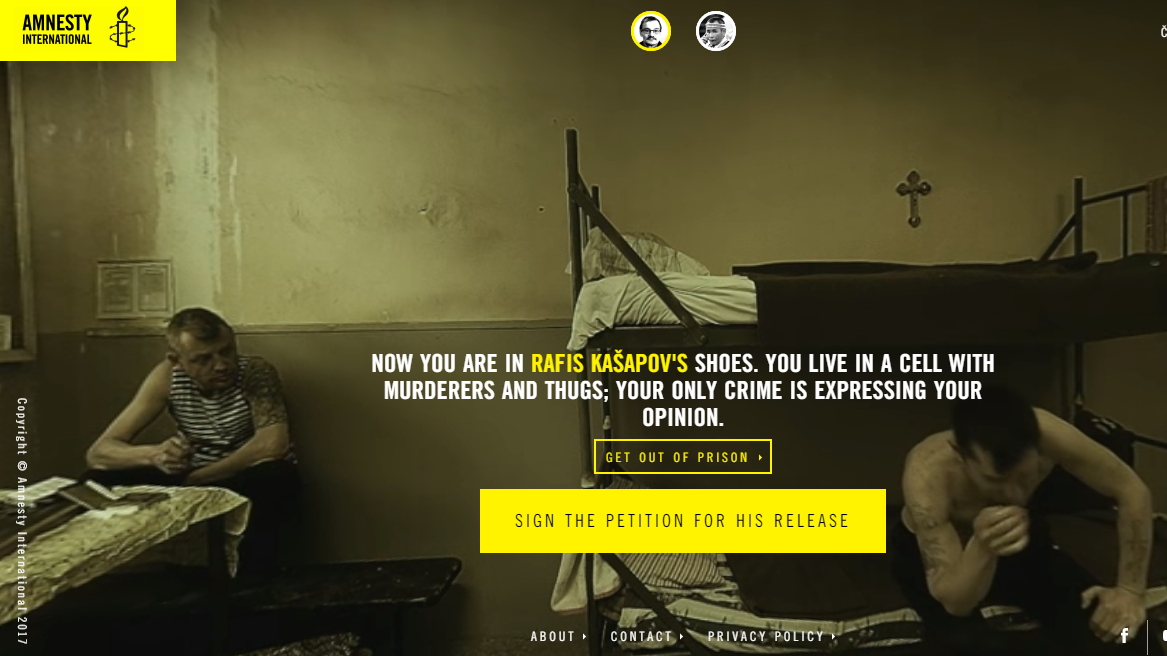
I am sitting in a prison bunk, opposite me, a serial killer. Or a thief. Without experience, you can’t say right away. I hear the sound of heavy drops falling from the ceiling. The camera’s neighbor gets out of bed and says in thieves' jargon, as if turning directly to me: “Well, what are you looking, young? Not so bad here. In the end you will get used to it.” This is all unrealistic, - I think, - I am here by mistake.
Acquaintances from the Russian prison is not so easy
However, it is: this is a 360-degree video- a virtual project created by the human rights organization Amnesty International together with Czech developers. But it is not without similarity to life: to end virtual conclusion and wait for the abolition of the sentence in this unreality is also not easy. By clicking on the "Exiting prison" button, you get the only answer: "To leave the Russian prison is not so easy."
Virtual reality projects (VR) as a format of visual storytelling are increasingly created by world media and developers. For different purposes - foreign media, such as, for example, The New York Times, along with their advertising department, work with the VR format to create immersive multimedia stories , including advertising, and international non -profit organizations to attract attention to global social problems, including violation of human rights.
The Czech Representative Office of Amnesty International its virtual project "Leave the Russian Prison" created in 2016, when Ildar Dadin was imprisoned in the Nevirtual prison
The Czech Representative Office of Amnesty International its virtual project “left the Russian prison” created in 2016, when Ildar Dadin was imprisoned in Russia in the prison. AI presented a project about Russian "prisoners of conscience" once again at the Prague Conference of Virtual Reality.
One of the key problems arising from the creation of such media formats is the conflict of documentary and simulation, objective reality and the directing of the material. According to AI coordinator in the Czech Republic, Martin Balkar , in the Russian Internet, after the publication of Prison Exit, a violent discussion about the location, filming conditions and who played the "cellmates" of Dadina, Daria Polyudova , Rafis Kashapov and Ecosologist Sergei Nikiforov , recognized by Amnesty International, were deployed in the Czech Republic. "Prisoners of conscience":
- We immediately announced that the shooting took place in the Prague Psychiatric Hospital. How can you think that we shot it in a Russian prison - how to get there? But we tried to get closer to reality - one of the actors made tattoos, exactly the same as Russian prisoners have. We were helped to transform some premises in this hospital so that they would look like a prison. We tried to recreate the true atmosphere, reproduce the real situation and try to convey the feelings of Russian prisoners.
- What result do you want to achieve?
Now we are collecting petitions for the liberation of Sergei Nikiforov and Rafis Kashapov
- Virtual reality was needed in order to draw the attention of the new audience - the young generation - to the problem of human rights in Russia. In addition, on the project’s website, we collected signatures under the appeal of the Russian Prosecutor General Chaika demanding to release Ildar. He, like other heroes of this project, are recognized by Amnesty International as prisoners of conscience. I can’t say how much this project contributed to the liberation of Ildar, but it was part of the general world movement of people who fought to be released. Now we are collecting signatures for the liberation of Sergei Nikiforov and Rafis Kashapov. And every six months we intend to change examples for new ones, if there are or will be. But before, Amnesty International should recognize them with “prisoners of conscience,” that is, we must be absolutely sure that these people are fighting for human rights, are not criminals.
- With whom did you communicate in Russia to increase the level of documentary?
- We ourselves watched the video watch on YouTube and talked with the Russians living in Prague. Then we showed him to the wife of Ildar ( Anastasia Zotova. - RS ) and his friends. And after the liberation of Ildar, she came to the Czech Republic, together we rejoiced at his liberation.
Max Vincenz is one of those who were engaged in the technical embodiment of Prison Exit, in particular, the shooting of GoPro, monitors the project statistics and regularly publishes information about signed petitions in the networks.
Over the entire existence of Prison Exit, the number of signatures reached 11 thousand. Despite the fact that these figures talk about the effectiveness of the project, the reaction to its visual component was ambiguous. A critical assessment of the VR Initiative received, for example, from the human rights organization "Rus Sitting". Andrei Barabanov , who spent in prison in the so -called "swamp business" for three years and seven months, says that the video was shot illiterate:
- We disassembled it in Rus, you can’t shoot it like that. I don’t know why they (Amnesty International. - RS) did not consult pre -those who were sitting.
- What mistakes are made?
Yes, a Russian prison is really a hopelessness, but you can save yourself there
- In the project, it was not possible to create the image of the look, who is sitting opposite the newcomer. At first he had to meet, tell the rules of life in the cell, what can be done, which is impossible. In 90% of cases, this is told normally. They must definitely sit behind an arc and drink chiffir. There can be no such attitude as in the video. This look says that he has been there for 15 years. According to Russian realities, a beginner is not put in a cell with a person who has been sitting for 15 years. Apparently, the authors had a desire to demonstrate that the Russian prison was an absolute hopelessness, and not show how to survive in it. They probably prefer the picture than the content, creating an atmosphere of oppression. Yes, this is really hopeless, but everything is not so bad, you can save yourself there.
Martin Balkar agrees with criticism, but at the same time says that AI had no task to tell how to survive in a Russian prison, they wanted to show the conditions under what people who get there for the protection of human rights are found.
- And from the representatives of the Russian government, you did not receive comments?
Every time we tried to agree on a meeting with the Russian ambassador to the Czech Republic, we were denied us
- This is a very important question, because when we send letters to the general prosecutor with signatures, we expect to hear the application, but in this case we did not receive anything in response. Every time we tried to agree on a meeting with the Russian ambassador to the Czech Republic, we were denied us. They said that for such petitions there is a special mailbox. We sent letters to the official address, but still no reaction.
- How else can human rights activists help?
- We must use any technology - virtual reality, augmented reality to help people better understand the problem and attract the attention of a new audience. Today we have released a video with the participation of “Yetyuber” (Czech popular bloggers. - RS) , which affect the opinion of the young generation (video in support of Azerbaijani activists Giyas Ibrahimov and Bayrama Mammadov. - RS) . After a couple of hours, the number of views reached 36 thousand. The PRISON Exit project was the same goal - to convey to the young people what it means to be in prison on charges of exposing their opinion. Bloggers took part in the project for free - we simply explained to them why this is important. And this is courage on their part. But this is a rarity for the Czech Republic.
In 2016, AI created another VR platform-"Fear of Heaven"-about the war in Syria. According to the leading creators of VR projects, virtual reality can help change the human perception of many stories that probably deserve more empathy and involvement.