
Translated material
Met Hamlet - take to the department
In the story with the Arbat boy, many were surprised by the inexplicable cruelty of the police. There is nothing to be surprised - they acted according to the template
Typical case
The boy reads Shakespeare on the street, police officers come up to him, take him, dragging him into the car, the boy yells, the stepmother stands up for him, they push her away - this video has been causing a storm of emotions on the Internet for two weeks.
Now this story is approaching the denouement: the Investigative Committee will check whether there are in the actions of the stepmother of Article 318 of the Criminal Code - “Application of violence in relation to a representative of the authorities” (up to five years), and the police - at the request of the mother of the child - will check whether there are no compositions of Article 151 of the Criminal Code - “The involvement of the minor in the commission of antisocial actions” (up to four years).
This is the logic of the system. The main object of police control in the family is parental responsibility.
If someone thought that something extraordinary happened-it is necessary to drag into the station for reading the Hamlet! - That is not so. We observed a typical practice - this is exactly what the police always do with minors, to whom she herself or surrounding citizens have claims.
If the child does not have documents with him, and next to him there is no adult legally responsible for him, then the delivery to the department is the policeman’s actions template. I saw a beggar either a bully or a lost child - I’m in a car in the car and take it to the department.
What does a woman have to do with it
But he was in the detention of our “reader” and a non -net, namely, participation in his detention of the inspector of the minors (PDN) unit.
The police represents the situation as an accidental one: the patrol rode, saw the child, reacted as expected.
But over the years of observing the work of police officers, I have never seen a patrol in which the PDN inspector would have been present in the usual order. Typically, the inspector works in the department and receives the child from the patrol according to the report for further proceedings. Yes, and the style of the lieutenant woman-office, in heels-indicates that she was in the patrol for a short while.
It seems that it was supposed to deliver the child to the department initially. Therefore, the inspector joined the patrolThis implies me to the idea that the police were originally going to “cut down a wand” - to get a matter of begging. From media reports, we know that the police have already held educational conversations with the boy. I suppose that it was supposed to be taken to the department initially. And so that it does not work out, the inspector joined the patrol.
Time of lawyers
And now a young woman in uniform calmly watches how her colleagues dragging a screaming boy. Does she not know how to handle children? Or is the task of reassuring, not entering her official duties?
Read also Sticks are more important than people, the Russian police do not work for people, but for indicators - the so -called "sticks". Therefore, she closes her eyes on some crimes, while others even factory herself
Here you need to understand how the service itself works.
PD (in Soviet times - the children's room of the police) is in every police department. Usually this is the most cozy space - a berth (sofa or chair) will certainly be equipped here, toys will be placed on the shelves, sometimes all living creatures (hamsters, birds, fish) even live). Inspectors bring food from home not only for themselves - in the refrigerator there is always an extra portion in case they deliver a hungry child.
Employees work as a social service from the Ministry of Internal Affairs - they arrange charitable collections in the department for textbooks and their uniforms, and on New Year's Eve, dressed up by Snow Maiden and dressing their colleagues with grandfathers frosts, deliver gifts to those to whom their parents will not buy them.
Almost all PDN employees are women. Before the reform of 2011, candidates with a pedagogical education were taken here, but it was possible to get a medical education. Then most posts of PDN inspectors were kept due to regional and municipal budgets. There were many inspectors, they were distributed “in the directions”: some oversee schools, others - dysfunctional families.
Today, not teachers, but lawyers are taken to minors' business inspectors. They do not know how to work with childrenSince 2012, all these states have been reduced, and only federal financing has remained. And today the service consists exclusively of the "zonal" inspectors, that is, those who work in all areas immediately in a certain territory. Typically, in large and medium cities, two or three administrative sections are included in the same PDN inspector and, therefore, the same number of district police officers. Those identify dysfunctional adolescents, and PDN works with them and their parents.
Simultaneously, personnel priorities changed in 2012 - now preference is given to specialists with legal education. The young generation of inspectors - legally trained, who could work with documents, but not with children, came to the service. Since it is usually young people who did not have time to get their own children, they have to learn to work with children and adolescents in the place and in the context of those attitudes that the authorities broadcast.
Work for "sticks"
And the installations every year are more and more repressive. If the inspectors were engaged in prevention, they had more time for conversations with “dysfunctional” ones, now there was only the control of violators (the school and social service are simply “dysfunctional” are left behind them).
Read also A policeman is higher than a judge if a criminal case is opened against you in Russia, there is no chance of being justified in court. Why so? Are the organs are not mistaken today?
That is, the main task of inspectors is to fix crimes and offenses and punishment for them. As a result, an important indicator of the efficiency of the PDN employee is the number of developed materials and their effectiveness is the number of administrative protocols and disclosed criminal cases.
Criminal cases, however, falls a little on the share of PD. The inspector helps the investigator collect testimonies, and alone works in fairly obvious property and violent matters - the teenager stole a phone, a bicycle, and he had a fight.
The inspector reports primarily in administrative practice. His work is evaluated by the quantity and quality of protocols about offenses. Just such a protocol is about the “improper performance of parental duties” - and was compiled in relation to the father of the “Arbat Hamlet”.
the police need a child primarily in order to get a case on parentsThe inspector will now have to attach 10-20 sheets of documents to this protocol-reports, witnesses, characteristics from educational institutions, an act of examining family and domestic conditions, medical documents (if any)-and submit all this farm to the commission on minors, where a decision on sanctions will be made-usually this is a small fine-100-500 rubles.
Further, if the citizens of the parents are “not corrected”, the second protocol will be drawn up and a second fine is written out. After three years of intensive control of the family, the commission usually makes a decision on the civil lawsuit of the guardianship authorities to the court to deprive parental rights.
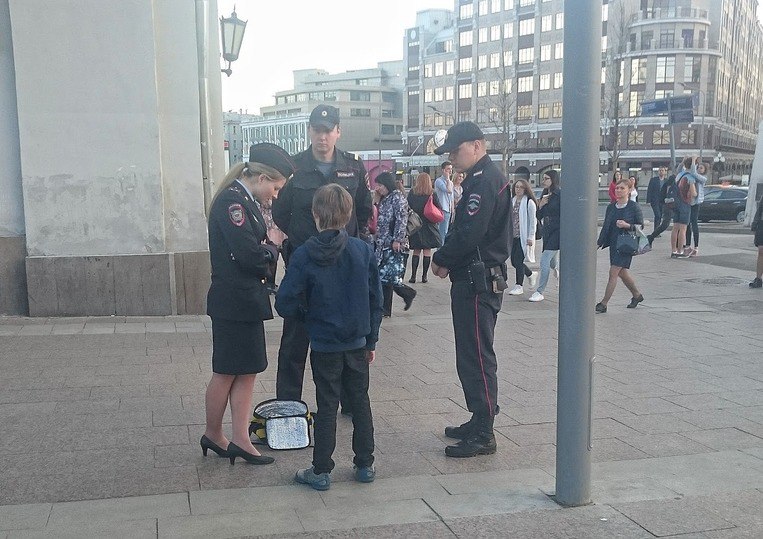 Moscow, May 26. The meeting of Hamlet with the police was unlikely to be random. Inspectors for minors do not go to ordinary patrols - especially in heels photos: provided by an eyewitness
In the case of our “reader”, it is obvious that the interest in the child, with whom, according to his father, several times the police conducted preventive conversations, was to issue either an administrative protocol, or if the materials gather successfully, a criminal case. And earn a “stick” in the reporting.
Work on paper
What else is required of PD inspectors, except for "sticks"? Like all other police officers, they require a bunch of papers - magazines, cases and cards. According to the inspectors themselves, at least half of their working time is spent on filling out the papers.
An employee of the service not only reports to the work report, he also invests or enters into certain affairs and file cabinets all the information about the actions done during the day. That is, any of his conversations with a teenager or a visit to the family is reflected in at least two documents - a report and a magazine, or a case, or a card.
A detailed file cabinet is maintained for objects of accounting (for each educational institution in the territory, for each family or teenager registered) and for types of activities: for example, there are journals of preventive conversations, raids, drawn up administrative protocols, a journal of refusal to initiate a criminal case, a journal of work with children's camps, a journal of sent orders and appeals, etc. According to this documentation. inspectors.
The frequency of raids and bypasses, preventive conversations, inspections and other things were set by the inspector normatively. For example, each family with adverse conditions for children must be checked monthly. However, if the family has very young children, inspectors do this significantly more often-two to three times a week to make sure that there is food in the house, and children are careful.
It is obvious that the final load depends on how much the inspector of subsidiary adolescents and families have. Depending on the share of minors in the population, the structure of employment, the quantity and quality of schools per one PDN inspector may account for 25 to 60 cousin adolescents and five to 20 families.
Inspector with a human face
Despite the repressive attitudes and meaningless paperwork, the PDN service benefits people.
The inspector plays a key role when the authorities decide on the fate of a particular child and a specific family (often dysfunctional, prone to asocial actions). He enters the commission on minors, without it, not a single departure to the raid of representatives of social services is impossible.
This is literally like this: observing more than once raids on the “horsemen”, I saw that representatives of guardianship or administration are simply afraid to go into the house without a police officer. A person in uniform, even a fragile girl, is perceived as protection, a guarantee of legitimacy.
The humanization of the police could begin from here. inspectors must be removed from the "stick" systemThe PDN inspector informally plays the role of a consultant for those families who cannot afford to spend money on a lawyer or psychologist.
If a humanization of the police will ever occur in Russia, then it could begin with PDN. If only because, unlike other police officers, PDN inspectors often deal not with offenders, but with ordinary citizens (for example, when registering guardianship).
First of all, PDs should stop being only a tool for punishment. It does not make families, which are in a difficult situation, prosperous. It is important to give the inspector the opportunity to decide for himself where to show severity, and where is soft. But for this, it is necessary to withdraw PD inspectors from the "stick" system - they should not be reported to the protocols about violations.
Well, of course, you should change the personnel strategy - the sensible inspector of PDN should be primarily a teacher. Knowledge of the intricacies of criminal and administrative law here is secondary.
Teenagers Police