
Translated material
Machine training

Study
" Life on the air "
Machine learning, big data and artificial intelligence - all these topics are in hearing. However, few people think about the controversial consequences of technologies outside marketing strategies. We already tried to figure out what machine creativity is, and talked about the main problems of the data collection era . Now we will try to figure out what machine learning is, how a technique will replace a person with most types of work - and why a new order can be a real anti -utopia.
I data collection
Data collection is rightly called online setting. “Google”, “Facebook”, “VKontakte” and many other services continuously build users profiles from information that they leave on the pages - public, private and even unpublished ( Facebook conducted studies that users most often want to write but washed without sending). This, of course, not only bothers ordinary users and human rights groups, but attracts the attention of legislators. Each click, commentary, like, watching a video and the time that you spent on reading a post in your tape without even clicking and without leaving a husky - everything will be recorded, analyzed and composed in a voluminous and detailed portrait, which will then be used to create targeted advertising. To illustrate this principle, the expansion of Dataselfie has been developed, which helps to visualize the data sent by users to Facebook. If one simple expansion is able to predict your religion, age and sexual orientation, imagine what the full -time Facebook and VKontakte programmers are capable of.
One of the consequences of deep personalization of the search was the formation of the so -called “filter bubble bubble” around the user. The history of your search queries, views of specific pages and even their parts affect the fact that the search engine will show you the next time and that it will recommend: you are surrounded by the content of a certain topic - which you like more likely will like it. Real Life Magazine describes a curious incident : the author watched the “Utube” video from the game Dota 2, and the next day the whole main page was in the recommendations of alte-rais racists (and sometimes frank neo-nazi). This obvious error in the classification of interests is a good example of how filters work in such advisory systems. Trying to increase the time that the user spends on the site, he is “fed” what he likes or may like, fingering from a wider range of opinions in a cozy bubble. Studies show that the path from the well -known Yetubers to the conspiracy therologist Alex Jones is not as long as it seems: as the user's interests are clarified by the Utuub recommendation, they can lead the right -wing fire to the increasingly radical fire.
Data collection can also be used in spheres that are far from marketing. In China, the idea came up to introduce in the future a universal rating of the Blessedness of citizens based on their shopping history, comments on the Internet, friends of friends, and so on. And in Japan half a year ago, one of the largest Japanese insurance companies concluded a contract with the IBM for the supply of Watson system , which can very quickly track all the personal data of the client, evaluate risks and form a interest rate - which means that it will subsequently replace a large part of the current insurance workers.II what is machine learning
Machine training is an attempt by a machine to find a pattern between a set of certain properties and a given correct answer. The machine is considered “trained” when it removes the pattern from this set of objects and properties. This pattern is called a model, and the output process itself is the modeling of the model. The result of the model with data directly depends on the set of data that the person “fed” the model during training. It is quite difficult to adjust such a model in the future: this process is associated with a long and costly retraining of data.
This follows several conclusions. Firstly, machine learning very poorly predicts or classifies what goes beyond the model. The standard practice in the industry is to throw out “Autsiders examples” already at the training stage: if you need to predict a run of five kilometers by age and favorite color, you will have to reject world champions and lovers of super-led colors-because to establish communication the sample will be too small. Secondly, if the training sample contains certain prejudices, they, of course, will directly affect the model. Say, if according to the sample, people of a certain social status, or a certain nationality, or sex on average, pay loans worse or study worse, then their chances of getting a loan or scholarship will be reduced only because they are part of a certain group. The worst thing is that even if the law is prohibited by discrimination on certain signs-gender, religion or sexual orientation, the system can use the so-called proxy (favorite color, favorite holiday or viewing all seasons of the “choir”), which, although not directly, with a high degree of probability, indicate the “same” signs.
III machine discrimination
Uber is surrounded by scandals from the very foundation, and more recently, another erupted: in some cities of the United States, Uber was noticed in discriminatory pricing policy , when the same routes may be more expensive on the basis of an analysis of the client’s payment. You leave the bar at two in the morning, order a taxi and, as usual, you get the full price before the trip - but it does not depend on the number of kilometers, but on the area in which you live, and your predisposition to spend more money in the tip of your back (established on the basis of your purchases). Considering that Uber has a huge amount of information about its customers and even knows if you are going back from a date for one night , the company may well afford to squeeze out all existing money from the client with a certain degree of accuracy.
An obvious example of the bias of computer algorithms is racism built into them, especially in the USA. The publication of Propublica describes several similar cases when the black defendants received higher grades when predicting relapses of violent crimes: an eighteen -year -old black girl with four minimal disorders received an assessment of “eight”, and a forty -year -old white man who was seized over two armed robberies and one attempt robberies, turned out to be less dangerous for the society with the evaluation of "three". The manufacturer of the risk assessment system, the NorthPointe company uses one hundred and thirty -seven questions for analysis, the answers to which for the most part can be found in the accused case - but he must answer some himself, including: "Were your parents in prison?" And "Do you use drugs?" Obviously, many of these issues are closely related to the socio-economic status of the suspect and will lead to poor results for the poor and color. The United States is generally known to racism, including the judicial system: black, as a rule, receive more severe sentences than white. There is no doubt that the computer model will make decisions that correspond to inequality dominant in society. The machine cannot magically calculate and independently cancel prejudices in the decision -making system. “Garbage at the entrance is the garbage at the exit,” the graduates of the faculty of computer sciences like to repeat, and here this saying is more applicable than ever. In addition, the use of machine risk assessment systems erodes collective responsibility for such manifestations of racism.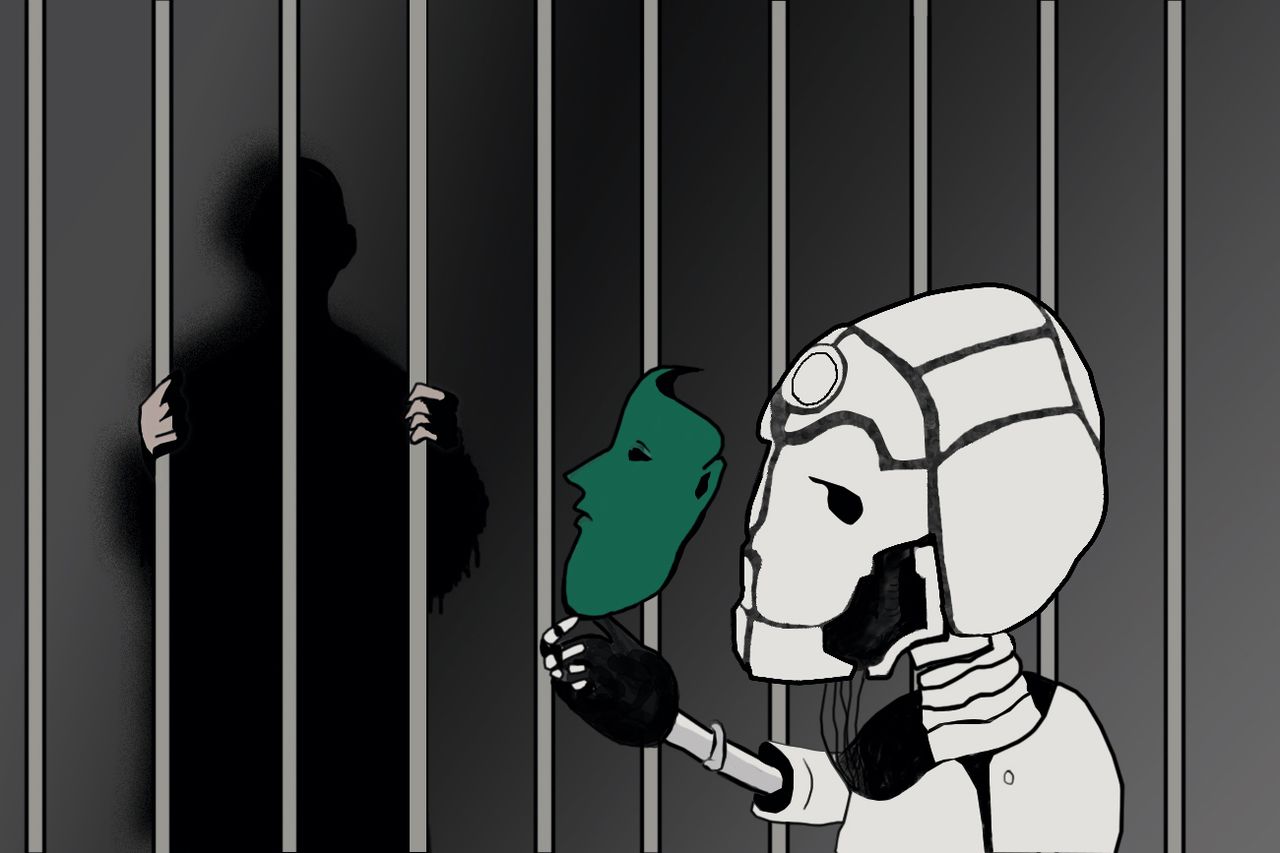
IV responsibility
In the USA, in some municipalities, an analysis of the address address of the outfit is used to determine the level of threat to the life of the police - and special forces can come to the scene about a complaint about loud music, and not an ordinary patrol, to knock out the door and shoot the dog simply because the system mistakenly gave out a red level of danger instead of green or yellow. Companies that provide risk assessment systems do not come in contact with activists who call for the opening of the code and more responsibility for false works . Eric Lumis, sentenced to six years in prison and five years of the probationary period, could not protest the assessment of the Compass system, which appreciated it as a dangerous criminal, since he did not know the algorithm that is the intellectual property of the company and protected by the patent. It is important not so much the danger of Lumis personally: the principle of judicial work itself is undermined, when it is impossible to dispute in principle unknown which and it is incomprehensible as the received arguments of the prosecution. Such unreliable risk assessment systems are also used in the courts of some states to determine the danger to the company of specific persons. Independent studies show their absolute incompetence and addiction. The US Department of Justice also expressed concern, but they have not yet been conducted their own studies.
Russian technological companies have not yet reached the courts. Private surveillance of citizens to collect data, which will then be used for analysis, begins with motorists. The Benish GPS company offers insurers and their customers to share information about the location and style of driving in order to reduce insurance payments. There were also projects to use the data of Internet accounters for calculating the credit rating. Be careful, perhaps you are now on the site for poor people - and you can’t see the loan.
The famous Stanford prison experiment showed that many people are ready to go to terrible things if they can transfer responsibility for their actions to the boss. In the marvelous new world, the role of “bearing responsibility” can be played by cars. People are already very inclined to rely on technology (and use it as an excuse - recall the well -known sketch of Little Britain “ The Computer Says ”, where the lazy nurse refuses to patients under far -fetched pretext). The use of machine learning can remove responsibility from an individual contractor who could enter the position of a person asking for a loan or scholarship. At the same time, companies providing machine learning systems also do not bear any responsibility: there is neither public access to the code or the training data of the model: we can neither find out the principle of the system, nor correct its shortcomings, which means we cannot question its solution.
An irresponsible attitude to evaluating systems and their uncontrolled distribution can only contribute to a decrease in social mobility and tightening prejudices existing in society, if companies that create systems will not actively deal with bias within themselves. But there is little hopes for this:
The choice between justice and earnings has never been the subject of disagreements for corporations.“In some situations, business can afford actions that would be illegal if the responsibility to them had not been transferred from people to“ algorithms ”. Moreover, the data on the basis of which this discrimination occurs, people give voluntarily, just to avoid it. This [consent to obtaining and processing data] is called “providing the best conditions for certain categories of customers”. The seller does not have the right to refuse the buyer in a product or service-this contradicts the laws on trade in most countries, and “Antifrod-system can,” comments Alex Smirnov, an information security expert.
At the beginning of 2017, the American Civil Freedoms Union (ACLU) published a analysis of the case to reduce medical payments on state insurance in Idakho. The limit of insurance payments for disabled people is reviewed once a year, and many who received a thirty percent decrease in the amount of insurance coating turned to ACLU for explanations. It turned out that a table in Excel was used to calculate insurance. The company refused to explain the principle of operation of this algorithm, referring to a commercial secret. In the end, the court ruled that the principle of work should be open, after which ACLU spent $ 50,000 on the study of the formula and came to disappointing conclusions.
Eric Epnik, Law Director of ACLU in Aidaho: “Everything went wrong there. Firstly, the data for the formula were damaged. They used historical data to predict the future, but two-thirds of the records had to be thrown out at the preparation stage due to data processing errors. So they tried to predict the needs of the population according to erroneous historical records - and then by a small part. And in bad data - a bad result. Secondly, testing of the state itself discovered problems: different results in different parts of the state, which could not be explained. And thirdly, our experts found fundamental statistical errors in the structure of the formula itself. ”
The Appnics asked how it turned out that Medicaid continued to use the program, despite the fact that it was completely irrational. “I don’t think they themselves knew how bad everything was. All people have this prejudice about computer answers: we have no doubt in them. This is cultural, maybe even biological: when the computer gives out something or when the statistics look at the data and invents the formula, we tend to trust this formula without asking how it actually works. I think the state was a victim of this satisfaction with computer solutions. In addition, I do not think that someone inside Medicaid knew how it works at all. When we asked each participant in the program to explain how the formula worked and how the grades were received, everyone nodded at each other: “I don’t know, but this one knows.” In the end, it turned out that we were walking in a circle. The problem was that no one understood the whole process entirely, but everyone suggested that someone else knew how the process was working. ”
The studies themselves are expensive, and Aclu believes that companies will not bear costs to check their models at their own free will, if no one will force them to do this in court, as it came out in Aydakho. ACLU continues to fight, but the industry as a whole has long been known for its irresponsibility, and almost all the licenses for the software begin with the words “provided as it is”, and the phrase “liability is not carried” is repeated two hundred times.
V unemployment
The introduction of machine learning will be increasingly influencing the labor market: both qualified and unskilled . Yes, the machine can completely replace a person. Say, the cashier, as shown in Amazon Go: the user simply takes products from the shelf and leaves the store, and the money is written off automatically. Another interesting example is autonomous cars. One of the ultimate goals of Uzura, which the company has announced for a long time and openly is to replace all drivers with its own park of autonomous cars. Not only low -paid work will be automated (Obama in an economic report to Congress in 2016 stated that those who earn less than $ 20 per hour have a chance to be 83 % replaced by a computer ). Employees of hedge funds with salaries of 300,000 dollars per year will also be automated . Many millions of people will lose their jobs (only in the USA - three and a half million drivers), creating a new class of “useless” - as Juval Harari writes in his book “Sapiens: a Brief History of Humanity” - people. Even in contrast to the suffering, but sometimes working Precariat , this class, in principle, will not be able to find any work and will be forced to rely on the help of the state. At the same time, a gradual deterioration in the position of the lower layers of society will take place: first the transition to Gig-economics (according to the principle of uber, Airbnb, Taskrabbit and other companies that allegedly work with partners to avoid taxes and payments for real employees) with the loss of rights and privileges of hired workers-and then completely dropping out of it with further automation.
The specifics of training in machine learning models at the moment creates new jobs not only for engineers, but also for low -paid interchangeable temporary workers: Wired recently wrote about the unbearable working conditions of Google , evaluating content on YouTube. However, appraisers will only be needed until the moment when the data is accumulated enough so that the machine can automatically sort content. After that, a very small number of qualified engineers will serve it, and the appraisers will be dismissed.
The mass loss of work is not even in production, but in the service sector obviously creates problems for the capitalist system, economists of various schools say . Согласно данным Банка Англии, в течение следующих десяти-двадцати лет будут автоматизированы восемьдесят миллионов американских и шестнадцать миллионов британских рабочих мест — а это половина всех рабочих мест обеих стран. Неизбежно усилится социальное расслоение, увеличится разница в доходах между богатыми и бедными и понизится социальная мобильность. Многие экономисты, философы и социологи пытаются представить будущее без работы ; пока не ясно, как изменятся общественные отношения и общественное сознание, поскольку для многих работа всё ещё является основой самоидентификации и самореализации, а также основой экономического устройства общества. Психология и гигиена соцсетей Александра Баева , Ольга Аверинова Психолог о том, почему не нужно бояться соцсетей и как мемы помогают повысить социальный статус и найти полового партнёра