
Translated material
"Alexander Nikolaevich suggested cut this scene"
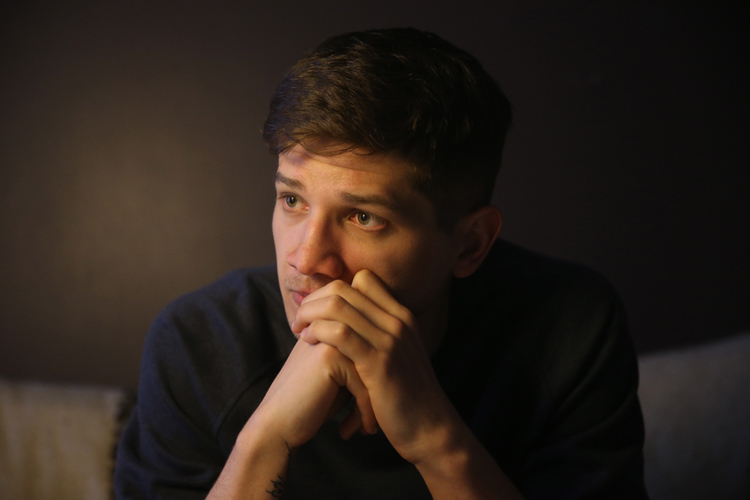
A few days ago, at the Kinotavr festival, the show “Testamus” was held - a small sensation of the Cannes festival (the film received a prize of Fipes) and a big discovery for Russian cinema. The director of the “tightness” Kantemir Balagov is one of the students of the only set of Sokurov’s workshop in Nalchik, and his full -length debut is actually the main film of the year (more about “crowding” can be read in our report from the festival ). Vasily Koretsky talked with Balangov about frosts in the North Caucasus, strong women and existentialism.
- Could this story happen in today's Nalchik? In general, how much circumstances of the place and time determine the plot of this drama?
- Yes, it could happen in today's Nalchik. But the motives would be somewhat different. Now all this could be hidden under the history of blood feud, for example. But in the 90s of the abductions of people were a business, a way of earning.
-And the sociocultural situation described in the film is the relationship between the diasporas, the state of the collapse of certain archaic connections ... has something changed over the years?
- The region is in a state of stagnation. I don’t even know where all this can move - but now all this is in a frozen state. That is, this story reflects all the contradictions today. But, as I said, the nuances of motives can be different.
- What is just such an ethnic alignment in the character system? We see in the film Jews, Kabardians, Russian ... Could they change places, say, the main character - to become a Balkark?
- The characters of the heroes are completely dictated by nationality: each nation has its own psychophysics, its own mentality. Jewish Ila - dynamics and freedom. Her boyfriend, Kabardian, is calm and humility. Unlike it, he cannot overcome the regional, national framework, he will not sacrifice everything for her. And Ila is capable of this, and at the end of the film she understands that in the first place for him is not her at all.
“But your heroine goes beyond her national gabitus: she doesn’t behave the way her relatives want, not as it is customary in the community.”
- And this is a change of generations. For example, now the Kabardian children have a legacy of traditions-but they are not that they blindly follow them. And the older generation builds these traditions to the cult.
- I noticed that in almost all the works of your fellow students in Sokurov’s workshop, the main character is a woman. Even so: a strong woman who wants to leave, who is cramped by the scope of the decorative tradition.
- Yes, I noticed this too (laughs) . It seems to me (I have repeatedly said this in an interview) that a woman is a hero of our time. Because in the nature of a man - to act, but when a woman begins to act, it is unusual, it is interesting to observe in cinema. Still, a man has the ability to adapt to some kind of framework, regional or religious features. And a woman in my understanding is still freedom, this is life. And when they try to framed it, she either resists, or humbles it. But such humility is fraught with explosion, disaster.
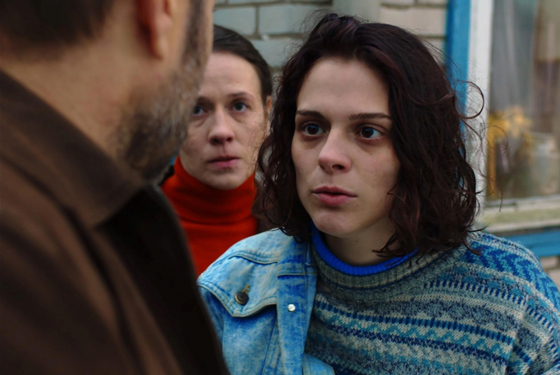 © "Example of intonation" Frame from the movie "Testamus"
- Are you talking about a woman in general or a woman in the culture of the North Caucasus?
- In the Caucasus.
-“tightness” is shown in sufficient detail by the total decay of society: not only the connections between social groups, but also the community, even the family institution does not withstand the tests of wild capitalism of the 98th year. Do you think this decomposition of old communities is a natural process that goes everywhere in the modern world? Or is it the result of the local circumstances of that era?
-I think that this breakdown is a consequence of the situation of the 90s. Because back in the 70s-80s-well, they told me so-there was nothing like this in interethnic relations in the Caucasus and in relation to the Caucasus. The central part of Russia did not ignore the Caucasus and treated the Caucasians not as a “black -skinned”, but as people from the “Solar Caucasus”, roughly speaking. And then something staggered. For now, to be honest, I haven’t thought about it so deeply, but I have an acute feeling that everything is going in the wrong direction now. As before, it will never be. But maybe this is good.
- What determined the degree of frankness of the view of the camera during the filming of scenes of sex, violence or conflict? Family quarrels are shot in large, in the frame - only faces, shoulders. And you shoot the scene with the heroine of virginity from afar, in fact, in porridge, partially cluturing the frame with some boxes. Even from the notorious “Chechen video” you choose general plans in a terrible VH quality.
-When I groped out my handwriting, some kind of vision, I was very helped by the lectures of Alexander Nikolaevich, in which he taught us that the tragedy is always static. If you remove the tragic scene on the general plan and the camera refers to what is happening absolutely indifferently, you will get a very strong dramatic effect. That is why the scene of sex shoots like that - it is not riveted, shot on the general plan, static. Only in this way can we project what is happening to our real experience: if we are witnesses of any tragedy, we always see it on the general plan. If we see it on a large one, we just die (laughs) -well, or there will be some other effect-but not a presence.
“But you have a scene shot in a completely different register - an episode of a frenzied heroine dance at a disco.” There is just the effect of approaching!
- And then I walked just from the opposite. I took a dance scene in the “satanic tango” Beli Tarra, there is literally a few seconds of a close -up man who makes strange movements and shouts: “Tango! Tango!" This scene hooked me so much that I also decided to show the heroine overflow through a similar psychophysics.
- It seems to me that this episode should not like Alexander Nikolaevich - this is the same “tactile” movie, which, according to him, is worse than the atomic bomb.
- Yes, Alexander Nikolaevich suggested cutting this scene. But I insisted.
-I know that you entered Sokurov immediately at the third year, and before that you studied at the accountant at the Academy of the Ministry of Internal Affairs and shot something at the same time ...
-Yes, the web series is five-minute. They limped in terms of acting, in terms of directing ... Yes, in terms of everything. I shot ten episodes and sent Sokurov. This helped me to do, but then I deleted everything, it was a little ashamed of them.
- How much is your directorial optics formed by your direct life experience, naked, so to speak, with a look, and how much is the experience of the moviegoer?
- Well, these two experience are fraught, especially since I am only 25 years old and my direct life experience is not so rich. But experience and optics can be taken not only from cinema, but also from literature. Well, if we talk about cinema, then for me the “fists in the pockets” of Bellockko, “Mushett” Bresson, Rosette, “Cranes are flying” are important - all the films that are focused on a person and human problems.
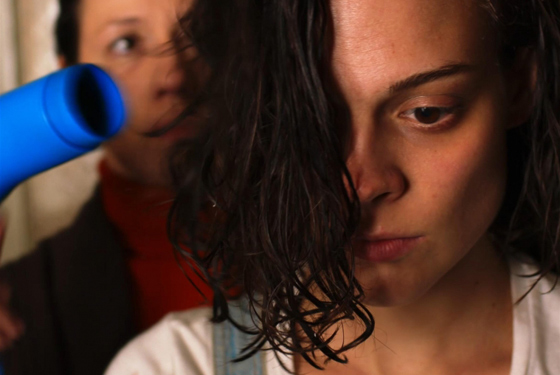 © "Example of intonation" Frame from the movie "Testamus"
- I wonder how you would approach the visualization of the literary text ...
- For me, any metaphor, any poetic image should have a real basis, because everything that surrounds us is reality. And severe poetic dissonance can only be built on the basis of reality. For example, Parajanov is not at all close to me - his poetic images do not affect me: I understand that this is all fiction. But if poetic images are created - like Tarkovsky, Sokurov, Tarra - from things that really surround us, but served as so, what we have never seen them - this is very strong.
-Tell us a little about the reconstruction of the household environment of the 90s.
- We tried to be extremely accurate - we even consulted with the dentists: after all, we have one of the actresses, and we found out whether such braces could be in 1998. We shot nature near St. Petersburg, in Surand, we found a house with an interesting layout, and I decided not to change anything in it, with the exception of some color details-wallpaper, curtains. Because the house was already inhabited, everything stood where it should stand, and no artist could do better. And we did field shootings already in Nalchik, a small group.
- In the film there are only four musical compositions - Kabardian folk music, “do not cry” Tatyana Bulanova, “Jerusalem” Timur Mutsuraev and the Virus group. Why these are these?
- This is the music of my childhood, my nostalgia, a memory, to which I sometimes return. But, of course, these songs are associated with drama, their text characterizes the state of the heroes. And I immediately knew that the Mutsuraev would sound in the film - and specifically this song, Jerusalem, is also important that it seems to me foreshadowing the emergence of the “Islamic state” (the organization is prohibited in the Russian Federation. - Ed. ).
-At a press conference, you said that the dramatic tension in the “cramped” is created by a series of “wrong moral elections” of heroes. But is it possible at all the right choice in such an extreme situation?
- For me, the right option for choosing is the one that is predicted by moral principles. For example, we can assume that a person will sacrifice himself for the sake of a loved one. But we raised the question differently: how humanely to demand self-sacrifice from our child? In general, I tried to make my characters polyphonic, because a person is not an absolute, it is not black and white, it consists completely of shades. These halftones are very difficult to achieve, it is very difficult to catch the transition from one layer to another. And I am interested in this particular arrhythmia of the character - what is the point of looking at a hero who behaves the same as we? I am interested when the hero goes against moral principles, and as a director I manage to justify his choice. Only then is an interesting artistic result.
- And how do you work with the actor, how do you achieve such a flicker of the character of the hero?
- Depends on the scene. If I need ambiguous behavior in the scene, I try to work with the actress so that she will do it organically in front of the camera. But I do not deny improvisation. Moreover, if the actor will do everything that I say, he may just be bored. He must be an artist, not the performer of my wishes. That is, we carefully rehearsed complex scenes-but in order for the actor to look on the site, but add something of his own. From the actor I want an experience. The cinema should have tactfulness, it should want to touch it. The same in the game-the actor should be so tactful that it is humanly convincing. Now in the cinema there is a little lack of humanity. Not in terms of stories, but in terms of their residence. I’m watching Russian films-there is some completely distant attitude of the actor!
- The film is divided into two parts - the main one, the action of which takes place on the cramped streets and in the houses of Nalchik, and the field, as if an epilog in which the heroes leave the city and travel along the mountain road to Voronezh. Surprisingly, both parts look filmed in one register, no way to the will in nature seems to happen ...
- Yes, exactly. Here, claustrophobia is created already at the expense of the mountains, fog. I wanted the viewer to have a feeling: now, outside the city, in nature, he will receive a sip of air. But no, nature also has its own tightness.