
Translated material
"Kinotavr-2017": Prorubono!
For technical reasons (shows of the first three and, apparently, the best films of the competition ended only in the evening before the weekend), we release the first text about the Kinotavre only today. Meanwhile, the news, while only good ones - after last year’s fall into the hole of the body format, Russian cinema returned to the form. Sudden-nizcobyget, evil, independent (9 out of 14 films of the program were shot without a state participation), it somehow grows-maybe, and not always in that direction. At the same time, it would be incorrect to talk about some exclusively repressive role of the state: at least three important paintings of this year-“blockbuster”, “arrhythmia”, “cramped” -were shot with the participation of the Film, the Ministry of Culture and the St. Petersburg Culture Committee, respectively. But the ideological pressure on the film process, of course, is felt by all its participants.
Anger and irritation from this press, melted into an indispensable ironic-e-scotch uniform (characteristic author’s handwriting of Alexei Agranovich, the constant director of the opening ceremony of the Kinotavra), are also present in the fabric of the festival. The depressed tension is also felt in the completely viscontievsky, as if for the last time played out, the scenes of the life of a hemisphere in the restaurants on the embankment, and in the duel of applause at the opening: a universal applause, which was accompanied by the appearance of Daniil Dondurey, which condemns censorship and especially self -bloodstream, against reflexive. applause at the mention of the name of Vladimir Medinsky, this censorship in one way or another introducing.
In general, the economical and concise scenography of the opening performance hid a powerful and accurate message in itself. We ran into censorship twice (the second-the text of Brodsky, read out by the chairman of the jury Evgeny Mironov), and the comic duet of the leaders, Peter Fedorov and Rinal Mukhametov, who depicted the analyst and the patient, quite accurately summarized the anamnesis of Russian cinema with his eternal self-true conversations of the box office and the unauthorized outfit complex-an inconspicuous desire-an incomprehensible desire “To be like a dad” (Soviet cinema). In smart magazines, the pages of the transcripts usually go to this-and Agranovich met a 15-minute sketch. At the same time, the ceremony, as expected by the protocol, included official speeches of officials, unsteady readings on the piece of the Epistle of even more higher persons. The conflict between these two elements, alive and dead, could have seemed to be a non -essential, purely stylistic consequence of a performative compromise in the spirit of the late USSR with its everything that understands the community of “its own” and ritual, for the promotion, muttering of sacred Leninist texts. But the impending danger of a new, five millionth, price of a rental certificate-and “rolling” is understood by all participants in the Russian film process as a form of not very hidden cinema cinema content-makes all the contradictions between creative forces and production and loud relations extremely pronounced, aggravated to dramatic resolution. In this sense, the ceremonial performance of the Kinotavr looked completely Brecht's “didactic production”, which enhances irritation, and does not remove it.
 © "Volga" Frame from the film "Blockbuster"
However, the film process is impossible without such conflicts of opinions and interests - and the place of the Ministry of Culture can easily occupy an ordinary producer. This happened, for example, with the first film of the competitive program - “Blockbuster” by Roman Volobuev; The director flew to Sochi only to officially announce the removal of his name from the titers of the film. Safeed by the producer for 15 minutes, this brilliant comedy of allusions and situations has not become less ridiculous or less beautiful, but now its beauty is the beauty of an ancient statue, which has been repelled not only by the head, but also to the wings. The bills were destroyed in the “blockbuster”, so to speak, a metaphysical, mystical dimension, the figure of the author with his mania and fixations. The film sounds a joke: "Everyone gets not what they deserve, but what looks like." Well, you want to be like an “Indivud” - get your Harvey Weinstein. However, even flattened, the blockbuster is much more meaningful than the “Cold Front” and can be considered a great success - rather, Russian cinema in general than a specific director or producer. We will write more about the Blockbuster case in the following reports - there is a suspicion that the appearance of this picture in its initial multidimensionality of the directorial version is symptomatic, and not by chance.
Another great luck of the Sochi contest is the “tightness” of the Sokurovsky student Kantemir Balagov , just from Cannes. The film makes an extremely strange, but strong impression. It was removed as if with a demonstrative contempt for the rules of good tone-monstrous, in the spirit of the provincial TV of the 90s, credits and a screensaver, an anachronically sharp digital picture, also producing the impression of a television, a sound like from a steel barrel, a narrow-screen “academic” format 4: 3. All this, however, in the course of the film merges into an amazing unity with the story: “crowding” is a rare case in Russian cinema when the director’s expressive funds are completely congenial to his message. Balagov tells (literally: the narrative begins after the title on behalf of the director) the story that happened in his native Nalchik in 1998: in the evening after the engagement, a boy and a girl from the Jewish community of the city were stolen by Kabardins for the sake of ransom. The community could not collect a sufficient amount, and the parents had to sell their business at half the price - their own. However, these action -packed circumstances only draw up another plot line - not criminal, but the drama of growing up the main character, the self -sister of the abducted silt. The garbage lo- fi aesthetics of the film, deliberate, emphasizing the provincial wretchedness of the surrounding Il, enters into a crushing resonance with existential circumstances and the general atmosphere of decay- country, ethnic communities, nuclear family. The new world of wild, barbaric capitalism corrupts the decorative frame of traditions, exposing the only real reality - money, war of all against all. The real war is going very close, in Chechnya, at some point the heroes-Russian, Kabardians, Jewish-are looking at the Chechen Snuff video, recording the execution of prisoners of Russian soldiers.
 © "Example of intonation" Frame from the movie "Testamus"
A strong heroine (fixation on powerful female characters, striving to break out of the viscous swamp of obsolete orders and conventions, a common feature of the work of Sokurovsky students from Nalchik) rapidly grows in the mode of almost real time. In a few days, a family, a community and a forbidden connection with a Kabardian, a tall loan become a cramped consistent. Children grow up and, in the best case, adopt their parents - this universal plot scheme of “tightness” in terms of influence exceeds even all the local features of the Caucasian life, presented on the screen with unobtrusive convincing. In general, Balagov is very cleverly controlled with severe artillery of existentialism, presenting the most cruel scenes with the detachment of the Haneke, cluttering the frame with all kinds of rubbish or showing violence (physical or emotional) either in general plans, or in super -circular portraits of persons distorted by emotions. But the poor is replaced by evil, Bulanova - Chechen videos, Timur Mutsuraev - the Virus group, and now Ila dancing frantically at a terrible disco (a police flasher replaces the strobe), turning into a figure from Philip Granrieo films, a pure affect smeared on the screen. In the context of a protracted search for reality, the Russian directors of “crowding” look at all a breakthrough - the reality of the distant era and the Caucasian nature almost unprecedented in our cinema is extremely tangible, material, compressing not only the heart of the heroine, but also the head of the viewer.
 © Experimental cinema league from the movie "Lestrass"
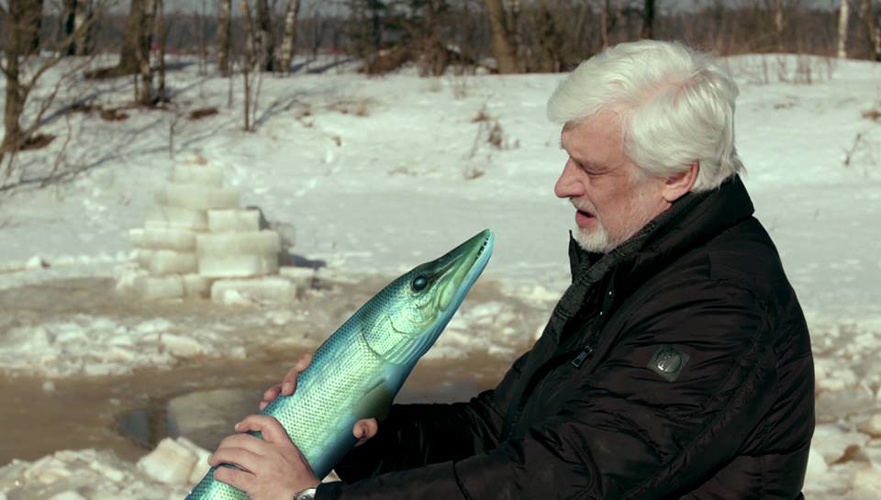
A completely different measurement of Russian life, not the physical, but the etheric, shaking of television virtuality, is devoted to the “crowded” “Lazebar” by Andrei Silvestrov, the film version of his play based on the play by Rodionov and Trepolskaya, which was staged in the Meyerhold center back in 2016. However, the relationship between the performance and the film is limited by the text of the play: by moving to another media, Sylvesters use its capabilities and features as much as possible. Baring from the television programs of another, almost Sorokinskaya, Russia, in which the baptismal dives into the hole became new on May 9, the Russian language mutated into a poetic language, and the president caught a speaking pike, the “hole” into the cinema turns into something more than a collection of cheerful stories. Firstly, of course, due to the greater scale and presence of special effects (pike generated on a computer, underwater shooting, Ivan Tourist, director Zinchenko and artist Shaburov in the episodic roles of a vehicle). Secondly-and this is the main thing-the plot about the TV now includes a reality lying (literally) on the other side of the screen; This second dimension lifts the “hole” to the infernal height, equal to Zvyagintsev with the “dislike” of Zvyagintsev. But the "hole" is undoubtedly more interesting. While cynical critics are joking that it would be nice to wait for the comedy Zvyagintsev, Sylvestrov has actually shot such a movie (it is funny that both films showed at the festival one day). The parallels with the “dislike” are simply amazing here: all the heroes of the “hole”, from the president to the alcoholic-freelance, crave one-love. They are looking for her in a shame, black water wormwood - and did the boy Alyosha Sleptsov, who had disappeared from Zvyagintsev, who was missing at Zvyagintsev, was coding into her? The bifurcation of modern reality, quite clearly read by Zvyagintsev, is a hysterical, super -intent life of images and fictions on the body of vs. Apatic vegetation of spectators, which was repressed, acquires extremely grotesque forms in Sylvestrova’s film. The action of the play takes place in the measurement of the media, on the screen of TV. But in the film version we see the audience intended for these news and talk shows: some mamleevsky silent connecting rods with heavy deep-sea plastics, taken in completely Kricanovskaya-there are even allusions for European painting-the manner. If you do not know that both films starred in parallel, you can consider these interludes a very accurate parody of Zvyagintsev. All the sympathetic misanthropy, for the sake of which Zvyagintsy, erects the hours of action -packed drama, kills women and children and juggles with quotes from Western European painting and the most ordinary plot templates (two paintings with exactly the same scheme are already shown in the Kinotavrovsky program - Anton Sazanov and “close” Ksenia. Zueva), here is achieved by one simple technical kunshtuk, a slight slowdown in the shooting that gives a persistent Uncanny effect. The bodies of the most ordinary old people, children, men and women are poured with tectonics, faces are stretched into the grimace of zombies ... On the big screen, an ordinary sausage, measuringly swaying in the hand of the grandmother who was grinning in the bright smile, looks no less magnificent than some megal objects of Anisha Kapoir or Bill Viola (although more appropriate, of course, to compare these experiments over these experiments over the experiments People in front of the camera with digital collages of the Aes+F group with their combination of anxiety and glossy attractiveness). The film, according to the director, is outdated even before the start of filming (strictly speaking, the “hole” describes the Pozhkrymsky virtuality, which has not yet scored in the epileptic seizure of patriotism), is a paradoxical way is ultramodern - precisely due to its form that does not reflect reality (media), but re -recreating its effect directly during the viewing.
It seems that the times of new formalism are in our cinema.