
Translated material
Russia.doc
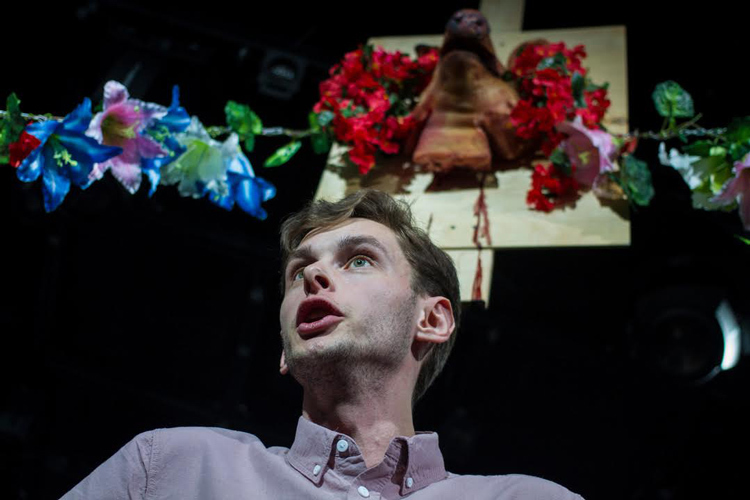
Tobolsk , Tchaikovsky, Tomsk, in line of Perm, Nizhnevartovsk and Dzerzhinsk-a series of art laboratories of the Territory festival-school, together with the company "Sibur" throughout the country for the second season. Chronologically, the last project of the “Territory” in the regions was the Laboratory of Documentary Theater, which was held in Voronezh under the leadership of Ruslan Malikov on the basis of the Koltsov Drama Theater and the local Institute of Arts: students have been practicing from the first year of study, looking at the surrounding reality and overcoming isolationism inherent in the Russian theater. Vyacheslav Durnenkov collected the Korithy of the “New Drama” from the “Vygvys” and an interview with the play “Speech”, set by Malikov, steamed with choreographer Irina Galushkina and artist Ekaterina Dzhagarova, who turned the scene into a medieval fair area decorated with clumsy garlands and real, poked to a tree, pork heads.
The screening of the project “Rech” in Voronezh is naturally embedded in the practice of documentary productions in the Russian regions that has developed over the past decade. This phenomenon, which is quite diverse and continuing to differentiate and divide into thematic, genre segments, has significantly changed and continues to change the everyday relations of theater and reality. As you know, the Dock revised the hierarchy of significant and insignificant, questioned the elitism of art, and most importantly, removed those blessed show, which the Russian scene was closed from everyday life for many years - not only in need of description and analysis, but also a dictating new aesthetic realities and requests.
It is interesting that the regions of documentary was in a sense even more necessary and at the same time more accessible than large hospitals in Moscow and other megacities: in a city where theaters are not three hundred, but one or at best, the scene is not just a scene, but a cultural center, for which a dialogue with the public and interaction with the surrounding space is the main meaning of existence. “Doc” outside Moscow and St. Petersburg is different: focused on the city or studying a specific social group, age; reconstructing an important event for the region; repulsive from the history of a particular place, but growing into a serious study of the global topic; Dictating his genre features or embedding into one or another tradition. The forms of Doc's existence in the regions can be the most unexpected: for example, in the “Golden Mask” nominated by the “Golden Mask” the Parafraz Theater, the audience, commercial potential of Verbatima was noticed in Glazov - and released a series of folk documentaries (“Kings and cabbage”, “We, fools, fools”).
 © "Territory"
A separate large and internally heterogeneous category of documentary performances in the regions are verbatics about the city. In the “elementary particles”, Semen Aleksandrovsky and Vyacheslav Durnenkov reflected on the legendary Novosibirsk Akademgorodok as the last Soviet utopia , the performance of Boris Pavlovich “I (not) will leave Kirov” examined the consciousness of a growing man, first of all, his attempts to correlate himself with a place where he lives, more than with a specific city -worn urban city. landscape. Another important topic is the study of the viewer and the study of oneself: the theater peers into the hall, yesterday and today, in its own history, is digging in the archives - this was, for example, in the performances of the Krasnoyarsk Youth Theater (“A teenager from the right bank”, “cabinet”) and a recent laboratory in the Saratov Tsyuz. Verbatim in the regions, on the one hand, helps the theater to find, so to speak, spatio-temporal adequacy, on the other hand, it establishes a horizontal connection with the auditorium. It was precisely by such a regional verbatim that Par Excellence looked “City Day” by Mikhail Bychkov at the Voronezh Chamber Theater - a performance about the loneliness of a citizen, about complex, contradictory relationships of man and place.
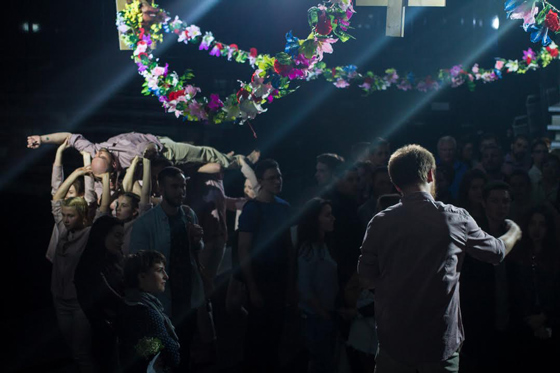
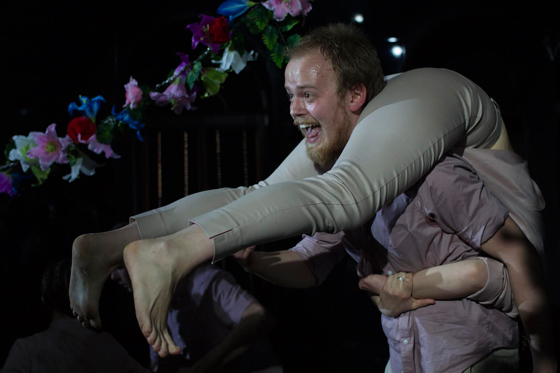
Voronezh project Ruslan Malikov and Vyacheslav Durnenkova develops and updates the tradition of documentary performance in the regions. Dramatic “speech” is divided into two parts: in the first - free installation of scraps of overheard dialogues, a mosaic of random observations of citizens of different sexes, ages and social statuses. Girls are discussing personal life, the bus driver will quarrel with a passenger who dragged a bag into the salon, accidentally adhering to the sole - and the audience is crowded straight on the stage, being in the epicenter of action. Each of the actors has a set of characteristic gestures, if recognizable, not domestic, but rather scaled to generalization, to the sign: choreographer Irina Galushkin sought to translate the character, the state of the speaker. Statuity is replaced by dynamics, loners are combined into groups, a torn rhythm fixes the fever of human existence - the complex work of consciousness, full of “glitches” and “bugs” in the gesture.
 © "Territory"
The super-unit “speech” made in the name is most fully pronounced in the second, analytical part of the performance: the authors of the production asked the heroes of the interview to observe how they say-by isolating the structure, finding repetitions and words-parasites. Spectators are now sitting in the stands: they are here-not an object of aggressive bodily and slobberry influence, as at the beginning of the performance, but observers. The discussion after the premiere talked a lot about how catastrophically poor, modern speech breaks. Meanwhile, the performance of Ruslan Malikov is rather not about simplification, but about the complication of the language - about the modern Babylonian tower, about how complicated the communication at the beginning of the 21st century. While you watch the “speech”, you catch yourself thinking more than once: now, it seems, I realized what this or that person is talking about. But this sensation is fleeting-the monologues of our contemporaries are so hermetic-alert. Studying the phenomenon of the evolution of the language, the Voronezh “speech” confirms the long -standing observation: the themes of documentary performances in the regions become less local, all less closed exclusively on local specifics - they are more and more facing not only the city, but also to the world.