
Translated material
"Kinotavr-2017", part two
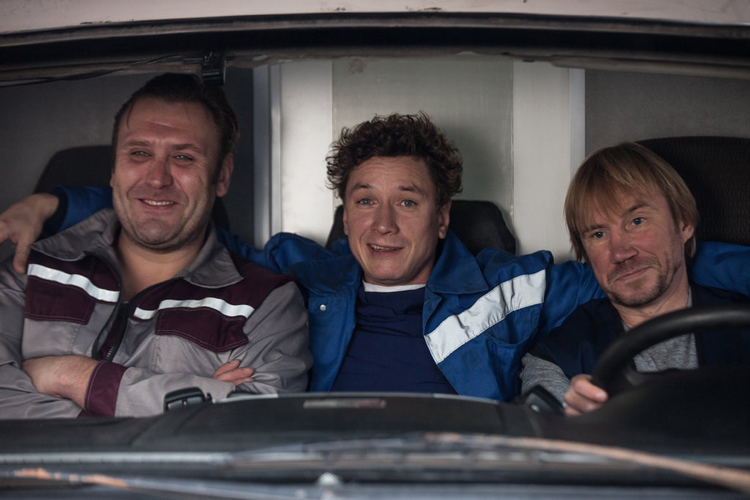
The final picture of the “Kinotavra” contest, “Arrhythmia” by Boris Khlebnikov, turned out to be the main disappointment of the festival (formally closing the shows “Myths of Moscow”, shot by the actor Molochonikov, clearly relate not to cinema, but to other media - either the stage, or outdoor advertising). So, about "arrhythmias." Returning to the cinema after a serial emigration, caused in partly failure of a “long happy life”, Khlebnikov actually steps on the same rake again. Like “Life”, “Arrhythmia” is a social cinema with a human (Alexander Yatsenko) face, all the same confused and ridiculous. Yatsenko plays his everlasting hero - a noble, but restless, strong and defenseless at the same time. His Oleg, an ambulance, working before falling and until he fell drinking at the short time that remains of work, is trying to confront the inhuman system of Russian healthcare. Each exit of the ambulance brigade becomes a heartbreaking example of a dull and harmful health care reform, which destroys not only the system itself, but also the people working in it, and the “arrhythmia” could become a pamphlet worse than the “health of Michael Moore” (we hope that all the following will not interfere with the film to at least become a reason for the public indignation of the Ministry of Health). But the civilian pathos here is successful (in fact - with the catastrophic consequences for the film), that intimate, human dimension that always distinguished the films of Khlebnikov and his peers. The core of the picture is not a production drama, but a love line: the entire film Oleg’s wife (Irina Gorbacheva), exhausted by the discrepancy between the duty schedules and the drunken fatigue of her husband, tries to part with him. The oscillatory movements of the hero, moving from the bedroom to the mattress, laid between the stove and the refrigerator, and vice versa, look monotonous-utting, and, most importantly, the black and white stripes in the life of the pairs follow with the inevitability of the seasons, and the final reunion of the spouses looks only another turn of this infinite spiral, continuing somewhere there, outside the chronometure of the film. Naturalism, which works well in the medical part (open fractures, knife wounds, burns, blood, moans, br-rr) and generally on the periphery of the plot (Khlebnikov traditionally collects a colorful palette of Russian types in his film), breaks when it comes to the script, replicas, conflicts. The plot of “arrhythmias” can be conveyed with the help of three or four telegram stickers, and the blood lying from patients does not turn the main characters into living people-despite all their tears and love for the songs of Valentina Strykalo. Yatsenko is predictably pretty, Gorbacheva has a fate of an annoyed external stimulus, which is explained by slightly embellished metaphors "wise thoughts of ordinary people." The fragility, the loss of a hero, which was slipping on a boring plane of a provincial life, capable of holding on to a strong, large business, is destroyed by a transparent, unarticulated directively refusing to leave this very plane, to the area of synthesis, an obvious fiction that could delete the “real time” of the film to the density that would do to the density of the film. a noticeable drawing of life, inconspicuous from the point “here and now”; There are no springboards for such a take -off and in a descriptive scenario that does not allow any “logical accidents”, events with a capital letter, albeit incredible, but truthful in the highest, Herzogovsky sense.
 © Mars Media Frame from the movie "Arrhythmia"
A healthy alternative to such a painfully loose, so characteristic realism for Russian cinema was proposed by Roman Volobuev, whose blockbuster produced by producers opened the competition program "Kinotavra". In his new film, Volobuev (then we will talk about the ideal, directorial version of the picture, the impressions of the production version are presented here ) breaks with the meaningful melancholy of the drama of the bewildered generation and enters into the zone of confidence: “Blockbuster” is a crushing comedy about female friendship and crime (“Telma and Louis” with Lousse The heterosexual end), sensitive to references and memes of today's Russia-and existing in some kind of autonomous time. However, why in "some"? “Blockbuster” is an ideal movie of the 90s, for which reality is, first of all, the reality is not a stringent texture, but of mass culture. In the film of Volobuev, kinematographic paths and cult films (also the 90s are mainly) germinate into the Russian world of the 2010s, so that Putin’s portrait is adjacent to the portrait of McConahi, the “pink room” of Lynch is found in Nur-bar, and the indispensable decoration of all American nuars-cheap motels-replaces the Soviet hotel. In general, the author’s love for Lynch and, it seems, for the Cohen brothers (a rolling option, alas, is deprived of this feeling) even somewhat explicit-the story is overpopulated by other-two characters (this motive, alas, is not in the rolling version) and the villains-idiots; But in the genre of intensive comedy (and the desire and ability of Volobuev to entertain the viewer every second of the film causes only hot gratitude) all these manifestations of stormy Sinephilian feelings look very appropriate. As for casting, the temptation is great to call each of the roles in the “blockbuster” the top of the career of its performer; Having restrained himself, we simply note that rarely one of the Russian directors managed to triumphantly arrange the very exit of their characters onto the stage (and yet-this is the best role of Evgeny Tsyganov!). Of course, the dramaturgy of the blockbuster is also lacking integrity, despite the bold borrowing of schemes from the Hollywood genre. But, on the other hand, weighty monolithic was unlikely to benefit the situy, especially so attentive to the witty and accurate signs of our time (cartoon on Poklonskaya, caricature of Tolokonnikov, a portrait of Vladislav Surkov).
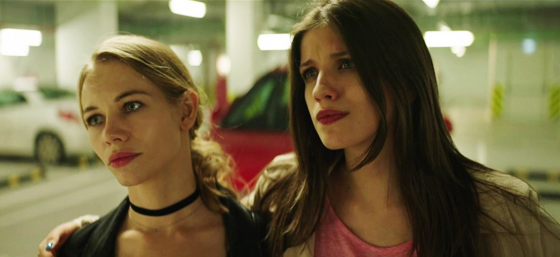 © "Volga" Frame from the film "Blockbuster"
If the experience of Volobuev, who had chosen the object of representation, not mythical, not visible “modernity”, but a modern culture that was quite articulated in the space around us, was repeated by someone from the comedian contestants, one could talk about a new wave. We hope that it will soon appear, but so far we can only talk about the wave of dislike: the plot of the Zvyagintsev film, however, performed in several other tonalities and details, was repeated in the short "dead end" Anton Sazonov and "loved ones" Ksenia Zueva (it is not a child from family hell not a child, but a grandmother). This context-retrospectively-to some extent deprives the “dislike” of complaints about the representation of the essence of time, taking away Zvyagintsev and his scriptwriter Negin, rather, sensitive clerks of his common, common places of collective consciousness. But at the same time, the directorial skill in the art of direct impact on the viewer emphasizes: an intuitively predictable, easily swallowed plot - part of the general formalistic mechanism of the public concussion. Alas, only Kantemir Balagov has yet mastered the foundations of this art from the new Russian directors (it is incredible that this happened under the leadership of the most delicate, “anti -tactile” author of our cinema - Sokurov). And here are the lesson that is presented to colleagues Balagov and Volobuev: the present is not to consider point blank, the distance is needed - cultural or temporary. It is worth going a step - and the picture will turn out. We wish Russian cinema to perform this tactical maneuver next year.