
Translated material
Both relics and weaknesses
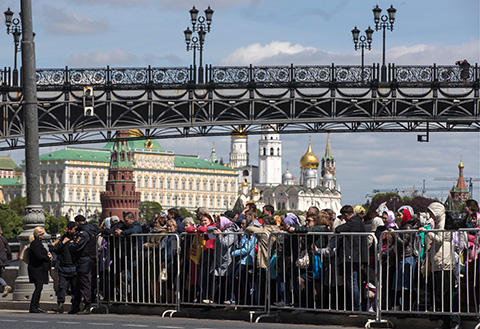
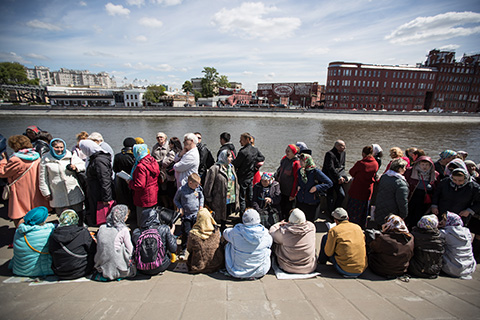
The Kropotkinskaya announces: “The line in the Cathedral of Christ the Savior from the station“ Park of Culture ””. But it turns out, even further - from the Ministry of Defense on the Frunze Embankment. To the Cathedral of Christ the Savior from here is almost three kilometers. However, there is no queue as such at this segment - there is only a framework for which you can pass. May 27, Saturday, half of the second, the people, apparently, are only gathering.
Near the ministry I meet a group of pilgrims from the Nizhny Novgorod region, from the city of Volodarsk. They have already defended their own and are heading towards the bus. Arrived almost the entire arrival, 49 people. This is not their first pilgrimage trip: there were both the Virgin’s belt, and when the Gifts of the Magi were brought to Moscow, Andrei readily says; He looks like 30 years with a little, with him an eleven -year -old daughter.
- There is simply no other opportunity to look at all these things, women are not allowed to the same Athos, for example, women can only touch the shrines here, to the Gifts of the Magi, for example, with which Jesus Christ himself played in childhood. And Nikolai the Wonderworker is one of the great saints revered by all Christians. We do not forget our saints, our parish was in Diveevo, and on Valaam, and in the Klyuchevskaya Lavra, and went to Alexander Svirsky ...
“Vera helps a lot, very much,” an already middle -aged woman named Tatyana comes into conversation. -If at home some turmoil or where, if I pray with zeal, do not believe it, it always helps. Although I will be honest to the Lord, I came literally three years like. I had it in my soul for a long time, but I began to go to church recently.
Andrei’s daughter regularly goes to the church and admits that the priest in the service told who Nikolai the Wonderworker is, but she only remembered a lot: “He helped people, he needs to pray that everything works out,” the girl hesitates uncertainly.
“Have you asked something from him today?” - asks Tatyana. -We all went to him with some request.
“We hope for the aid of St. Nicholas, who will ask for the fulfillment of our petitions by his prayers,-as Anna echoes her, another pilgrim from the group in the written one. - This is such a saint who in Rus' is considered a Russian person. If you are not quite competent grandmother to ask where it came from and what nationality, I am more than sure that she will answer: Russian. My grandmother probably thought so. This saint personally helped me a lot. There were such cases in life - insoluble situations - when I prayed on the knees of Nicholas the sung on my knees, and then I got up in the morning and went to do what I should. And everything worked out for me, and at the same time they helped me, and this is also a miracle, two Nicholas. I have never seen them in my life, they held high posts in certain structures, and just helped on a phone call. As a result, a woman with three children, my relative, began to receive all the benefits that she had not yet received due to confusion with documents. These two people are still recorded in me in the renser, and I pray for their health.
Archpriest Maxim Khizhiya from the Vladimir diocese confirms: “Almost every Russian Orthodox family has an empirical experience of relations with Nikolai Minor. I have been serving for 26 years and heard so many stories - just an endless stream. Probably, this can be compared with the veneration of the Poles of the Virgin. In my deanery, 27 temples, and every third has a throne in the name of St. Nicholas. Now a new temple is being built in the Goose-Khrustalny, also in honor of Nikolai. Nikolai is one of the fundamental pillars of the folk faith, this is a millennial tradition. As for the fertile fire, people can argue, but about Nicholas the sainty, it would not even occur to anyone, this is an indisputable shrine. ”
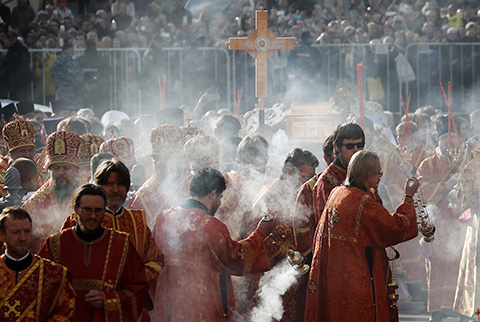
The idea to agree on bringing the relics of Nikolai to Russia seems to him one of the most successful steps of the Moscow Patriarchate: “This is a big and important event, firstly, because for the first time a shrine of the universal scale came from the Roman Catholic Church. This indicates the good intentions of Catholics, which, of course, will contribute to the normalization of relations between Catholics and Orthodox: it will remove a certain tension that exists, will increase the degree of trust. We see not declarations on the topic “Let's live together”, but specific joint ritual actions, and this is important. In addition, the relics of St. Nicholas are what can unite in one line of people with very different religious views - both conservatives, liberals, various political moods, right and left. So this is a big thing. ”
The pilgrims are wrapped in the bus, and I cross the road and finally get beyond the scope to pace in the opposite direction. Ahead of me is a girl frankly hipster, I am a little surprised and decide to catch up with her. "Are you the first time for the relics?" - "I? No, I'm not to the relics, I'm just walking, the weather is good, ”she replies.
Masha, in the appearance of a student, admits that he accompanies her mother. I try to talk to my mother. “No, no, I'm focusing,” she refuses.
Two girlfriends about 20 years old, Muscovites, to the question of whether they believe them, answer: "We are trying to be." Why go to the relics? “It is said, let your faith be for you,” one answers instructively.
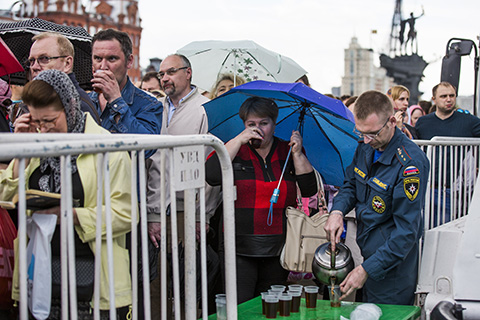
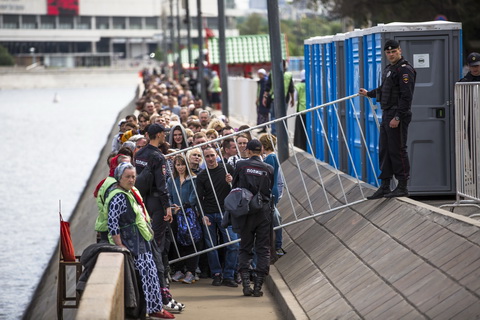
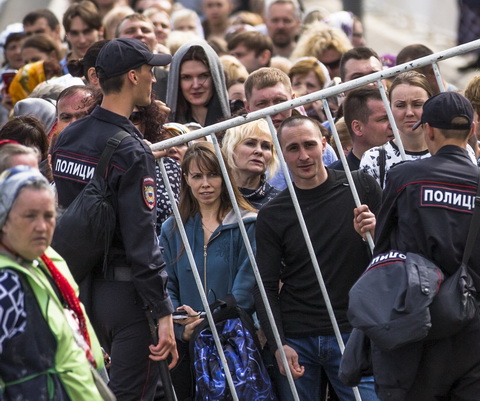
Tents with pies and water, toilet boines are placed along the embankment. In the booths relatively clean, only the paper ended everywhere. Along the framework, riot police, the Ministry of Emergencies, and the police are on duty, Orthodox volunteers come across in salad bibs. Walking boats float along the river. Many stop to photograph them.
Having reached almost to the very Crimean bridge, we finally rest on the fence. 13.55. The people are gradually suitable, forming a group of a person at 50-70. Most gathered from 30 to 40 years old, men and women approximately in half, only women come across the elderly, and men older than 40 are almost not visible. Only behind me is a man of about 60 years with an old woman. A little ahead of two schoolboards, one in the form of a cadet corps with a magnificent bow on a spit, the other in jeans and a plaid shirt of the release, with light blond hair to the waist. It turns out that classmates, next year they finish the cadet corps. A girl with a bow gathers for a medical, the second - for a legal at the University of the Ministry of Defense. I ask if there are religious lessons in the corps. No, there is nothing like that, but here they are exclusively of their own free will.
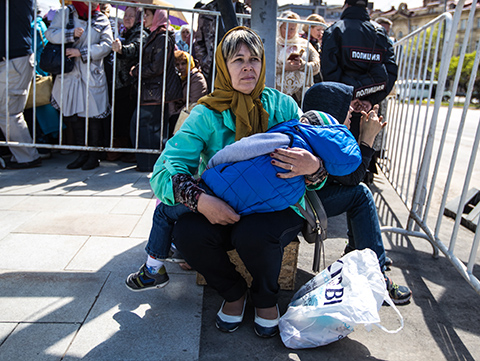
A complete woman with a stroller begins to cry with a stroller. Two years old, he covered his face with his hands and sobs bitterly: "Mom, mother!"
“Go ahead, they will miss you,” voices are heard.
- I will not go.
- Why?
- He (policeman. - S.S.) saw that I was with a stroller, but did not suggest passing.
- Woman, you bother us!
- How?
- The child is crying, we are worried about you. Then step aside and shake it.
Among the police, a move begins, and after a few minutes one of them pushes the frame and passes the woman with the child forward.
Very soon, having counted everyone over their heads, they miss us. 14.18. Under the Crimean bridge, the framework of metal detectors are installed, we quickly pass through them, catching up with a woman with a stroller. The boy is no longer crying. “You can’t get anywhere from her,” someone grows behind me. The Prechista embankment begins, here is the next fence, before which we get stuck for a long time.
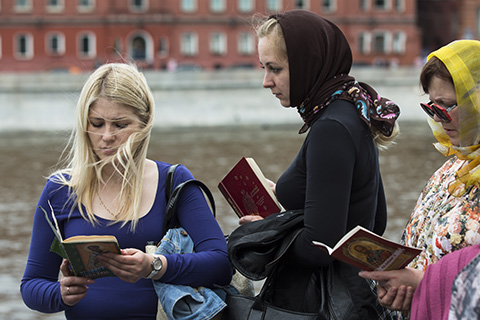
To the right of me, two women of about thirty are leafing through a prayer book, find an akathist to Nicholas the Wonderworker and plunge into reading. On the left, a woman is a little over fifty, with a St. George ribbon on a bag, in her hands some kind of boulevard newspaper with a header of half a page Hitler forced his girlfriend to sleep with a black boxer? " A woman reads enthusiastically. Some men are talking on a mobile phone, mainly about business. “I have two workers work there, both do not say Russian, but you give them my second mobile with charging, let them have it just in case.” Someone fights off the reproaches of acquaintances: "If you wanted to, you would have gone first without me."
The sun begins to bake, the people are trying to cover their heads with scarves. The woman on the left, meanwhile, goes to the next plot: "Elena Podkaminskaya will give birth to from the builder from Samara?" (For some reason, all headlines in this newspaper with a question mark). The old woman behind me is clearly tired. “There was no need to go today,” her son reproaches. “Yesterday I drove here at two or three hours, the embankment was generally empty, but today is a day off.” “I was not torn,” the old woman makes excuses. “You were all whining, ached,” the son is not inferior.
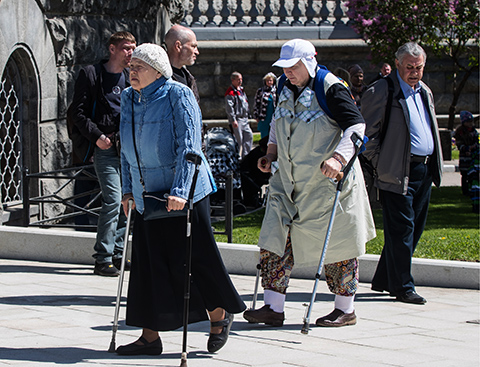
We have been standing for more than an hour, the queue has become subsided, subsided. The next title of the boulevard sheet is finally affirmative: "You can go to the relics at least every day." The old woman does not stand up: “Let's go, something I have at all ...” I am adding to them and also get out of the framework. 15.39.
I return home to the subway. On the walls of the car, advertising of the Orthodox radio “Vera” was stuck: “Blessed are molesty, for they inherit the earth”, “Blessed are pure in their hearts, for they will see God”. I do not immediately notice that a homeless person entered the car, a young guy, quite decent dressed, but skinny and smelly. He walks along the car, hanging his right leg, and broadcasts in a monotonous, mechanical voice: "... a black strip began in life plus health problems ..."
No one serves ...
Honest the remains
The massive veneration of the relics of Christians began around the 3rd century AD, when crowds of pilgrims reached for the graves of martyrs for faith. However, the official status of the relics was finally fixed soon - only in 787 at the second Nicaean Cathedral, which ordered to read the remains of the saints, to erupt bishops and clergy from the dignity, rejecting the relics of the martyrs, and the laity - to excommunicate from the church. Gradually, the veneration of relics acquired an unprecedented scope. Moreover, Elena, the mother of Emperor Konstantin the Great, and Konstantin himself tried to do everything at one time to transport as many rarities associated with the name of Christ from Jerusalem to Rome: this is the Cross of the Lord, and spikes from the thorny crown, and much more, not to mention the dust of the two main apostles, Peter and Pavel. The relics were bought up, stolen and falsified throughout history, which led to the presence of three heads of John the Baptist, who lived to our times a piece of lace from the wedding dress of the Virgin Mary, an unprecedented amount of fragments of the Cross of the Lord.
By the 13th century, the Vatican built a profitable industry on relics, expanding wide agitation in favor of pilgrimage in Rome instead of Jerusalem. A special indulgence has reached a certain number of times by the Roman basilica, since the 14th century the so -called anniversary years have been included in practice, when pilgrims were attracted by a complete release of sins.
Eastern Christians did not reach such organizational heights in the glorification of relics, but relics were read out. In Russia, the Kiev-Pechersk Lavra, where the remains of 122 saints are resting, Pochaevskaya with the miraculous icon of the Mother of God and Cancers, where the relics of the Monk Job and Amphilochia, and the Pskov-Pecherskaya with a total number of burials of almost 10 thousand, have always been the main place for the attraction of believers. And, too, to put it mildly, they did not poor and do not poor.
At the same time, politics often intervened in the canonization process. So, for example, the alleged wife of the Vladimir and Tver Prince Mikhail Yaroslavich Anna Kashinskaya (died in 1337), which was classified as the noble in 1650 for the miraculous guards of the inhabitants of the city of Kashin from the Lithuanians, 27 years later excluded from the list of saints. When, in the very peak of the struggle of the Nikonians with the Old Believers, the coffin of the faithful was opened, it turned out that her fingers were folded into biases, which was a strong argument in favor of the historical correctness of the Old Believers. The saint was “restored in rights” only in 1909, after the decree on religious, and the Old Believers were legalized.
The belt of the Virgin brought to Moscow collected more than 800 thousand pilgrims (in total in Russia - about 3 million). Then everyone wondered: why? Opinions were divided dramatically: from the conviction that the true faith, to the accusations of those who came to paganism, returned to Rus'. Religious scholar Sergei Filatov, head of the Encyclopedia of the Modern Religious Life of Russia, believes that the phenomenon of worshiping relics is a natural attribute of the folk faith:
“The religious scholars have a conditional, but division into the so -called folk spirituality and intellectual. The whole world of miracles, worship of holy icons, relics, strict observance of posts - these are all manifestations of popular religiosity. Whereas for an intellectual environment, the main thing is the reading of the Bible, thoughts about morality, attempts to observe Christian commandments. Both are everywhere to some extent, and in our time people are rarely found who are firmly at a particular position, nevertheless, these two types of religiosity are different. Some priests-intellectuals completely deny folk religiosity, believing that this is wildness, but among supporters of folk spirituality there are very educated people-it is simply a certain type of consciousness. The departure from folk religiosity began to quickly occur in Russia since the time of Khrushchev, many priests told me that crowds to miraculous icons, to church on throne holidays-this world began to disappear from the mid-50s of the twentieth century and almost disappeared by the 80s. Nevertheless, it never dies until the end, just ceases to be dominant. And by such phenomena as the queue for relics, we can judge how still folk religiosity is still strong. Moreover, Nikolai Minor - quite legendary holy, reliable sources about his life have not been preserved. In addition, the relics were brought from the distant country, from the Italian city of Bari - this gives them an additional taste of miracle. Those particles of the relics of the saint who lie nearby, in Moscow temples, are not so attractive. So, if the relics of Nikolai do not collect millions of pilgrims, this will indicate that folk religiosity is very weakening. ” 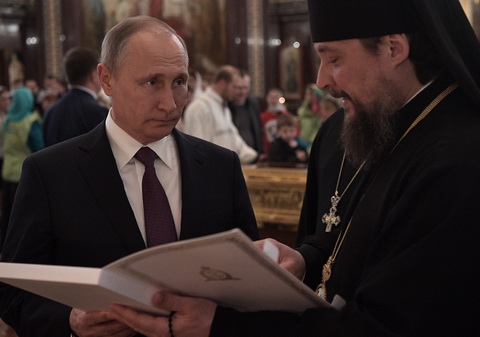
Read the material on the website of the magazine The New Times .
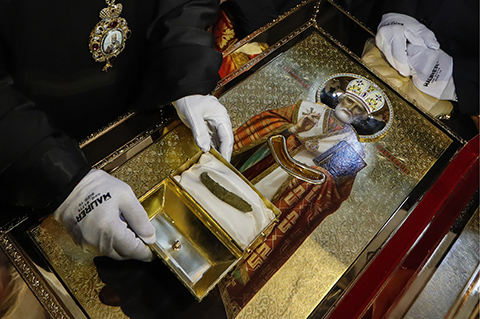
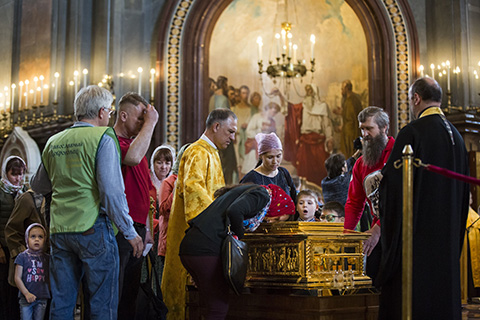
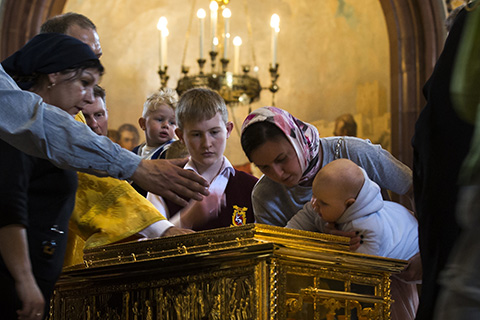
Photo: 1, 2. 3.12. Russia. Moscow. 05/26/2017. The worship of the relics of St. Nicholas the Wonderworker in the Cathedral of Christ the Savior. Alexander Zemlianichenko/AP/TASS
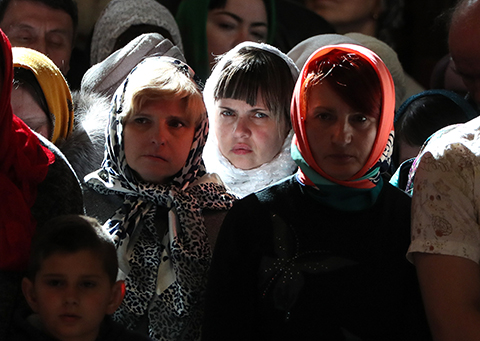
4, 5, 6, 7. Russia. Moscow. May 22, 2017. Believers in line to the Cathedral of Christ the Savior, where the ark is located with a particle of the relics of St. Nicholas the Wonderworker. The relics of Nicholas the Wonderworker for the first time in 930 years left the Italian city of Bari and will be in Russia until July 28. Stanislav Krasilnikov/TASS
8. Russia. Moscow. May 21, 2017. The clergy during the solemn meeting of the ark with a particle of the relics of Nicholas the Wonderworker at the Cathedral of Christ the Savior. The relics of St. Nicholas the Wonderworker for the first time in 930 years left the Italian city of Bari and will be in Russia until July 28. Artem Geodakyan/TASS
9. Russia. Moscow. May 22, 2017. Believers during the liturgy in the Cathedral of Christ the Savior on the day of the celebration of the transfer of the relics of Nicholas the Wonderworker from the world of the Lycian to the bar. The relics of St. Nicholas the Wonderworker for the first time in 930 years left the Italian city of Bari and will be in Russia until July 28. Valery Sharifulin/TASS
10. Russia. Moscow. May 22, 2017. Volunteers of the organization "Forty forties" during the liturgy in the Cathedral of Christ the Savior on the day of the celebration of the relics of Nicholas the Wonderworker from the world of the Lycian to the bar. The relics of St. Nicholas the Wonderworker for the first time in 930 years left the Italian city of Bari and will be in Russia until July 28. Valery Sharifulin/TASS
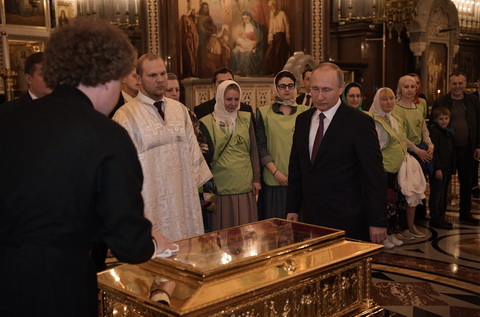
11. Russia. Moscow. May 24, 2017. Russian President Vladimir Putin (on the right in the foreground) during the worship of the relics of St. Nicholas the Wonderworker in the Cathedral of Christ the Savior. Alexey Nikolsky/Press Service of the President of the Russian Federation/TASS