
Translated material
Stop darken!

On June 18, in Moscow (cinema "Pioneer") and St. Petersburg ("Lark"), the shows of the new film by Philip Grandrhee "Opp Gorge of Night" will be held. Who is this director? Why did he become the object of the Sinefilian cult in Russia of the zero-tens? Says Alexey Artamonov.
The name of Philip Grandrhey managed to become one of the main passwords of Russian Sinefils of the 21st century: it is not surprising that he will soon teach in the MSNU , building his reputation around the sacred cows of modern author's cinema. The world of his films, extremely condensed, tactile and opaque, filled with primitive violence and ancient passions, at the end of the nineties - the beginning of the zero was loudly discussed (and was often condemned) in Europe in the context of the French so -called transgression cinema (work of Catherine Braya, Gaspara Noe and Bruno Dumon). By the way, Grandrhey was much closer to his colleagues to the transgressive philosophy of Georges Batay. However, to understand the style of Grandrhey, the concept of photogenician Jean Epstein is much more important (“Any aspect of things, creatures and souls that multiplies its moral quality due to cinematic reproduction”), “Theater of cruelty” by Antonen Arto and the painting of Francis Bacon with its fluid bodily and the desire to portray, not illustrating, preceding emotions. affects embodied in deformation of bodies.
These are general introductory ones, which there is no need to dwell on in more detail - in order to supplement the picture, you can read one of the many interviews that Grandrheh gave during his visit to Russia. For 20 years of work in his ideas about cinema, little has changed. More importantly, why did the real cult of Grandrhee have developed in Russia? This is partly due to the fact that we learned about the director and spoke quite late, only after his third film - “Lake” (2008). This unbearably intimate, conditional and at the same time naturalistic picture opened the actor Dmitry Kubasov, who played the main role in the film - a patient with an epilepsy of a logger, living with his family away from civilization. Since then, Grandrhee managed to act as a video artist and in 2014 show his installation “White Epilepsy” in the Moscow GTSIA, as well as to make a documentary about the Japanese director of Masao Adati, who exchanged a movie in the early 70s to participate in the ultralery Red Army of Japan. Dmitry Mamuli almost completely borrowed the method and aesthetics of this work for his film portrait Yuri Mamleeva, which clearly did not benefit the film.
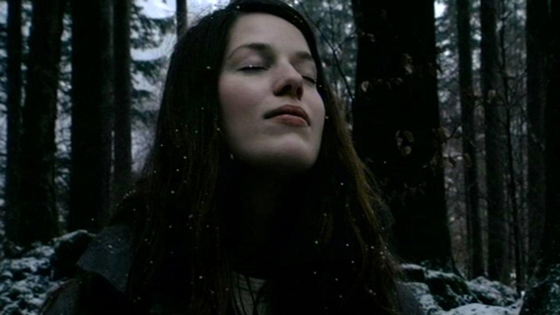 © Mandrake Films Frame from the movie "Lake"
It seems that Philip Grandrhey with his infinitely declared desire to exclude Lakanovsky symbolic and imaginary (which, of course, it is impossible) and to break to the real, non-intellectual, and the muzzle perfectly coincided with the self-consumption of Russian millennials. When, on the one hand, the artistic, but anemia and apathy reigned in the cinema, and on the other, the same fat oil magpie, as at festivals of jam, when almost all the concepts and principles were depreciated and politics almost never left the place anywhere, a thirst for direct sensations arose, and with it a request for a similar radical vitalism. Now such a desire to merge with the screen seems bright, stage important, but nevertheless hopelessly obsolete relic of the lack of being, and unwillingness to part with a pleasant object - a fear of a long -coming present, requiring distance.
“Calm around the night” (2016) is the first full-length Grandrhee Game Picture over the past nine years, from which they have been waiting for something new. Something really distinguishes it from previous works-formally it is the most conventional film by the director, filled with the largest number of heroes. All the integral components of the Grandrhee of the Universe on the spot. A mobile vibrating camera, then almost sticking to the actors, then losing them in a haze and corporate defocus. The natural, animal cruelty of a man and the insurmountable masochistic tendencies of a woman, sexual hunger, insatiable, devouring from the inside, and, wider, a thirst for direct bodily contact. Anxiety in front of another. Minimum words. The maximum of affects, marginal human manifestations and sensations: lust, pain, love, hatred, jealousy, fear, despair, death. To capture them, Grandrhey always cleared his films from literary psychologism, reducing them to simple and universal plot constructions. In the “contrary to the night” of the plot, it seems more complicated, but it is based on two basic plots-“Odyssey” and the legend of Oedipus (more precisely, a kind of “anti-gid”-again, the apology is sub-symbolic, but it will not work to tell in more detail without a spoiler).
 © Mandrake Films Frame from the movie "On the Specks of the Night"
A beautiful young man with a guitar and Britpop-Formation Lenz (Christian Marr, and Pit Puty was originally planned) returns from Britain to Paris to find a woman with the Pristovsky name Madeline. In search, he is helped by the old friend Louis (Paul Ami), a brutal pimp, involved in a porn industry and reminiscent of a Sophia bandit from a "new life". Gradually, Lenz has a relationship with Lena (Roxanne Meskida), a young singer with a dangerous father, and then a painful and destructive connection with Elena (Ariana Labed), a nurse with a dark past, in which they already had a Lenetz.
There is no sense in retelling the plot in more detail - it is drowning in sensory redundancy, which is famous for the cinema Grandrient. And although it has many events, the first 40 minutes we observe only a vague exposition, and all further is organized in a bizarre sequence, in which the main thing is the internal intensity of the scenes. After the “New Life” in an interview with the famous French cinema, Nicole Bren, a big fan of his work, Grandrhey admitted that his dream is to create a completely “Spinosian” film built in pure ethical categories: rage, joy, pride, etc. That is what he sought to achieve in his last work. He says that the “monadology” of Leibniz, the idea of simple substances, and all the heroes are only different expressions of the same personality.
 © Mandrake Films Frame from the movie "On the Specks of the Night"
A collective of rather different authors worked on the script: the French writer and translator Bertran Shefer, one of the scriptwriters of the Hollywood Say-Fai “Facel of the Future” John Genri Betterort, the rising star of French female cinema-Director Rebecca Zlotovsky. However, it is impossible to get rid of the feeling that “contrary to the night” is the sum of previous motives of Grandrhey and a series of self -reproaches, often not the most successful. In addition, much in it reminds of the best films of Lynch, and this comparison is not in favor of Granrius: Lena's performance causes the famous scene from Malholland-Drive in memory, the innocent Lenz-an agent of Cooper, an infernal rapid, which removes a snuff,-Frank Buta from the Blue velvet, and everything is generally the “internal empire”. With the basic psychoanalytic figures, Lynch works thinner, without pedaling and not trying to crush the viewer with their physical presence. This involuntary parallel once again confirms that the film cannot be a catalog of sensations and is inevitably present in the field of cultural hypertext. Cleaning it of syntax, of the symbolic one is the task of non -fulfilling and, by and large, meaningless. In addition, Grandrhey goes beyond the previously clearly defined convention and awkwardly tries to draw into his orbit the surrounding reality, in particular, filming his naive ideas about the life of youth, and all these drunken walks along the embankment of the Seine, home parties with the Eiffel Tower outside the window, guitar solo on the balcony and so on - the weakest episodes of the film, the worst episodes of the film, the film. Borrowed as if from a completely different cinematic world.
20 years ago, obsessed with the idea of “first glance”, the fullness of perception that the child loses along with finding the tongue, Grandrhey really discovered a new, his own territory. But is it possible to get into the transgression space again and again through the same gate? I would like to believe that this question is asked by those young authors who belong to the devoted fan club Grandrhee. “Contact the night” - convincing evidence that it is already impossible to build a statement on affects only today. But those who are still unfamiliar with his cinema, they can still experience the same thing that Jean Epstein survived at the beginning of the 20th century and to which Grandrhey himself continues to strive: when during the earthquake in the cinema a physically tangible trembling descended from the screen to the auditorium. The ability to achieve this effect is its contribution to the history of cinema, but this element alone is clearly not enough. A truly transgressive act would today break out of the frost of bodily sensations and head towards reality in its dialectical contradictory, and not reduced real and literally understood spinoza and deed.