
Translated material
Russia of the future
The observer of Taiga.info Alexei Mazur about the history of power verticals in Russia, the corruption of local deputies, Stalin’s experience and “sharashki”, competition in the management system, “folk budget” and ways to educate an alternative elite.
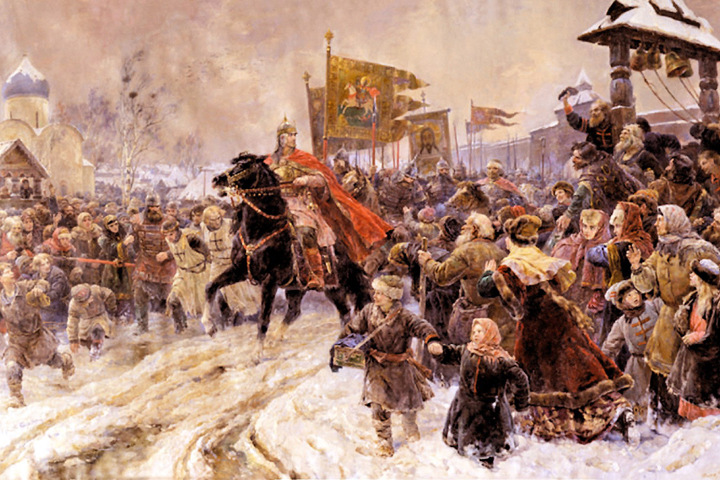
The obvious plot passing through the entire history of Russia is the ratio of “vertical” (centralized power system) and “horizontal” (local self -government). Even the episode of the varyagov’s calling, from which the history of the state originates, looks like a call “horizontal” “vertical”. It is clear that this episode, like many others in our history, is stated precisely from the point of view of “vertical”.
The ratio of "vertical" and "horizontal"
In Kievan Rus, “Vertical” was represented by the princely Rurikovich. And as the branching of this kind, the first Russian “vertical” branched.
Then the Mongols came and established their “vertical” in the form of a khan’s rate and issued labels for reign. They brought from China the innovations useful for the state structure - control and accounting, the census of the population and the division of the territory into administrative districts (tumens).
Then the Mongols were weakened, and their place was taken by the strengthened Grand Duchy of Moscow, which took the Horde “Vertical” as the basis of its structure. All the specific principalities were eliminated, and Novgorod lost self -government and veche bell.
Thus, the “vertical” system defeated a possible “horizontal” alternative in the form of trade republics of Novgorod and Pskov. Later, another Russian alter ego was eaten and digested-the Grand Duchy of Lithuania, which was not Lithuanian, but West-Russian. The fact that the tough Russian “vertical” defeated both the trade republics and the gentry republic of the Polish -Lithuanian Commonwealth (where the GDL entered) was not an accident. Nevertheless, the “horizontal” at that time was a real alternative. Add to its manifestations and the emerging free Cossacks. This means that “vertical” and “autocracy” developed under the influence of certain historical circumstances, and are not at all the result of the “mentality” of the Russian people.
The autocratic "vertical" reached its peak under Ivan IV, after which it broke and fell into trouble. At this time, the “horizontal” again showed itself - from Cossacks to the Zemstvo militia. It was Russia who owed its restoration and liberation from the occupation in 1612.
130806 KPI for the state
But the vertical was rapidly reanimated. The first Romanovs still relied on the Zemstvo cathedrals, but later, up to the collapse of the autocracy, the “horizontal” existed to the extent that the “vertical” considered it useful.
The 1917 revolution took off the autocracy. After October, the “horizontal” was announced - the power of the Soviets was established, the entire “vertical” was formally formally formed “from the bottom up”. But in fact, a rigid “vertical” formalized in the CPSU was again installed again.
This laid contradiction showed itself in 1990, when the formal became real, and in Russia the "power of the Soviets" was really formed. But, as it happened more than once in history, the “vertical” was quite quickly “reanimated”. In 1993, she dispersed the advice and, in the process of the next twenty years, almost completely subjugated the horizontal.
For a hundred years, as we have a paradoxical situation. Ideologically we have a wide local government and the election of key officials. But in fact, both representative bodies and the elections themselves are profanated.
One of the key ideas of the opposition today is that more authority needs to transfer “horizontal”. In order to discuss this idea seriously, you need to understand the question - why is it a hundred years after the fall of the autocracy and the declared “horizontal” structure of the state “Vertical” continues to dominate and crush all the institutions of local self -government and democracy?
There are two significant reasons for this. The first - the “vertical” management system was and still remains more effective in Russia. This is due to the size of the state and the absence of the traditions of the “lower” association of citizens that arise only today.
The second reason is the Vertical and Horizontal model is not complete. A very important element is missed, which could be called "boyars".
I will explain in more detail. Vertical is a centralized system of power. It consists of the “overlord” (the king, then, formally, is the “multinational people”, but in fact - the Politburo of the Central Committee of the CPSU or the President of the Russian Federation) and the officials appointed by him. “Horizontal” is local self -government, whose leaders are “elected from below”. In reality, “vertical” exerts significant pressure on the “horizontal”. It affects the elections, or even cancel them, creates a situation of complete dependence of local self -government on the “vertical” - first of all, financial. We will not forget about the power component: most opposition mayors elected in 2010 either joined United Russia or ended up in prison (Bratsk, Yaroslavl, Berdsk).
“Vertical” is effective insofar as a successful management system is built in it. First of all, these are responsible, competent and honest personnel, in the second - discipline, diligence, sensible instructions, correct KPIs and established adequate control.
“Horizontal” is effective insofar as “control from the bottom” is effective. Since citizens are able to adequately evaluate the actions of the elected persons, formulate their interests and monitor their compliance.
Roughly speaking, the vertical is the “tentacles” of the authorities, stretching down from top to bottom, and the “horizontal” is “grass”, growing from the bottom up. In the place where they are found, rivalry is possible, and symbiosis is also possible. In an ideal version, they probably can create a single and harmonious system. For this, it is necessary that the main goals of the “vertical” and “horizontal” coincide. Today it is not entirely true.
It must be understood that if the grass grows poorly, and the “vertical” tentacles are not long enough, then a vacuum arises between them, which is filled with someone. And this “someone” pretends either to “grass” or “tentacles”-depending on where his position formally refers.
And this vacuum is filled with “boyars” - those who pursue their own selfish (not necessarily monetary) interests and use the post that he got not for the goals that were supposed.
As a rule, these are officials included in one or another group of influences, and a business close to power, whose main “competitive advantage” is the ability to receive preferences from the state.
In such a more complete model, it becomes clear that mechanical delegation of powers from “vertical” to “horizontal” will not lead to an improvement in the situation. These powers will not go “horizontal”, but “boyars”.
What should be the “correct” distribution of powers between “vertical” and “horizontal”? The answer to it sounds simple - in each case you need to understand who is more effective in a particular place (region, municipality) and in a specific field of activity.
Let's look at the effectiveness of the "vertical". It is divided into many departments competing among themselves for powers and resources. "Vertical" today is redundant. It is also very corrupt, but there are no personnel training systems. Well, perhaps in the FSB, and then this is an open question, if you recall the parade on the Gelendvagen.
But with the "horizontal" the situation is no better. Local elections are total corrupt. Not in the sense that mandates are bought from the election commission, but in the sense that mandates are bought - by spending money on advertising, political strategists and the bribery of voters. Or deputies are “appointed” with the help of an “administrative resource”. The local deputy, as a rule, pursues the interests of his voters “according to the residual” principle, and first of all - business, his own or his sponsors, or his authorities. Among the deputies, we see many leaders of MUPs, GUPs, chief physicians and school principals. There is a small percentage of party functionaries.
The only advantage of such a “horizontal” over the “vertical” is that local deputies and officials are at least somehow forced to look back at the local public opinion (where it is). Again, you can always say to voters: "You yourself chose them."
If you look at things with open eyes - there is no effective local government in Russia today. Its rudiments arise in large megacities (in Novosibirsk, for example). The grass is growing, but you can’t accelerate this process, pulling the grass by the ends up.
At the moment, both “vertical” and “Gorional” are almost completely filled with “boyars”, of which our political class really consists. If Putin can still believe that he wanted to go to the KGB to become a scout, today they are going to the FSB to get into the privileged layer of “boyars”.
134573 What can be done in Novosibirsk for 26 billion
Another example is that today in Novosibirsk, the developer (“EP”) and the party functionary (Communist Party) are going on to the procurement in the district. Billboards are hung around the district (30 thousand rubles a month). On some portrait of the developer with the slogan "Novosibirsk is the city of the future." The party functionary congratulates Novosibirsk (not even citizens) on the other on the city day. Why do they go to the Legislative Assembly, whose interests will be protected, what is the difference to the voter from who exactly will become a deputy is impossible to understand. But it is clear that the money in the elections is invested considerable, and this is hardly the money of ideological supporters.
Since we have a significant layer of “boyars” both in “horizontal” and in “vertical” (and there is a version that they are completely “boyars”), the answer to the question is who is more effective, “horizontal” or “vertical” is reduced to who controls the “boyars” better.
Management reform
In the future, serious reform of both the system of public administration and local self -government is necessary. While the state administration is not effective and effective, any other undertakings are doomed to failure.
This reform can not only be reduced to the introduction of free elections and transfer of authority to the level of local self -government.
During the reform, a number of problems will need to be solved:
- Create a system of selection and training of personnel. Now there is no alternative elite. There is not a single “reservoir” from which it would be possible to draw honest and competent managers at least with a minimum quality guarantee. Especially honest.
- Change of motivation for "boyars". One way or another, for some time a significant part of the posts in the state apparatus and in local self -government will be occupied by representatives of the "boyars". The essential part of it is nuclei, driven not so much by self -interest as ambition. With the correct arrangement of incentives, the ambitious people become good servants of the state.
- determination of the quality of local self -government (its ability to control the chosen ones). And depending on this - delegation of part of the authority down.
- The creation of "fertilizers" for "horizontal" - a system of involving citizens in local government.
- The introduction of healthy competition in the public administration system.
The last task is critical. If we look at the world and historical experience, we will see that the main engine of progress is competition. Even the Soviet Union understood this, in which the real competition between the design bureau (in those sectors where the USSR had achieved advanced positions was practiced, it was real and tough competition), and fake in the form of a “socialist competition”.
In the capitalist (market) economy, the competition is “sewn up” into the structure itself, but the developed states carefully monitor that this competition is “conscientious”, that is, with the right KPI. In democratic countries, competition in public administration is provided by multi -party and changing the authorities in the elections. In our country, these mechanisms partly work inefficiently, partly deliberately profanated. Now competition is on the principle of “proximity to the body” and the coolness of the “roof” (about the same).
Therefore, until the “civil society grass” has grown from below, it will be artificial methods to compete in “vertical”. Well, like Stalin between the "sharashki" approximately.
I propose to solve the problem of training personnel and the introduction of competition “in one bottle” - to create several (or several dozen) “managerial corporations”, which combine the analytical center, the school training of managers and create their own “management guild”. The main meaning of the guild is collective responsibility. Again, we do not open anything new: if we want to have a guaranteed quality of managers, we cannot do without collective responsibility.
The subjects of the formation of such guilds can be both formal parties (in theory - this is their direct function) and existing or specially educated analytical centers. The federal center distributes grants for the creation of analytical centers and the preparation of the first portion of managers.
Further simply - there is a certain task. For example, improving the quality of medical care in a separate region. Guilds offer projects to solve the problem, estimates, conditions (change legislation, for example) and personnel. And also - KPI, by which the result will be evaluated. Realizing that it is not necessary to solve the problem to them. Further, “Vertical” gives several guilds to conduct a reform of medicine in several regions. According to the result, successful guilds are increasing funding, failed - is reduced. Not only the amount of financing is reduced, but also the amount of tasks allocated in the future.
In addition, guilds can offer various municipalities and regions their services to solve certain problems. "Vertical" can encourage this activity through subsidizing projects.
Such a scheme will significantly improve the quality of management, even if the “overlord” (one who makes key decisions) is not competent in all matters (and this never happens). “Guilds”, competing for the “order”, they themselves will indicate both thin places and possible problems.
As for the “growing horizontal”, we can everywhere implement the participation of citizens in the distribution of the budget of municipalities. Each citizen has a certain part of the budget for improvement (as well as culture, sports, education, and so on). There are complex industries like medicine, and there is a “flavor”, which include culture, additional extracurricular education, mass sport and improvement.
Further - simple. Each citizen annually votes a “virtual ruble” - on which particular landscaping project he wants to spend it on which sports school or cultural institution. It is clear that not the entire budget should immediately be given to such a vote, but part of it is possible. And immediately there will be an objective criterion of demand, which now does not exist close.
PS I understand that today there are thoughts on how to properly organize public administration seem meaningless and divorced from life. But as experience shows when it suddenly comes to business, it is too late to think and once.
Alexey Mazur