
Translated material
Mutual self -disclosure session: “Interview with Putin” Oliver Stone
Why Stone is a greater Putinist than Putin himself
What image of the President of Russia tried to create the author and hero of the film and what they really did - the New Times sorted out
Putin and the Kremlin have a rather significant image problem. With a practically inexhaustible budget and full control over all the media in the country, as it may seem paradoxical, there are not enough people who would praise Vladimir Putin.
That is, of course, there is an entire army of people who are no longer engaged in anything: they run around the clock from one television channel to another, sit in “expert centers” and write “analytical notes” about the greatness of the national leader and the growth of national well -being.
But the efficiency of such professional heralds even inside the country is very small, not to mention the far abroad. The fact that Putin once again praised a certain expert or TV presenter on a salary, at Putin himself and on a television channel also belonging to Putin - this already sounds quite unconvincing even for the hottest fans.
Therefore, you have to look for evidence of sincere love outside Russia all the time, and when they are not located, to invent themselves. So, “American journalists” appear on the air of Russian television channels, who are in fact St. Petersburg swindlers, “Western experts” who spent in their United States for fraud and immediately from the gates of the prison, who fell into the Russian Today studio with speeches in the spirit of “Better Putin have no one in 100 years”, and other rather comic characters.
The fact that Putin once again praised a certain expert or TV presenter on a salary, at Putin himself and on a television channel also belonging to Putin - this already sounds quite unconvincing even for the hottest fans
In the best case, the Kremlin media managers could hope for some in the past of a moderately famous American actor or TV presenter who will receive an apartment in Saransk, a Russian passport and his own show on the same RT channel.
The real start of the campaign
Therefore, the last film of Oliver Stone “Interview with Putin” is, of course, an unprecedented luck for hundreds of people in offices in Old Square, Zubovsky Boulevard, Yamsky Field and other team centers of agitprop. Four hours of the most serious propaganda, while absolutely sincere and the budget cost some miserable several million dollars to buy a license from a distributor, Showtime, a better gift for the election campaign was simply not invented.
There was no doubt that it was the film of Oliver Stone, and not the annual “Direct Line with Vladimir Putin”, which had not yet been announced by the presidential campaign. It is enough to see how much attention and airtime is allocated to the coverage of the film that has not yet been released in the Russian box office in Russian state media.
For two weeks in dozens of editions, hundreds of employees spend thousands of human arms, analyzing literally every second of four -hour (four series) of the film on the headlines. This is not an exaggeration - for example, an episode, which is dedicated to about a hundred news headlines in the spirit of “Putin laughed at a typical American gift”, occupies exactly four seconds of screen time.
Diagnosis for a stop
This propaganda campaign in Russian media leads to amazing self -disclosure sessions. For example, the heading “Putin said that the state does not control the work of the media in Russia” is published on the website of the Federal State Enterprise Russia Today, the former RIA Novosti, which was liquidated by the decree of Putin himself.
But a much brighter diagnosis of “interview with Putin” served as his author, Oliver Stone. A three -time Oscar laureate and the author of at least a dozen films from the Golden Fund of world cinema in political views are closest to those Western left -handed, which are usually called the offensive word Tankie. This is a historical term that initially ridiculed members of the British Communist Party, supporting the Soviet invasion of Hungary of 1956. But over time, he began to denote fans of any, the most bloody authoritarian regimes, if only they were anti -Western, anti -imperialist and so on.
“Tanks” can be any leftist who uses all the freedoms and privileges of the West, where he lives, but at the same time acting as a hot fan and defender of some Saddam Hussein, on the principle of “the enemy of my enemy is my friend”. This ideology always goes hand in hand with a tendency to conspiracy theories, anti -Semitism (“tankers” almost always stand on extreme anti -Israeli positions) and moral relativism in the spirit “no matter what these regimes, America/West is worse”.
Stone - precisely from those. He went to the "Interview with Putin" for a long time and consistently. Kennedy killed not Harvey Oswald, but the CIA conspiracy and the US military-industrial complex-about this, one of the most famous Stone films, JFK (in the Russian-speaking rental "John F. Kennedy. Shots in Dallas). The Jewish conspiracy in the media is from the recent speech of Stone. The hot, sincere and non -critical apologetics of the most dubious regimes is the filmmaker of the Stone of the last decade (“My Friend Hugo”, “Ukraine is in the fire”).
Therefore, the “interview with Putin” is not the Kremlin’s political order, but the consistent life and creative position of one of the most talented and famous American filmmakers. And this position is such that the main character of the picture, Vladimir Putin, often looks more adequate and more reasonable than his interviewer.
Too alive Putin
The interviewer is actually said loudly. Interview as a journalistic genre involves some rules and restrictions that Stone is not even trying to observe.
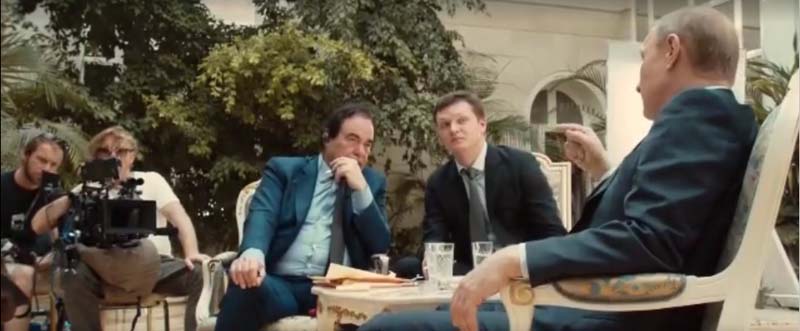
Firstly, in the film, in addition to Putin and Stone himself, there is the third main character-a young translator-synchronist, and Stone all 30 hours of his meetings with Putin, of which 4 hours of the film were mounted at the end, communicates with him. He looks at the translator, says with the translator, and he addresses Putin in the third person.
But this is, in fact, a trifle, because, in fact, Oliver Stone speaks not with Putin, but with himself. Stone pronounces lengthy monologues in the spirit of “you say that Wall Street is your friend, and I ask-does Wall Street want to destroy Russia?”, “Many educated people believe that the purpose of the United States is to destroy the Russian economy” or “Has there was ever an enemy in American history?”
No one in life would allow the Vesti operator to shoot Putin under such angles in which baldness, tummy, and fingers, nervously squeezing the armrest are visible
Putin himself corrects your anti -Western Philippic - for this, of course, you must have a talent worthy of Oscar. Putin, for example, is forced to explain that there is no formal obligation to expand NATO east. But if Stone does not bother Putin with his anti -Americanism too radical even for him, then as an interviewer he at best throws him the so -called “softballs” - questions are not on the backfill, convenient, not pose interviewed into a dead end. To understand what Softball Question is, see any interview with Putin on federal channels - what is with Sergey Brilev, what is with Vladimir Solovyov. Even the most star leading Russian federal channels are needed not so much to ask questions as for decoration for the next Putin monologue.
In the world of dogmas
But Stone, of course, is a much more talented director than Russian television channels, and no one in life would allow the Vesti operator to shoot Putin under such angles in which baldness, tummy, and fingers, nervously squeezing the armrest are visible. Therefore, Putin turns out to be a much more living character than a cyborg from Russian television. For this, by the way, Stone is mainly praised in English -speaking film awards - for the sincerity of the picture, despite the fact that everything else does not cause anything but, at best, bewilderment.
And, of course, on Channel One, they would not allow such a blunder during installation, which is not from the inability, but simply from the fact that Oliver Stone actually does not know about Russia, even within the article in Wikipedia. When a conversation about international terrorism comes in, Stone once again enthusiastically plays along with Putin, who tells how the CIA sponsored Chechen militants. On the screen at that time they show the Nord-Ost and Beslano shots-no one explained to Oliver Stone that in at least one of these tragic episodes of Russian history, wine for the death of most hostages lies not at all on terrorists who would not sponsor them.
Since Putin and Russia in the picture of the world of Oliver Stone and other anti-Western leftists, in fact, take a secondary position as the decoration for their hatred of the US Estabrication, it is clear that Putin Stone’s answers are not very necessary, he is most often contained in his very question.
As a result, from an epic four -hour canvas about the most contradictory, powerful, wise and experimental policy, unjustly slandered by the West, as the author conceived, a self -bleeding autobiography of two middle -aged people turned out
But Putin, devoid of the usual demiuric halo of Russian TV, is revealed in full. It is interesting how much the final installation will differ on the first channel from the original, but in any case, the irony of his answers will probably not pass by even the most devoted viewer of Russian television. “President Medvedev independently fulfilled his duties” - it is difficult to assume that in Russia there is at least one person who would believe in it.
And the series in which Putin talks about his historical meeting in the Kremlin with the oligarchs, at which he set the new rules of the game (“you know who did not like it? Those who earn their billions and millions are not thanks to talent, but thanks to the ability to establish relations with the authorities”), will surely go after the evening release of the news in which Igor Sechin as a talented businessman will be told.
As a result, from an epic four -hour canvas about the most contradictory, powerful, wise and experimental policy, unjustly slandered by the West, as the author conceived, a self -and -playing autobiography of two middle -aged, confused people turned out. Each of them was hopelessly stuck in his picket fence from long -outed and contradictory ideological dogmas. Oliver Stone with such heat smashes “American hegemony” (which is actually far from sinless, of course) that Putin himself has to pull him. And Putin has been giving these interviews for 18 years in a row, and his armor is absolutely impenetrable. Attempts by the most lively and arrogant reporters to “catch” it on some cunning question always end in failure and paroxysmisms of loyalty in the Russian media in the spirit of “Putin put in place of a Western journalist”. He can even answer the most immediate question with a confident, deliberate lies - and there will be nothing left for the opponent but to sit with an open mouth. After all, Putin will not happen for this. There is no one to scold him and "put in place." His chances of elections in no way depend on whether he speaks the truth or lies. And he is probably instinctively in the know about the joke “Brandolini Law” - “to refute any nonsense requires an order of magnitude more energy than for its essay.” Moreover, when Putin with such immediacy says that “the state in Russia does not interfere in the work of the media” (it is interesting whether this moment will show on Channel One), it seems that he seemed to believe it himself. And this is the most frightening moment of the whole film.
See also: "Two loneliness"