
Translated material
History as consolation
Alexander Rubtsov - about the "miracle of atonement" in real politics
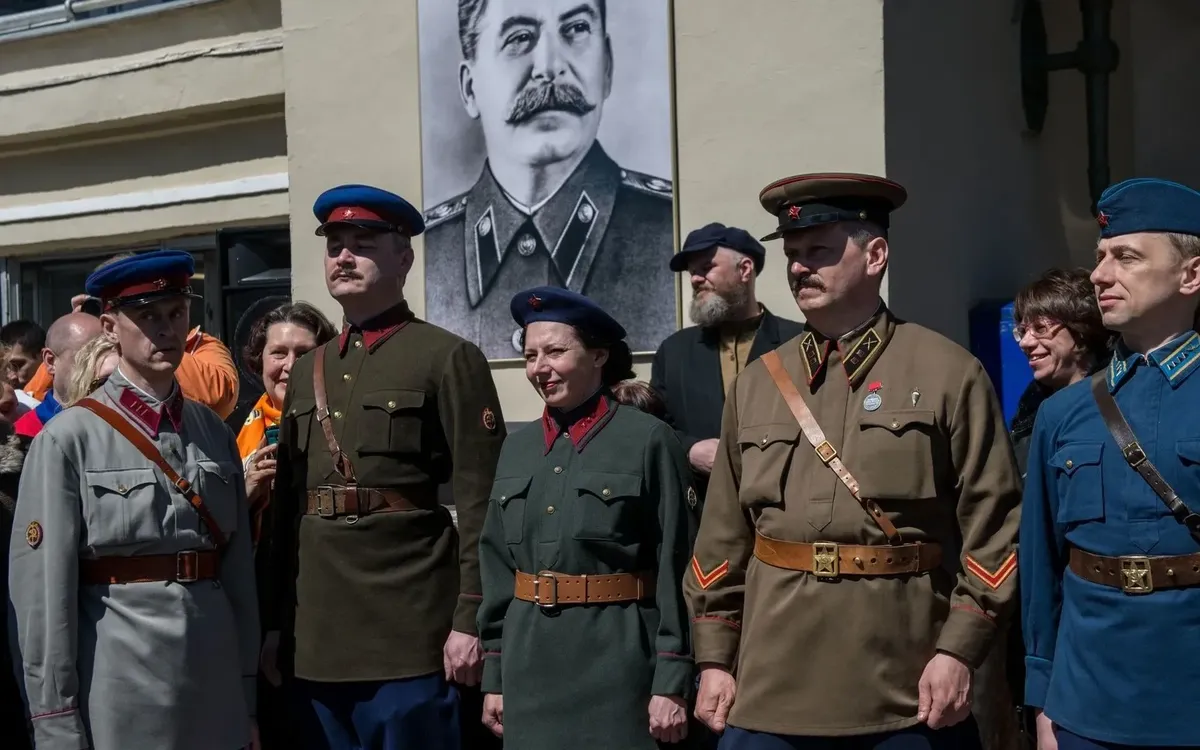
No matter what monuments erected power, she always puts them to herself, her dreams and ideals. The Triumph of Vladimir, Grozny and Stalin will remain in the chronicles of our time to evidence of the confusion of power on a historical miracle - the remission of any, arbitrarily grave sins for the interest in the interests of the state and the church. As if the analogues of the magical transformation of Saul into Paul, the transformations of the publican and harlots, but in the context are no longer a sacred, but political history, are re -written in the history of the reign.
This is a mixture of sacred and political, symbols of faith and power - one of the main bonds of the shadow ideology of Putinism, trying to book a place in the future “History Textbook”. This is an attempt to muffle the fears of reckoning, tormenting operational conscience. But, as Agatha Christie said: "Old sins have long shadows."
At least take the saints ...
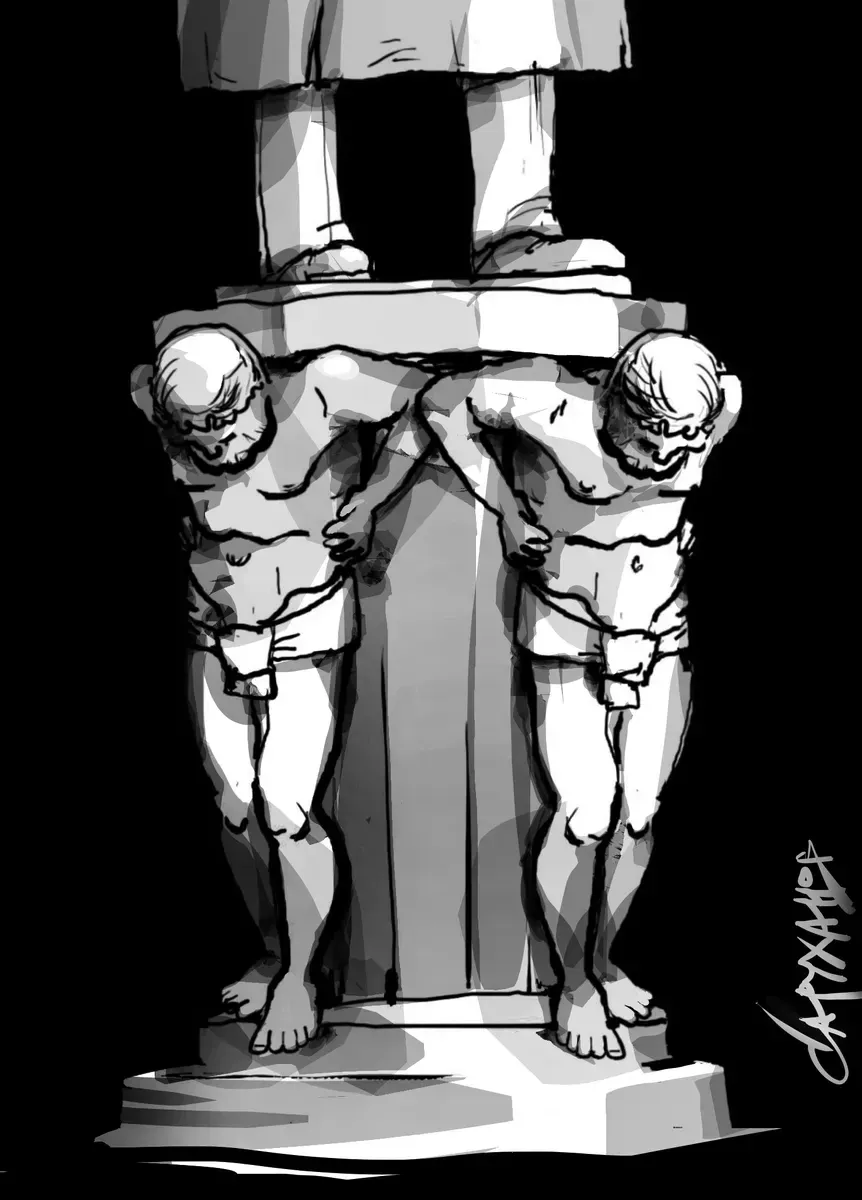
All the heroes of this triad are rare sinners, although with different chances of rehabilitation. Vladimir is canonized in the rank of equal apostles with the release of the sins of youth - legendary adultery and cunning, not to mention treason, violence, pogroms and murders. With the shading of the earlier history (Olga Christianity, the first “Askold” baptism, etc.), the uniqueness of state merits is also stretched. The secondary, secular canonization of the saint in our time looks, to put it mildly, unexpected. It will also be necessary to explain why the award in the form of a huge monument in the very heart of the capital found the hero right now, and not over the centuries of past reign. The act is purely political: ceremonial monuments to saints are alien to Orthodoxy. The hook in Kyiv in Kiev by the liquidator of idolatry was sharply condemned by the Metropolitan Filaret (the compromise was held only in the package with the coordination of the Vladimir Cathedral). The idea of Parisen Vladimir over Moscow, like the Rio ate, was even comical, that from the Lenin Mountains, from the Vorobyovs. The claims of the Prince-Vladimir Cathedral in St. Petersburg or, for example, the fourth largest seniority of the Order of the empire (even if it is Vladimir with swords and bow ”look more proportionate.
The artistic quality of the product leaves much to be desired, but now completely recalling the “mother of the Russian cities”, “where the Russian land has come from the Kremlin with Ukraine, every time the Russian land,” is spelled out. And to drink: it was the “fun of Rus'” that saved our people from circulating to withdrawal Islam. At the same time, this is the memory of baptism in the waters of the Dnieper and it is like a peak of Korsuni.
Worse with the apology of Ivan IV - church and political. Enough the murders of the St. Philip and the Holy Martyr Kornil of the Pskov-Pechersky, who "from this expenditure by the earthly king was preferred to the heavenly king in an eternal dwelling." It cannot be that in the bosom of one church one saint killed another saint. Everything is said at the Bishop Cathedral in October 2004 by the chairman of the Synodal Chanonization Commission Metropolitan Krutitsky and Kolomensky, the patriarchal governor of the Moscow diocese Juvenal: “Actually, the question of the glorification of Ivan the Terrible [...] is a matter of not so much faith, religious feeling or reliable historical knowledge as a matter of a socio-political struggle.” The image is used “as a banner, as a symbol of political intolerance”, in it “they are trying to glorify not Christians who have condensed the Holy Spirit, but the principle of unlimited, including morally and religious, political power.” A separate resolution was adopted against the rehabilitation of Ivan IV. The question of the king’s monumental apology with all imperial principles was resolved back in 1862 - the exception of Ivan IV from the sculptural pantheon in honor of the millennium of Rus'.
As for the monuments to Stalin, even the persons who have scolded to command culture and history itself have not yet been decided to bless their reproduction. However, the degree of exaltation here is different - such as, for example, in a “historian” replicated with the light hand of a very risky likening: “What is the difference between the heavenly Savior and the earthly? Both of them are remembered in a moment of mortal danger. The difference is that, barely passed the danger, they forget about God ... "
Stalin himself did not forget about himself and did not give others. Contemplating his reflection in the mirror of history, he rested on the face of Ivan IV: "Power without a thunderstorm is a horse without reins." His weakness to the outburst is reflected in the story of Eisenstein. According to Cherkasov, Stalin criticized the oprichnin “only because she did not destroy the remaining five large boyars families. [...] Stalin added with humor: “Then God interfered!”, Because, having destroyed one family, Ivan was tormented by remorse for a year, while he had to act more decisively. ” God did not interfere with Stalin, he did not suffer with nonsense and did not repeat the mistakes, surpassing the prototype in quantity and quality.
Eisenstein remained only to take off the all -true greatness: “This is a genius, and not just an outstanding person” (from work notes). But Ivan Vasilievich was even more. According to Klyuchevsky, the king “contemplated these majestic images of the Old Testament chosen ones [...] - Moses, Saul, David, Solomon. But in these images, he, as in the mirror, tried to see himself, his own royal figure, to catch them a reflection of his brilliance or to transfer the reflection of their light and greatness to himself. [...] This was a political revelation for him, and since then his royal “I” became the subject of a devout worship for him. For himself, he became a shrine for himself and in his thoughts he created a whole theology of political self -affair in the form of the academic theory of his royal power. ”
"Political theology" in Russian inversion
The words about the “theology of the political” Klyuchevsky seemed to look into the “political theology” of Karl Schmitt: “All the exact concepts of the modern doctrine of the state are secularized theological concepts.” Theology acts as algebra of political science. The science of God and the science of power is one construction, although in different worlds. It is quite vital ... And insanely beautiful, regardless of realities! And promising. Thus, the legitimation and its arsenal, from ideology to PR, can be interpreted as a “political theodics” - an justification for power in all the imperfections of its creation. The political strategist for money makes for earthly power the same thing that, at the command of the soul, the philosophers and fathers of the Church made to strengthen the legitimacy of the Kingdom of Heaven and its high -ranking inhabitants.
A miracle in the dogmas of faith is restrained by politics in the idea of "emergency." The denial of a miracle by enlightenment is continued by ignoring the “exceptional case” in the science of power. The liberal theory of state and law is built on a formal procedure that excludes the exclusive. However, the essence of the authorities - its sovereignty - is set precisely in the situation of emergency. "Normal does not prove anything, the exception proves everything." In this logic, the sovereign is a political god, that is, the Fuhrer. The “terrible lawyer” barely escaped the Nuremberg Tribunal, but remained the classic of the theory of political.
The scheme is also embodied by us, but with the usual identity. Schmitt from theology deduces political science, from the metaphysics of religion - the overall physics of the authorities, from the transcedal - immanent. We have the other way around. Schmitt, according to the drawings of theology, builds a secular theory of political - in our country they are trying to impose a politically sacred to us earthly policy. The paradox is that these opposite movements of thought lead to one - to the idea of a leader, Fuhrer.
Political temple
The miracle of atonement requires saints, and therefore the very idea of holiness. Hence the chatter about Pantheon (as if it were not or few). The announcement of the archivists with “scams of the ended” was accompanied by a literal canonization of 28 Panfilovites: “This is a holy legend that you simply cannot touch.” The idea is developing: “It (Cosmodemyanskaya) is a saint, as holy as 28 heroes-Panfilov. [...] You can relate to their lives only as the lives of saints. ” "... The epic Soviet heroes [...] should be treated as in the church relate to the canonized saints." The rhetoric of the sacred is supplemented by the image of the temptation: "With all these soothes [...] we are tempted, the saints for us are trying to pervert us." And finally, the infernal finale: “May he burn in hell! How will those who cast doubt on, digging and trying to refute the feat of our ancestors. ”
Further, Zoya Kosmodemyanskaya is not just declared a “national saint”: the house in which she spent the last night is now called the “Russian Calvary”. Hence the step to the parallels between Stalin and the Savior, although the creation of a single field of political "holiness" is enough. Desecularization begins in the revolutions of speech, but is understood simultaneously both sacred and organizationally. This is a metaphor, but with organizing and terrible administrative punishments, up to political hell.
If such a bold metaphoric and tolerant is tolerant from the standpoint of faith, then artistic, journalistic exaggerations are clearly running out here, especially with Golgotha and Savior. And vice versa, examples of tact here can be found in people of the church, for example, from the famous warrior with the “political” and “glamorous” Orthodoxy of Nikolai Kaverin: “Church legend, however, should be reliable in its essence and in spirit. [...] Myth -making, unverified facts from the history of the Church and the biographies of ascetics violate churchness and introduce elements of paganism painted with pseudo -appropriation and pseudo -Orthodoxy. ” This is a warning to “zealots to compose pseudo -shaped myths by reason”: “... myth -making in the church sphere can captivate people in opposition to the Church, in troubles and schisms.”
Disruptions and schisms in the political world are not introduced by archival documents, but by their massive refutations. The scandal around the famous publication was not at all a historian Mironenko, but by Medinsky himself, with his machine-gun statements like no one and that ever advertised the certificate-creation of 1948. And the fact that Zoya set fire to the houses of fellow villagers does not learn from those who knew about it before (where are their texts?), But from those who, with official stamps and with a business exaltation on every corner, now broadcasts that ... it is impossible to talk about it.
Atonement-Light
Policy, appealing to strong emotions, passions and blind faith, is generally characterized by flirting with religion and the Church, not to mention domestic occultism. Behind the “working” relations here is a shadow, latent ideology - a methodical restructuring of the consciousness of a controlled personality. But the authorities of the authorities are not subject to rational giving. There is another calculation: merits separately, sins separately. And your own logic: do not stop, but you will not be judged. No arithmetic mean, no “general balance”.
In order to believe in the redemption of power by history, it is necessary for the clarity of Grozny and Stalin to put in front of the Kremlin next to Vladimir. This ligament will complement the “political theology” of a separate, plastic “political science”. Saint Vladimir here is more like a model sample here: if we apply the principle to two others, on the “excommunicated” members of the triumvirate, it means that the experience of atonement in the channel of “positive history” can be repeated infinity. If in spiritual life, atonement begins with repentance, then in a policy that hopes to forever control the history, they continue to sin at the calculation of the issued indulgences on themselves.
In Christianity as a religion of salvation, forgiveness is important, but also the sinfulness of the forgiven. This is the power of miracle and grace. From here in the New Testament these images: "Truly I tell you that the taxi and harlots go forward to you to the kingdom of God." This priority of faith in God over the affairs of the law is fraught with the temptation of favorable political analogies. In the review of Dmitry Travin for the film "Viking" Vladimir looks like that seduced atonement. This is not a transformation of Savl on the way to Damascus, and not a long -term comprehension of faith in Augustine. The inexperienced Varangian liked the rite of instant purification from the years of the accumulated sins, which is not surprising with such a baggage of betrayals, pogroms, murders, rape. “Faith is convenient and inexpensive. You can sin and repent. [...] The main thing is to go to church. Listen to listen. And also contribute to the construction of temples and the state as much as possible. ” You can’t look into someone else's soul, but this “policy of monuments” does not cause their flattering selection of heroes of other thoughts with its plain selection.