
Translated material
Seen -free questions about climate change
The text continues the project on the Ecology "Variable" .
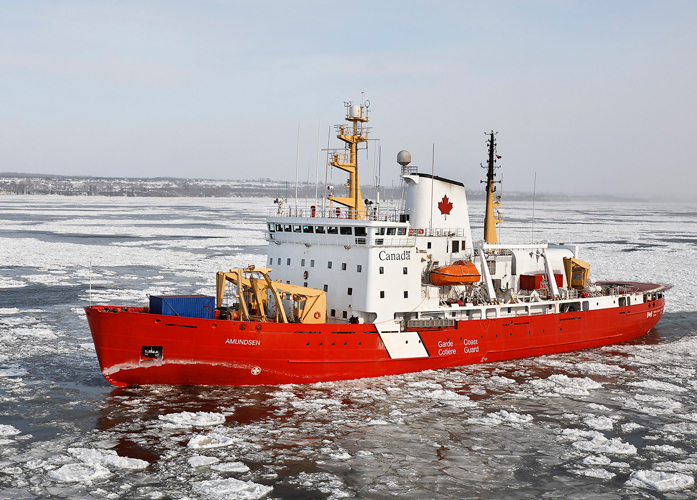
Canadian scientists in June canceled the first part of a large environmental study with a budget of $ 17 million. They were going to study how the climate change affected the vicinity of the Gudzon Gulf - so far it turned out that you could not go anywhere for this. Due to climate change, Arctic ice drifts in lower latitude, and the icebreaker, which explores, was always busy with the rescue of other vessels to work.
That is, the study of climate change had to be canceled due to climate change. Shah and Mat, skeptics ! Remember the phrase from the film “Look for a Woman”: “If you are not pressed in the subway, this does not mean that the subway does not exist.” Let's figure out why the metro, that is, the climate change, really exists, no matter what they say there.
1. Who said people are to blame?
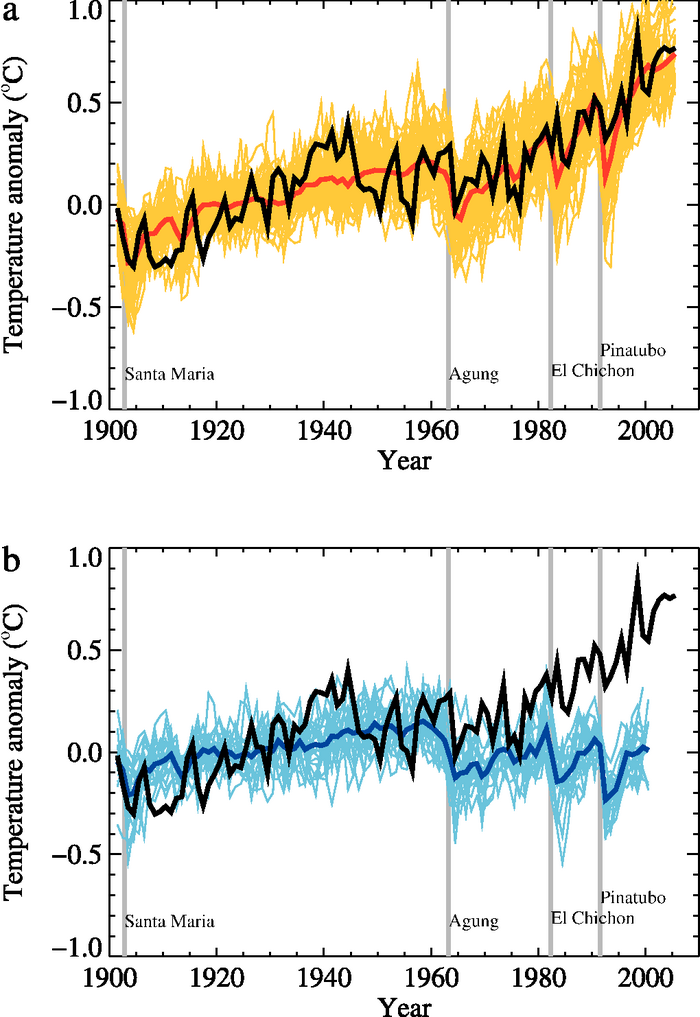
During the time of visualization, it is better to remember the picture, more precisely, a graph. An international group of climatologists worked on him, which, apparently, like me, was tired of answering this question and wanted clarity. Here he is:
Since it is difficult to experiment with the Earth’s climate (and no one will give), climatologists develop climate change models. Perhaps this became with the advent of supercomputers, and “play” with this model, substituting various options for the development of events, with the advent of super -supercomputers and a large array of data on which the climate was in the past. What is this data? All that will be found: annual rings of trees, ice cores (these are such poles of ice that scientists get out of wells in Greenland or Antarctic - in fact, the canned air of the distant past is stored in bubbles in such ice), bottom deposits.
The main heater in the Earth, the Sun, influenced the climate in the 20th century: in the late 1930s there was a peak of solar activity, and in the same period there were relatively few ice in the Arctic. Another maximum of the activity of the Sun occurred in 1980-1990, and then in 1997-2003. In the press at that time it was possible to read that warming on Earth is caused by the activity of the sun. Climatologists objected and were right: warming continues, although solar activity is quite low.
That's who seriously affects the climate is volcanoes. After eruption with the removal of a large number of ash and other particles into the stratosphere, the earth is shaded for one to three years, and the temperature on the entire planet is dropped by about 0.2-0.4 degrees. So, in 1991, the Pinatubo volcano volcano occurred. The effect of Pinatubo, that is, “cooling” the surface of the Earth’s surface, was twice as much as the heating effect of all CO2 emissions. Will volcanoes save the earth from overheating? No, because such eruptions rarely happen and their cooling effect quickly disappears, and carbon dioxide remains.
The sun, volcanoes and all other natural factors on the lower schedule give a blue broken line, which somewhere since the 1960s inexorably diverges with a black-a line of real observations. This means that with one natural factors, without an increase in the concentration of greenhouse gases, today's warming cannot be explained.
In addition, the climate change “betrays” itself in other indicators - for example, the area of Arctic ice or the mass of glaciers, that is, it is not a matter of air temperature.
2. And how, by the way, do we know that greenhouse gases in the atmosphere got precisely due to the fault of a person?
The CO2 cycle in nature can be represented as two huge loops. The first loop originates in the "breath" of the soil and plants, and ends with photosynthesis. The second loop is the physical process of the gas exchange of the ocean with the atmosphere, as well as the “breath” and photosynthesis of phytoplankton.
When a person began to extract coal, and then oil and gas, he intervened in the CO2 cycle. The same coal formed millions of years ago from plant residues. At that moment, the atmosphere was removed and “packed” in layers of minerals of carbon. Now a person “unpacks” it, obtaining coal and burning it, and sends it back to the atmosphere.
It seems that everything goes according to plan, the cycle continues. But over the year, a person burns as much coal as formed over millions of years. And here the effect of Zyuss arises: the fact is that the “old” carbon in fossil fuel almost does not contain an isotope of carbon-14, which has already broken up in it-that is, when fuel combustion in the atmosphere, the relative concentration of carbon-12 increases sharply. This is exactly what we have observed from about the middle of the 19th century.
In normal condition, that is, without frantic emissions of CO2 transport, boiler rooms and industrial enterprises, CO2 slowly absorb the ocean and ground ecosystems. But in the current situation, neither the ocean nor the plants have time to “eat” so many CO2, so more than half of the volume of this gas remains in the atmosphere. The more emissions, the more the climatic system “sways”.
3. Didn't Russian scientists prove that this is all not true?
It seems to me that this is the most common myth called "Russian scientists deny a person’s influence on global warming." This is even a shame. First of all, the Soviet geophysicist, Academician Mikhail Ivanovich Budyko was the first in 1971, when many of the those who were currently doubting on foot went under the table, suggested that in the 20th century, warming was waiting for us. It was Budyko who created the energy -balance sheet model of the climate, which became the base in modern studies of global warming.
In 1991, Mikhail Budyko predicted that the average air temperature "at the beginning of the 21st century will increase by about one degree compared to the temperature in the pre -industrial period." Budyko was correctly confirmed by British scientists. In 2016, they stated that the average air temperature rose by 1 degree of Celsius.
If you move on to the present, it consolidates data on the global change in the climate of Roshydromet. This scientific institution in 2014 released the second - that is, there was the first - an assessment report on climate changes and their consequences in the Russian Federation. Also, Roshydromet six times a year produces a climate change for a wide range of readers, and a popular science site is also valid on the same problem.
“It is extremely unlikely (less than 5%) that climate changes observed over the past 50 years occur without external influence; With a high degree of probability (more than 90%), it can be argued that the observed increase in the concentrations of anthropogenic greenhouse gases determines most of the global warming starting from the middle of the 20th century, ”the Roshydromet, published in 2008, said in the first report.
That is, when someone says that Russian scientists have refuted everything, specify what kind of scientists are there and whether they are engaged in climatology-because those who are engaged did not refute anything.
4. That is, an inevitable disaster awaits us? Or not?
Coffee is my bad habit, I drink every morning. What will I drink instead of coffee? After all, he will not be soon, but all due to global climate change. An increase in the temperature in the tropics has already led to the fact that the coffee bug-pest was bred in an incredible amount and threatens to exterminate all coffee plantations.
A similar situation with sugar maples from which maple syrup is made. Winter became colder, and summer - land. Trees do not have time to adapt to changes. According to American experts, the terms of collecting juices have already moved, and by the end of the century they can change for a month. To preserve the production of maple syrup production, the US Department of Agriculture proposes to consider the transfer of plantations to the north.
Interruptions will also come with wine both in the old and in a new light. California may lose 70% of the territory suitable for growing grapes by 2050, and Australia - as much as 73%.
Does this pull on an inevitable catastrophe? (For me and my habits-quite.) In the 90s, the media replicated someone's careless remark that children born at the beginning of this century will no longer know what snowless is. Of course, this will not reach this: climate change is much slower, winter is provided with the grandchildren of these children. The example of a frog, which is slowly cooked in a saucepan, is more appropriate.
5. Why do everyone say about "less than two"? And less than two what?
Less than two do not get together! Joke. In fact, “less than two” Celsius degrees is a kind of climatic meme, a phrase-paralle: it is convenient to designate the scenario of the development of events in which the frog in the saucepan will not be cooked.
Of course, everyone is interested in the future: how will the climate change and how does it threaten us? The problem from the point of view of forecasting is that this directly depends on our actions: how much CO2 we will throw into the atmosphere tomorrow and the day after tomorrow. Therefore, climatologists are not talking about forecasts, but about scenarios: when emissions in volumes and the temperature will grow into B degrees, during emissions in volumes B - on g degrees and so on.
In addition to temperature, you can calculate in models and other parameters, and then evaluated the consequences for the biosphere. The consolation forecast that everyone will be alive and well, will not flood anyone, all species inhabiting the Earth will have time to more or less adapt to climate change-this is an increase in the average Earth temperature by 1.5 degrees Celsius from indicators of the pre-industrial era. Of course, you can’t do without loss at all, coral reefs are being destroyed now (at one degree, recall), but still the consequences are not so catastrophic.
The next line is two degrees. This is a line on which problems with fresh water begin to arise, including, say, in the European part of Russia (where they are today), and the rise of the level of the ocean threatens to flood large cities.
Two degrees - this is the threshold that the countries of the world agreed not to exceed in order to avoid the destructive consequences of climate change. True, until the agreement is not going on further than the agreements, but at the current pace, climatologists usually call them “Business as Usual” , “Everything is as usual” - the temperature can grow by already four degrees. The World Bank once ordered scientists a report on what the world around us will be similar to such a turn of events (spoiler: there will be nothing good). So, in a good way, it is high time from shameful questions about the climate to move on to decisive action.