
Translated material
KAMO BRESS
110 years ago, on June 26 (in the new style) of 1907, the famous “Tiflis ex” by the Bolsheviks took place, which even more split the Russian Social Democrats
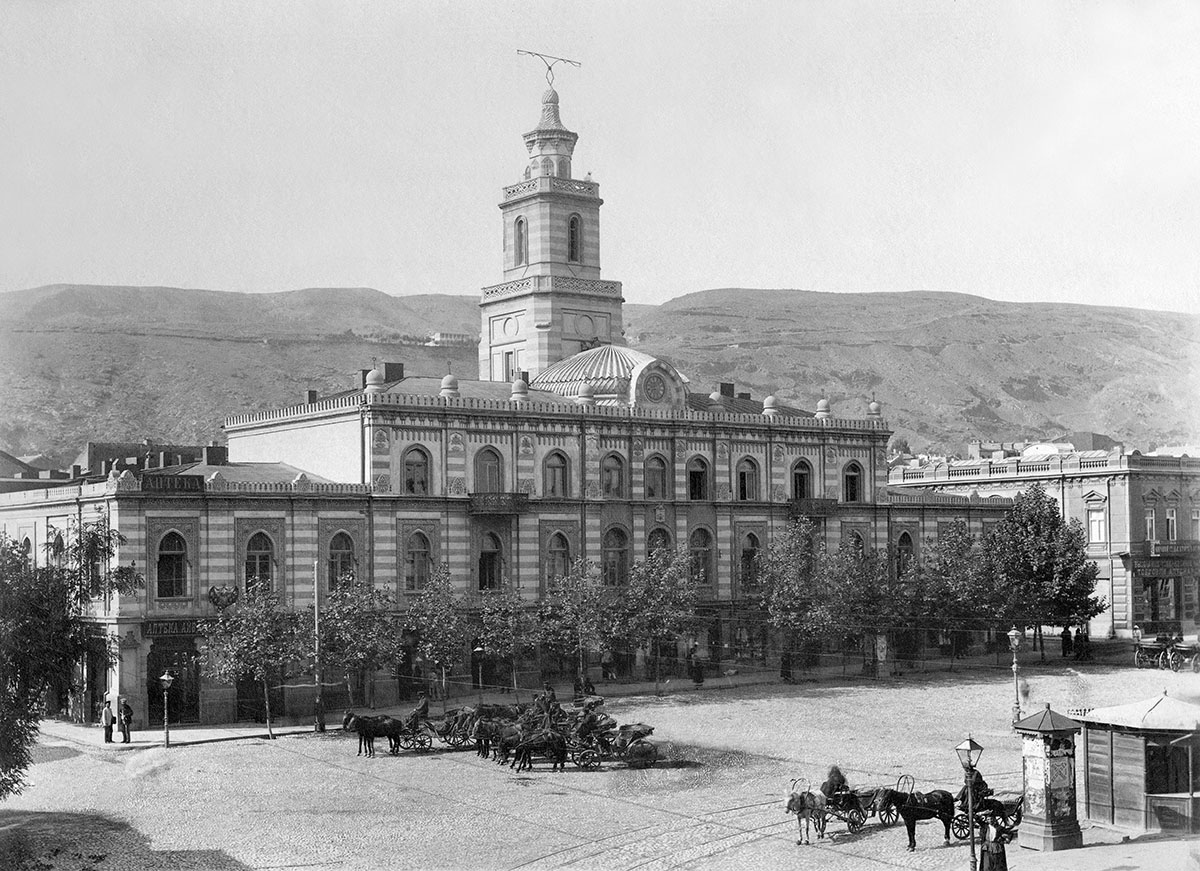
On this day, the duty officer of the police department in St. Petersburg accepted a telegram from Tiflis, signed by Colonel Grandmother: “Today is 11 in the morning Tiflis on Erivan Square, the treasury transport of 350 thousand was shone with seven bombs and fired from corners from revolvers, two city Cossacks were killed, two Cossacks were injured, one arrow was wounded from the public. 16, the stolen money, with the exception of a bag with nine thousand seized from circulation, has not yet been sought out, searches, arrests are made, all possible arrests have been accepted. ” A little later, clarification will follow: the prey of the attackers amounted to 250, not 350 thousand rubles; Nevertheless, the amount was very impressive - about 5 million of the current dollars*. Over the next months, the police found that we are not talking about a banal robbery with dashing criminals, but about the “exse”, “set”, as they said, as a group of militants, led by Simon Ter-Petrosyan (party nickname Kamo).
Exprration in Tiflissa
A raid on treasury transport was far from the first in the series of Transcaucasian “Exes”, carried out by the Kamo group. His wife Sofya Medvedev-Tere-Petrosyan recalled: “A large expropriation should be made when transporting money, it became clear to Kamo and all comrades with a detailed clarification of the plan ... Soon it was possible to establish three main channels of the monetary movement: on Julf (due to the presence of Russian occupation detachments in Persia), to the Batum (for Chiatatur's cobs, etc.) and in Tiflisa itself-with Tiflisa itself. Mail to the office of the State Bank. Three consistent attempts were made ... The first failed, because Kamo was very wounded by an exploding bomb. This event managed to hide from the police, and one doctor friendly located to him placed him under an alien surname in a private hospital ... The second attempt was successfully started; The militants drove on the train, driving money, but had to abandon the expropriation at the very last moment. The conductors who were supposed to lead our comrades through the deaf mountain paths, known only to themselves after the attack, stuck and fled. Comrades to Tiflis returned in deep grief. All explosions and all money were spent on the expedition. ”
On June 26, the Treasury guarded by horse police officers was thrown with bombs (there were at least five of them), after which Kamo dressed as an officer took the bags to his span and delivered to a conspiracy apartment, where the money was hidden into the sofa and taken to a safe place. Then Kamo sent them to Europe.
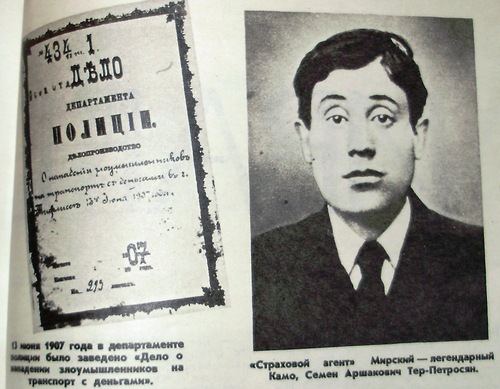
Police wanted police were built on the fact that large 500-ruble bills (“Petenki”, as they were called because of the Peter I depicted on them), the numbers of which were rewritten according to the existing rules and were at the disposal of the police, revolutionaries could not use it within the country. The Ministry of Internal Affairs informed European colleagues, and the foreign agents of the police department led by the state adviser Garting, who himself in his youth participated in the revolutionary movement, established tight surveillance of famous social democrats. As a result of the coordinated actions of law enforcement officers of several countries in January 1908 in Paris, Munich and Stockholm, several people were arrested with Tiflis money; The largest “fish” was Maxim Litvinov, the organizer of the purchase and supply of weapons to Russia during the first Russian revolution, one of the closest associates of Lenin. The Bolshevik agents managed to exchange a relatively small amount. The rest of the money, due to the impossibility of using it, was destroyed two years later.
The money was hidden in the sofa and taken to a safe place. Further, Kamo sent them to Europe
The fate of the direct executors of the operation was sad. Eliso Khomidze was soon arrested in St. Petersburg, sent administratively to Siberia (they could not prove his participation in the case, otherwise the sentence would be much more severe) and died of consumption soon after the liberation of the February revolution. A few years after the "ex -" Goldava, a few years after the "exse". Another bomb player, nicknamed Vanichka, was shot dead while trying to arrest in Baku. Kamo himself was arrested in Germany, issued to Russia, sentenced to death; The 1913 amnesty, announced on the occasion of the 300th anniversary of the Romanov House, retained his life. After imprisonment and a number of dizzying adventures during the Civil War, the responsible employee of the Georgian People's Commissariat Simon Arshakovich Ter-Petrosyan died in 1922 in Tiflis under the wheels of a truck.
Social Democrats and "Exes"
Revolutionary activities required funds, and considerable. It was necessary to purchase weapons, create underground and pay for foreign printing houses, print newspapers and brochures, organize the shoots of the arrested comrades. Yes, and just to live professional revolutionaries also needed something. The attitude to expropriations (it was about the means of state and large capital) among Russian left -wing radicals were different. The Socialist -Revolutionaries and anarchists considered them quite acceptable and practiced quite widely. Social Democrats were not so unanimous. During the revolution of 1905–1907, the IV (unification) congress of the RSDLP after a hot discussion rejected the draft resolution proposed by Lenin: “We recognize the congress to recognize: <...> 4) that military performances belonging to the enemy, that is, the autocratic government, and for the appeal of these funds for the needs of the uprising, are also acceptable, and it is necessary Serious attention to ensure that the interests of the population are less violated ”**. The final resolution of the congress on this issue read: "The congress rejects the expropriation of cash capital in private banks and all forms of forced contributions for the purposes of the revolution." But further it was said that the expropriation of state funds “in the event of the formation of the bodies of revolutionary power in the given area and at their direction is allowed; At the same time, the confiscation of folk money collected in state institutions should be in the public and at full reporting ”***. The 1st Conference of the military and combat organizations of the RSDLP in the fall of 1906 in the Finnish Tammorsa, the decision of the Congress condemned: “Experience is nothing more than the removal of their struggle means and transfer them to the hands of the people; <...> IV Party Congress, denying the expropriation of state funds, as it were, recognizes the right to dispose of these funds exclusively for the government; <...> The prohibition of expropriation, the unification congress pushed the overwhelming combat energy of the masses on the path of amateur performances that are not subject to control of the party, and therefore demoralizing the proletariat and those harmful to the interests of the movement ... "
The question was again raised at the next, V Congress of the RSDLP in London. Over the past year, the situation in Russia has changed into the worst, from the point of view of the prospects of the revolutionary movement, the side: even the optimists were clear that the energy of the masses was exhausted, the government as a whole took control of its control. Against this background, the resolution on the issue of expropriations turned out to be even more radical: “exes” to ban without any reservations, combat squads and groups engaged in them - to dissolve. One of the delegates of the congress was the representative of the Bolsheviks of Transcaucasia Joseph Dzhugashvili (party nickname Koba).
The revolutionaries could not use large 500-ruble bills inside the country. I managed to exchange a relatively small amount. The rest of the money was destroyed two years later
Who stood behind the Exc?
The question of Stalin's participation in the Tiflis Exca still remains debatable. On the one hand, it is known that the Transcaucasian Bolsheviks mainly supported this activity (unlike the Transcaucasian Mensheviks), and Stalin - including. He returned to Tiflis from London, where the congress was held, about 10 days before raiding on treasury transport and on the day of the Exs was in the city. He was close to Kamo, who was at least one of the organizers of the operation and its main performer. However, there is no reliable information about Koba’s involvement in Tiflis, although rumors went, including in the social democratic environment (though 10 years later the leader of the Mensheviks, Yuli Martov, who accused Stalin of involvement in this “Exc”, could not present evidence). It is also known that a few weeks after the Tiflis raid, the Committee of the Transcaucasian organizations of the RSDLP called Stalin the main “political patron” of the Kamo group; But, firstly, “political patronage” is a rather vague concept, and secondly, local Mensheviks played the first violin’s leadership, whose relations were very critical to local Bolsheviks. It is known that the police never accused Stalin of complicity in the raid, although, of course, this line during the investigation was worked out as a very probable. It is also important that the “ex” undoubtedly began to cook earlier than Koba returned from abroad (and it was absent for more than a month), and it was also unlikely to be suitable for direct organizers. It is characteristic that Stalin himself, as far as is known, mentioned his participation in this matter, although this could add to him authority among the part of the Social Democratic Party to which he belonged.
A few weeks after the Tiflis raid, the Committee of Transcaucasian Organizations of the RSDLP called Stalin the main "political patron" of the Kamo group
Participation in the decision on the operation, and possibly in its planning, Leonid Krasin (party nickname Nikitich), looks much more likely. In fact, this was laid “in position”: at the time of the events described, he headed the combat technical group under the Central Committee of the RSDLP, which was engaged in the supply of combat squads with weapons and the party - money. True, he, unlike Stalin, was far from Tiflis during EXS.
As for the leader of the Bolsheviks, Lenin, according to some reports, knew about the plan in advance. Probably, he was informed about the possibility of profit in Tiflis in London either Krasin or Stalin. Of course, Lenin had nothing to do with the organization and planning of the raid, but he was not going to impede him - a hot supporter of party discipline when he was in hand, he did not consider himself obliged to obey those decisions that were contrary to his understanding of the “features of the moment”.
"Resolutely to scare! .."
The party consequences of “Tiflis” were not too inspiring for the Bolsheviks: the Mensheviks condemned the “party comrades” and insisted on the investigation of both Tiflis events and the European “adventures” of the stolen five hundred -sides. Plekhanov, the authoritative at that time from the Russian Social Democrats, wrote Martov: “Have you read about Berlin history ( Camo's arrest. -NT)? The point is so vile that, right, it seems that it is time for us to break with the Bolsheviks. I beg you to write to me what do you think about it? " Later he will call the incident "Bolshevik bacunism." The Bolsheviks will have to get out - because it was a direct violation of the decision of the congress ...
Of course, the Bolsheviks and Mensheviks would have dispersed without a Tiflis incident, their ideas about the paths and prospects of Russian Marxism were very different. But, one way or another, the events in Tiflis deepened the split and accelerated the final break.
* This, however, was not a record. In March 1906, the Socialist -Revolutionaries, who widely practiced the Exxi, got the amount of the amount of mutual loan in Moscow during a raid on the merchant company three and a half times more.
** Lenin V.I. PSS, 5th ed., Vol. 12.
*** CPSU in resolutions and decisions of congresses, conferences and plenums of the Central Committee. Ed. 7th, part I (1898–1925): M., 1953.