
Translated material
Doct does not give a damn about your emotions
“They left one in the middle of the night” - this is what many women remember about the hospital where they gave birth. Why is this happening? It's not about doctors, but in the system.
There is no one to nurse
Many women, especially concluding a contract for paid births, expect that the doctor will “hold their hand” from the moment of admission to the hospital until the delivery. But concern for the duties of an obstetrician-gynecologist is not included. Its task is to examine a woman who has arrived in the medical facility, check her condition once every few hours (the interval depends on the stage of childbirth and the specifics of a particular case) and then conduct birth. Caring for a woman could be in the competence of the midwife (by the way, she visits a giving birth to a woman more often, about half an hour or an hour). But the circle of responsibilities of the average medical personnel in Russia is very limited. The work of the midwife, in addition to the provision of obstetric benefits, boils down to the “technical” tasks - make an injection, put a dropper, prepare medical equipment, etc. And all this is strictly according to the purpose of the obstetrician-gynecologist. As one of the women in labor, describing her experience: "The midwife is the hands of childbirth."
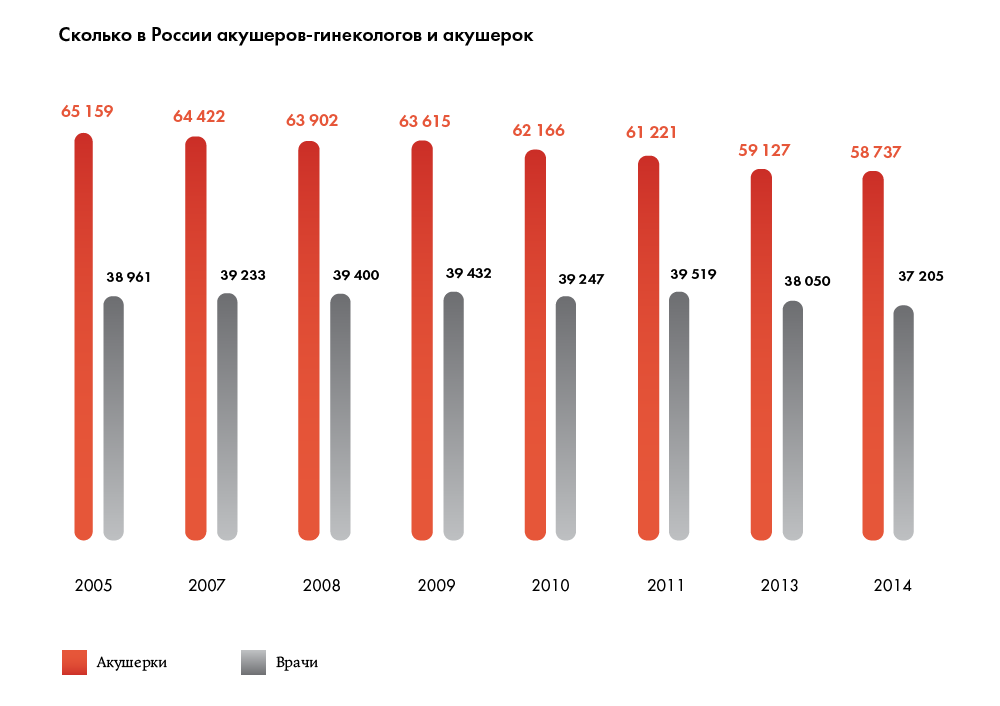
Another problem is the lack of midwives. In 2014, one doctor accounted for 1.6 midwife. For comparison: in Sweden at that time there were four midwives per doctor, and in Finland - six and a half.
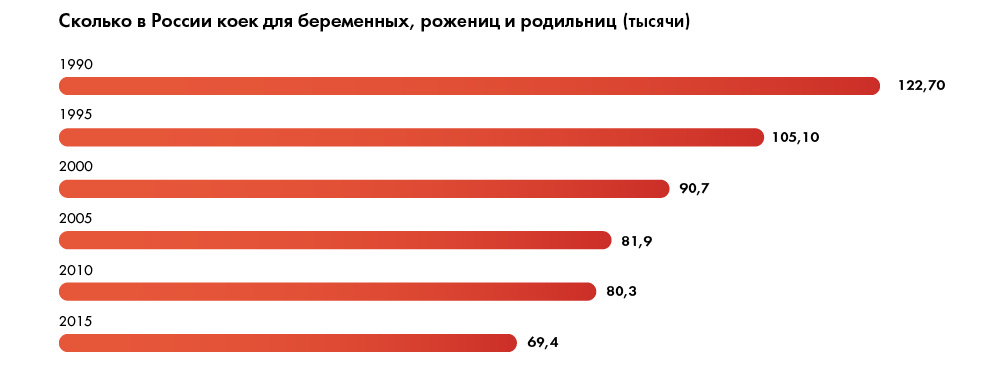
The number of doctors in recent years has decreased slightly (see drawings): if in 2005 there were five obstetrician-gynecologists for 10 thousand women, then in 2014-4.7 . A strong reduction in the number of beds in itself should not scare - the standards have changed, and these beds began to use more effectively. But it is important that the reduction occurs unevenly - first of all, small cities and rural areas lose. So far, in large cities they create new high-tech perinatal centers (their number increased from 35 in 2005 to 61 in 2015), in the outback they close the feldsher-midwife points, small maternity hospitals and maternity warehouses.
 Source: Ministry of Health of the Russian Federation Illustration: Anastasia Alexyuk for TD
  Source: Rosstat Illustration: Anastasia Alexyuk for TD
The emotional support of the women in labor is not included in anyone’s duties, and the organization of medical care does not imply that the staff will have time (and strength) to “nurse” with patients.
You are not the only one here
Most often, this is true - the patient who came to the hospital with contractions is not the only object of care for the doctor and midwife. Russian maternity hospitals are organized and equipped with very differently. But one thing unites them - the routine work of the state maternity hospital is a “conveyor”. One of the midwives I had interviewed even said that she was working at the "Obstetric Plant".
Stopping on a daily duty, doctors understand that all the birth that will occur in the next 24 hours on their responsibility. The work in the hospital is somewhat similar to the work of firefighters: the periods of the lull alternate with the periods when the doctor has to lead three clans at the same time. The number of patients is actually limited only by the number of places in the birth and postpartum departments. If they are filled, the birth woman will be sent to another medical institution.
It seems that if the money is paid, the woman has the right to count on special attention from the doctors. But this is not always the caseIn one major hospital, where I conducted a study, on two attendants and four on -duty midwives, there may be up to 20 births, including cesarean section operations. Obviously, in the moments of the maximum workload of the staff, some of the patients remain “abandoned” for a while.
It can be assumed that the situation in the commercial segment of obstetric care will be strikingly different. And if the money is paid, the woman has the right to count on special attention from doctors. But this is not always the case.
Read also I met Hamlet - deliver to the department in the story with the Arbat boy many were surprised by the inexplicable cruelty of the police. There is nothing to be surprised - they acted according to the template
For example, it may happen that the “individual” doctor or midwife, the services of which are concluded, are simultaneously part of the duty team. Or that several women with whom the doctor has concluded an agreement, childbirth happens at the same time. In one of the maternity hospitals, they told me about a small scandal: a “paid” woman actually gave birth to an obstetrician and midwife on her own, since all specialists were busy with other, more complex, childbirth.
The “forgotten” woman in labor is , of course, an extremely rare event. But the fact that because of the Abrala a doctor will even be physiological childbirth as a more convenient and faster, and not as the patient dreams, is quite likely. A typical option - will give birth on Rakhmanov’s bed, and will not give a woman the opportunity to choose a more convenient pose for her.
The doctor can be understood that he has enough worries besides patients.
Paper - a doctor's instrument
What does the day of the doctor on a conditional “ordinary” maternity hospital look like?
It begins at eight in the morning with work with childbirth stories (what happened overnight? Are there emergency cases?). It takes a little less than an hour. Then the flying flyer at the head physician (the latest news about the rules and standards of work; news of the hospital; discussion of complex patients). After the fly - bypassing patients with stories in their hands. Then the filling of these stories (the condition of every woman; which was assigned). In the process, new patients come, who need to be examined, and whose admission to the hospital also needs to be arranged. Regular examinations of women in labor are carried out, and new data is entered into the history of childbirth (at least once every two to three hours). A partogram (graphic scheme) of each birth is conducted. Cesarean section (emergency and planned) are carried out, after which the operation protocol is separately drawn up. Upon discharge of a woman from the hospital, the obstetrician-gynecologist fills her exchange card. And so on until nine in the morning of the next day.
From this description you can catch that the obstetrician-gynecologist reads and writes a lot at work. The history of childbirth - the main “working” document of a doctor - contains detailed information about each case (from the patient’s passport data to a detailed description of which drugs were used). This is the main document, which will become evidence in the case of litigation.
Doctors operate reporting machines. They use any freed time for paperworkThe midwives, although they do not bear legal responsibility for childbirth, their volume of paper work. The duties of the midwife of the maternity ward include filling out a journal of accounting for pregnant women and women in labor; design areas for tests that are recorded in a special journal; Filling out a magazine of childbirth; filling out the birth certificates of the child with data entering into a special journal; Filling out a journal of medicine accounting and filling out quartzing magazines (the list may differ slightly in different maternity hospitals).
Read also The birth under the escort of Alexander Kudryavtseva recorded the stories of women who found themselves in a pre -trial detention center and colony during pregnancy
As the touch of the mythical king Midas turned any object into gold, so any innovation in maternity hospitals contributes to even more bureaucratization of their activities.
Health liberalization, which began in the 1990s, was associated with the introduction of the forms of informed consent to medical procedures (having arrived in the hospital, the woman signs consent to the provision of medical care and then consent is drawn up for almost all manipulations, up to the production of an intravenous catheter). The transition to financing through the compulsory medical insurance system gave rise to another level of verification of the genera of genera - representatives of insurance companies - and new sanctions for errors in filling out documents (for example, a fine for illegible handwriting).
Paradoxically, even the initiatives aimed at combating bureaucratization lead to even greater bureaucratization. A striking example is the introduction of electronic document management in the maternity hospitals. In practice, the introduction of an electronic system does not mean abandoning the old, paper. Magazines and history of childbirth are duplicated from fears that the computer program will fail, and the data will not be preserved. As a result, the bureaucratic work of doctors doubles.
In fact, doctors part -time work as reporting machines. They use any freed time to draw up numerous documents.
You can't live without part -time jobs
The low salaries of ordinary doctors are unlikely to be news for someone. They vary from region to region and from the hospital to the maternity hospital. But, for example, in a small regional maternity hospital in 2016, I called the figures of nine thousand rubles (a doctor’s rate) and five thousand rubles (midwife rate). The real salary is slightly higher, but even given the surcharges for the category and money of birth certificates, the doctor does not exceed 15 thousand rubles.
Experts have two ways - to participate in paid births and earn extra money in other institutions. These strategies are not mutually exclusive. Some doctors and midwives combine them.
Commercial births are common mainly in large cities where the population has money. What does a specialist work schedule look like in them? Take a real example of the St. Petersburg midwife. Its full rate in the maternity hospital involves seven to eight daily duty per month, from nine in the morning to nine in the morning (in principle, there are those who work at one and a half rates). She also participates in paid births. This means that at any time she should go to birth to the woman with whom she has a contract. The situation is the most inconvenient for the midwife, if the “paid” patient comes with fights to the hospital at the end of the work shift. Then it turns out that the midwife does not spend 24 at work, but, say, 32 hours in a row or 40 hours, if the second arrived after the first “paid” patient.
Doctors have two ways to survive - to participate in paid births or get a second job. Some doctors and midwives use both methods at onceHere is also a real example of the doctor of the obstetrician-gynecologist from the provincial maternity hospital. In the city where she lives, there is no paid birth at all, so the doctor has to look for other sources of income. In particular, to work in several institutions - in the hospital at full rate (again seven to eight daily duty per month), and in the time free of duty - in the diagnostic center (in the first half of the day) and in the private clinic (in the afternoon).
When enthusiasm for work passes, the employees of the hospital begin to burn rapidly. What the young doctors learn primarily is to retain themselves - if they have a little time, instead of approaching the patient again, they will rather spend him to rest.
Where to go to the patient and the doctor
It is better to conclude a contract for paid childbirth or find a doctor “by acquaintance”. In both cases, the chances of attention from doctors are still higher than if a woman enters the hospital “from the street” and gives birth “for free” (according to the compulsory medical insurance policy). If in childbirth it is precisely emotional support, you can organize the presence of a partner on them (in some maternity hospitals this is a free option) or invite a separate specialist in emotional support in childbirth - Doula. These decisions are available to those who have money. At the moment, less than 30% of the population uses paid medical services in Russia . And there are only eight commercial maternity hospitals in Russia, and childbirth there is several times more expensive than on paid bunks in state.
Read also
 Irina Weiserberg: The place of strength even the most beloved child can remain an orphan, and the most successful woman can abandon the child. If "Aystenok" does not help them
The doctor in his medical feat would be very helped by institutional changes. First of all , a reduction in paper load. Doctors themselves say that filling out part of the documents could be delegated to people who actually perform bureaucratic functions to medical registrars.
Another way to change the situation is to increase the independence of midwives. If a doctor is responsible for everything in the Russian system, then in other countries - a canonical example of the Netherlands here - the midwife has its own area of responsibility. The doctor deals exclusively with pathology when serious medical manipulations are required. Oblasts are independent specialists who take physiological childbirth on their own. Such a system allows you to unload doctors, save health system resources (training and labor of highly qualified doctors are expensive) and avoid unnecessary interventions in normal birth. It can also be assumed that an increase in the prestige of the profession of a midwife will make it a more attractive career choice.
The author is a sociologist, teacher of the Faculty of Political Sciences and Sociology of the European University in St. Petersburg
Other articles of the heading "Such Russia"