
Translated material
Muzung in hell

Study
" Life on the air "
Blood in the lens and pain on the film, prisons in Mogadish and the hard War Porn. For the past two years, the famous television journalist Andrei Loshak spent in places to which the definition of “hell on earth” is applicable. From Afghanistan to Somalia, he documented the stories of people who for some reason decided not to turn away from pain, but to try to win it. He shot his films for the Humanitarian award Aurora Prize , which was one of these people - the doctor Tom Katen, who takes 400 patients per day in a poor African village. Especially for the "friend" Andrei discusses whether war, hunger, evil and pain can look aesthetically aesthetic on the screen.
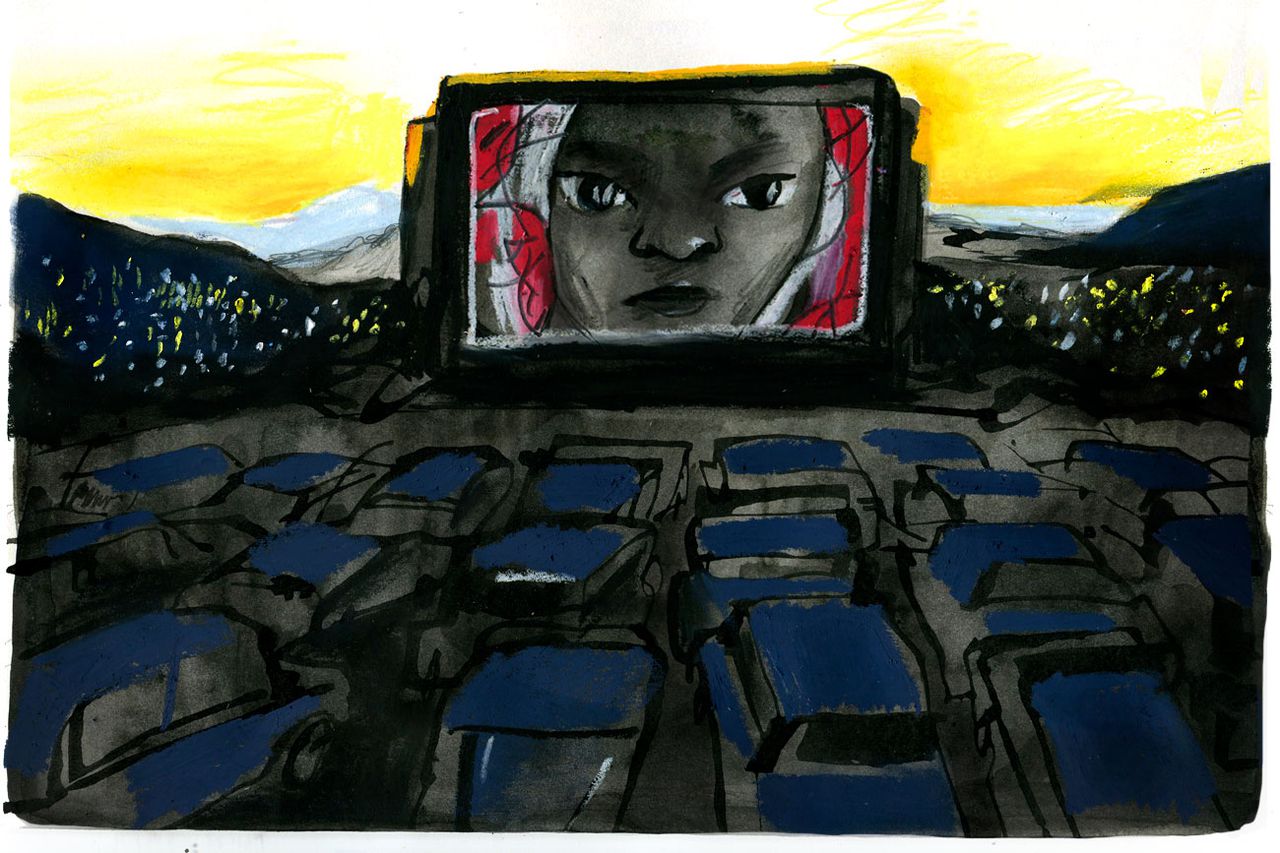
For the past two years, I have been shooting short films about its finalists for the Aurora humanitarian award - as a rule, these are people from the most terrible places on Earth.
The editorial office of Batenka invited me to speculate on the topic: “Should war, mass crimes and other horrors look beautiful in documentary cinema? Is this not aesthetizing violence? " The question is provocative, because it questions the ethics of the work of the photographer, a documentary and even a reporter in hot spots: real people die, and these scaders think how to give material more poisonous.
Here, of course, you can’t do without Susan Umbable, whose essay “Looking at the Pain of others” answers this question more or less unambiguously. There is nothing ineveless here, says the umbrella, because the victims of large -scale misfortunes are always interested in finding the world to find out about them. It is felt very well in refugee camps. Usually in Africa people, seeing the “muzung” (the common name of the white man) with the camera, react negatively: they hide their faces, curses, ask for money. But the refugees behave exactly the opposite - they put on the film crew, promptly talk about their hardships, invite you to look at their wretched dwelling. The living conditions in the camps are monstrous, the situation can no longer become worse, and the muzung hung with equipment for them is a ray, albeit ghostly, but hope.
And yes, we still try to beautifully remove even such a terrible place as a camp for internally moved faces in Mogadish. We use the Slow Mo mode because the slow -down shots are more convincing and more meaningful. We ask our guards to walk with machine guns past a little snotty boy - a good, in the sense of a terrible shot. Then we apply embedient music on installation to enhance the feeling of fear, tension, despair .
It is stupid to argue that human tragedies are poetic and even beautiful in their own way, and the larger the scale, the stronger they fascinate.
This feature of the human psyche was well understood by terrorists: they have long been trying to furnish their villains as colorful as possible. On September 11, with its epic scope reminiscent of Hollywood blockbusters, it became the standard of a “successful” terrorist attack. Enterity is important no less than performance. ISIS is especially actively using this. Everyone saw these personnel: the hostage, which is now cut off, stands on the knees in an orange robe against the backdrop of sandy landscapes, is the lifting nasomes behind the scenes, a person in a balaclava brings a knife ... In these carefully directed rollers, which are often taken as a production, really a lot of devilish obscene beauty, making them something akin to pornography. In fact, the terrorists are only trying to comply with the requests of the audience and in this sense differs little from the British ITN channel, which on September 11, the whole day twisted the frames of destruction of twin towers to the dramatic music of Wagner. “We just wanted to strengthen the impression of what happened, without making any sunbathing comments,” said the channel chief editor in response to accusations of vulgarity.
Interestingly, in the territories controlled by terrorists, any spectacles are prohibited, except for public executions. Theater, cinema, music is from Shaitan. In the documentary “The City of Ghosts” there are shots shot on Rakki Squares - the capital of ISIS. The crowd stands near the scaffold, in the eyes - excitement. Sontag writes about the voyeurist interest of people to death - this is one of the reasons for the popularity of "bad news" on TV. She puts an image of violence in a row with pornography - both are equally staggering and ultimately leads to insensibility. In this case, the craving for monitoring the murder is the most disgusting type of pornography.
The questions that I asked in Africa were rather an ethical, not aesthetic nature. In the Western press you can find the term Disaster Pornography (as well as Poverty Porn, War Porn and the like). As a rule, we are talking about white journalists/photographers who come to Africa to human safari: find and show children dying of hunger, destroyed by the war of the city, raped women and smug militants with Kalashnikovs. All this is considered the exploitation of violence and stereotypes. No matter how regrettable, this is what our film crew had to do. Because nowhere in the world there are so much violence and disasters as in Africa. It is necessary to talk about this-as long as the situation is preserved when the deaths of hunger are threatened in Somalia by millions of people, and up to seven billion dollars has fallen in the shares of the next senseless mobile application. I seriously oppressed me something else. There is such a term - “parachute journalism”: he came to the savages all in white, took their misfortunes, without going deep into details - and retired to his comfortable life, soon forgetting about their existence. And misfortunes did not disappear. This is a foul sensation of myself with a “parachutist” in Africa did not leave me.
There is a famous story about the South African photographer Kevin Carter (Samizdat told her in detail). He received Pulitzer for a picture taken in Sudan during the famine of the 93rd year. A small dystrophic girl sits without strength on the ground, and a vulture was attached behind her. A terrible and powerful image. Carter waited in an ambush for about twenty minutes to take this photo. Then he drove the vulture and went further in the direction of the center, which distributed humanitarian aid. The girl seemed to go there too, but she did not have enough strength. Carter did not help her in any way, because there were dozens of such dying children around. This cost the photographer dearly - public opinion crucified him for indifference, in some articles Carter himself was compared with the vulture waiting for the death of his victim. All this was deeply unfair: Carter, an honest, courageous and not at all insensitive guy, wrote that he was haunted by images of the dying people whom he shot. He was just not a “parachutist”-Africa was his homeland. Carter was the first to remove the “necklace” - a method of reprisal invented by fighters with an apartheid, when a tire is put on the neck of a lively victim and set aside. The “necklace” on the continent is still very popular-I came across YouTube on amateur shooting of executions when I mounted a video about the finalist of the prize from the Central African Republic. It would be better if I have never seen it. But back to the Carter. Three months after the presentation of Pulitzer, he committed suicide, unable to withstand the deepest inner crisis.
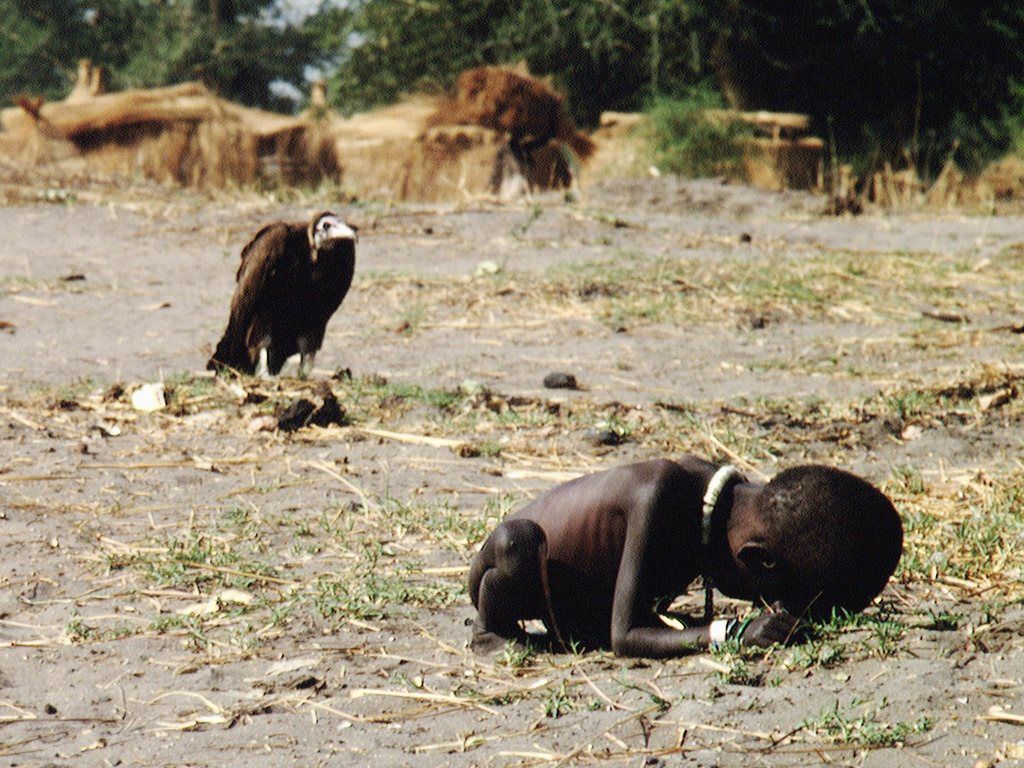
I remembered this story in a refugee camp in Mogadisho. We were already in Somalia for the fourth day, a complete darkness was going on around, which was only gathering with each shooting. We stopped in front of a woman with a baby in her arms. The refugee said that for two weeks they went to the camp for two weeks to escape from hunger, but they still have nothing to eat. While they were walking, the baby broke paralysis. To demonstrate this, she put the child on the legs - they gave up, like plush. We moved on, listening to the new stories of suffering and despair, but the baby’s face with plush legs did not come out of my head. And then it dawned on me, that in my backpack there was money deposited on the way back: I was going to spend it during a long transit stop in Istanbul. Imperceptibly put their boy's mother. She shone. I’m not telling this to show what a fine fellow I am: it is unlikely that my modest alms will save this family from long hunger.
Having finished shooting in this hell, we went to a safe base surrounded by a double perimeter, with an excellent Kenyan cook, preparing a variety of and tasty food. But my conscience did not torment me that evening: having worked as a professional, I at least tried to remain a man. There is nothing more important than this.