
Translated material
Profile: Vitalik Buterin
Creator of the Ethereum blockchain platform and the second most popular cryptocurrency, cooperating with authorities and companies.

On June 25, the price of the Ethereum cryptocurrency on the Ethereum platform fell briefly, rose back, and then began to fall again. Such extraordinary behavior of the exchange rate was the result of false information about the death of the creator of the cryptocurrency, Vitalik Buterin.
Over the past few years, the 23-year-old programmer has turned the spotlight on the blockchain industry, creating what many consider to be a revolutionary platform. Having survived the “ideological war”, by 2017 Buterin and his team had turned Ethereum into one of the leading cryptocurrencies, for which “miners” buy video cards, and from Ethereum into an ambitious blockchain platform, which, with the support of governments and companies of different countries, could become a step towards a new economic era, where the Internet will be at the forefront.
The birth of an idea
Vitalik Buterin was 19 years old when he formulated the concept of Ethereum. He was born in 1994 in the city of Kolomna, and at the age of six he moved with his parents to Canada. Fond of mathematics and computer technology since childhood, from 2007 to 2010 he spent a lot of time in the MMORPG World of Warcraft. Like millions of other people, the game took a lot of time as a programmer, but when publisher Blizzard changed the damage level of the Life Siphon spell on one of Buterin's favorite heroes, he quit the game.
The programmer was looking for new entertainment, and in 2011 he found one in Bitcoin. At first, cryptocurrency seemed like a small project to him, but a few weeks later he got his first job, writing articles about cryptocurrency at Bitcoin Weekly. In an hour he received about 1.5 dollars, and a little later he founded the publication Bitcoin Magazine .
He managed to enter the Canadian University of Waterloo, but devoted more and more time to crypto projects. In 2013, he worked up to 30 hours a week on them, lost interest in his studies and dropped out of university. And at the end of the year, the Bitcoin rate skyrocketed , capturing the attention of the IT industry.
On this wave, Buterin began to travel the world, attending various Bitcoin conferences and helping various open source projects. In 2014, he won the World Technology Awards, beating out Mark Zuckerberg. And later received a grant for 100 thousand dollars from the foundation of PayPal founder Peter Thiel. With this money, he planned to create a project, the idea of which he formulated for several years.
Creation of Ethereum
Buterin liked Bitcoin, but the cryptocurrency, in the programmer’s opinion, had too limited functionality. It was not a developed system, but only an unusual way of transactions. The programmer saw much greater potential in cryptocurrencies and blockchain technology, on which Bitcoin operates.
Blockchain is a data storage technology where any information is recorded, as if “closed” on a previously created data block. It is impossible to change at least part of the data, otherwise it will lead to an error in the entire branch of the block. For the blockchain and the cryptocurrencies based on it to work, decentralization is needed - therefore, blocks of data are stored in different places, for example, with miners. This is required to ensure that an attacker cannot change all copies of the blockchain at once.
This is how blockchain technology works. The principle of its operation is most clearly described using the example of a notebook for promissory notes. With the help of blockchain, you can always find out the true owner or sender of money, since the entire chain of transactions and transfers is stored in blocks. In theory (and somewhere already in practice), this system simplifies public and private registries, the functions of notaries, cadastral disputes and other things related to the transfer of money. Simply put, technology greatly simplifies the bureaucratic system.

By 2017, the value of blockchain had been described many times, but at the end of 2014, far fewer people knew about its potential. Buterin was among them. His idea was to create a platform, essentially a new branch of social networks, that would store and protect market data of companies, banks and infrastructure institutions, working on a decentralized system and with the Smart Contract function. She was responsible for simplifying money transfers and any transactions involving money.
It was necessary to tell the world about the platform and ensure that the number of transactions on it grew. It took time. Some immediately understood the idea and believed in it. But there were also those who called us swindlers and the project unrealistic, because they believed that it was technologically impossible to implement it.
Vitalik Buterin, co-founder of the Ethereum blockchain platform
Buterin described the concept of Ethereum to friends, after which new participants were involved in the development, and the project was made public. The programmer noted that the most difficult stage of the work was creating a blockchain system from scratch, the possible holes of which had to be regularly checked and closed. This took the team much longer than Buterin and the three co-founders of Ethereum planned: Mihai Alisie, Anthony Di Iorio and Charles Hoskinson.
In early 2014, the team founded Ethereum Switzerland GmbH in Switzerland. Buterin explained : the authors of the project decided to open a head office in Switzerland because there are many banks and financial institutions there that may be interested in the technology, plus liberal laws regarding cryptocurrencies.

The idea of an Internet platform built on blockchain technology and Smart Contracts, which almost completely eliminates the human factor and speeds up financial processes, has attracted a lot of attention. In the summer of 2014, Buterin’s team and their Ethereum project collected over 31 thousand bitcoins through crowdfunding. In exchange for them, users received 60 thousand ether tokens (Ethereum cryptocurrency), something like shares that do not give control rights. By exchanging bitcoins, Buterin earned $18 million, which he invested in the development of the protocol. The platform launched in July 2015.
The team limited the capabilities of Ether (a unit of Ethereum) so that it could only be exchanged for Bitcoin or vice versa. No other cryptocurrencies were used. In addition, the platform’s functions have added the ability to create your own program or cryptocurrency. The benefit was that the authors of the new cryptocurrency could use the functions of Ethereum, including Smart Contracts.

Ideological war
Less than a year later, in the spring of 2016, Ethereum was rapidly gaining popularity among both private companies and startups. The platform was still considered a field for risky experiments. One of them was The DAO, a blockchain project using the Buterin system.
On April 30, the authors of decentralized development announced they were raising funds to launch the service. The project was described in technology media as “an ambitious economic organization that offers complete transparency, unprecedented flexibility and autonomous governance using blockchain.” By May 21, the project had received $154 million and more than 12 million ether ($50 million at the then exchange rate).
For the platform's management, which had only hoped to raise $5 million, the crowdfunding campaign was a remarkable success. The blockchain protection of Ethereum seemed reliable to the authors, and any day they were going to invest money in continuing development.
However, the situation got out of control. An unknown hacker found a loophole in the source code of The DAO, with the help of which he managed to siphon 12 million ether from the startup’s accounts. For about six hours, the authors of the project tried to plug the hole in the system: they could not log into their profile, the site was constantly crashing and rising. The company was saved from instant collapse only by the Ethereum protection system: the cryptocurrency can be withdrawn only after a specific period of time - a little more than a month.
The creators of The DAO had 34 days to figure out how to return the money to the real owners.
The reputation of The DAO and Ethereum is in a difficult position. The decentralized system, which was considered so secure, allowed the attacker to steal a huge amount, but no one understood how to get it back. And while the authors were trying to come up with a solution, the Ethereum rate was rapidly falling: in a couple of days the price dropped from 22 to 12 dollars.
Blockchain is a very new technology, its capabilities are not fully understood, so when programmers tried to track the hacker's transaction data, it turned out to be almost impossible. The authors were able to find only the long and encrypted address of the attacker, and only had to start from that.
The management of The DAO involved the FBI offices in New York and Boston in the investigation, but the intelligence services were unable to find the attacker. Members of the Ethereum community were looking for the hacker, but they were unable to find the thief. The only assumption we could make about the hacker was that he did not act alone, but as part of a group from Switzerland. The attacker himself published an open letter in which he stated that he acted within the rules of the service and did not violate anything.
A month after the start of the crisis, on July 20, the authors of The DAO had two options for solving the problem, one of which was proposed by Buterin. The head of Ethereum wanted to use the “ soft fork ” method - freezing all stolen funds and then rolling back the block of the blockchain until the moment of hacking.

Since the Ethereum structure is decentralized, all changes to the system are introduced only through community voting. Buterin was supported almost unanimously, but debate raged within the organization and in the community about the second option - a “hard fork ” - updating the Ethereum protocols and dividing the system into two “universes”. Despite protests, management decided to take this more radical approach.
In one, the hack never happened, and the stolen money remained in people's accounts. In another “universe” a hack took place. The trick was that the "hacked" version would disappear after the system was patched. But when the division was completed, the authors were faced with a new problem - the community split into two camps: some accepted the emergence of a second “universe,” while others said that this was a violation of decentralization standards and the concept of blockchain.
This ideological war led to community members continuing to mine in the original “universe” where the hack took place. It soon gained too much value to be removed, and a group of volunteers led by a man under the pseudonym Arvicco ( rumored to live in Russia) created Ethereum Classic, the second cryptocurrency within the platform. Currently, the price of its token is approximately $19. The price of the updated Ethereum, in which hacking has never occurred, is about $300.

The community blamed The DAO for the theft; allegedly the programming team made a mistake in the code, which led to the crisis. This was also recognized by some company participants. After losing users' money, many systems that exchange cryptocurrencies for fiduciary (ordinary paper) money removed DAO from their registry.
From that moment on, the rate of the token began to fall, now it costs less than a dollar. As for the hacker, he took about 50 million dollars at the exchange rate as of October 2016 from the original “universe” (according to another version , the hacker stole about 100 million dollars).
The failure of the DAO project, which received such widespread support, showed blockchain supporters the vulnerability of the platform. Despite decentralization, hackers managed to find vulnerabilities. And the crisis of opinion that unfolded after the hack became unprecedented proof of the unpredictability of crypto platforms and Ethereum.
Connection of Ethereum with the Akasha project
In April 2017, Buterin stated that the platform team is trying to remain neutral and does not make assessments regarding other cryptocurrencies and teams. However, the platform partners with various companies, including Akasha.
In May 2016, Bitcoin Magazine founder and Ethereum vice president Mihai Alisie introduced Akasha, a decentralized social network similar to Facebook, where people communicate, leave comments and like each other. Buterin acts as an advisor to the project, he works on the Ethereum system and the Inter Planetary File System (IPFS) - a p2p hypermedia protocol similar to torrent trackers.
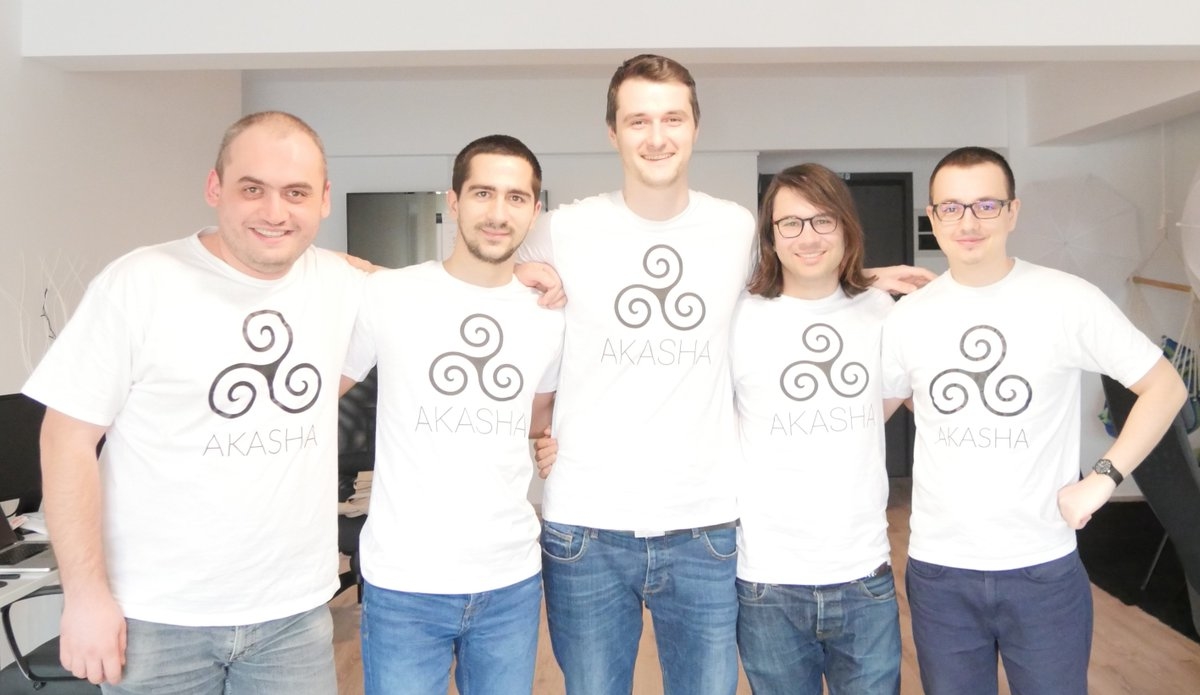
According to Alize, Akasha will solve the problem of manipulation of ratings and content, when special companies on social networks create armies of bots or non-existent subscribers, or publish unconfirmed, deliberately false information. That is, we can assume that this will also help in the fight against fake news, a phenomenon that began to be discussed after the US presidential election in November 2016.
Akasha user files and records are not stored on servers and are protected by blockchain protocols. It allows you to conduct transactions using the Ethereum cryptocurrency, including receiving payments for posts and downloading content. At the same time, Buterin noted that the social network should not be considered as a way to earn money.
In addition to fighting bots, the authors of Akasha intend to defeat the problem of “perishability of stored information” on the Internet, including websites, documents, email archives or videos. This data can easily be deleted by governments or corporations, or it can simply disappear because the hosting owner stops paying for the content of the resource.
The next time you come across a 404 page, remember that it is a small tragedy in itself. This can be compared to our collective brain losing part of its memory. We live in an information age that is subject to censorship and digital amnesia. This affects every network user.
Mihai Alize, creator of Akasha and co-founder of Ethereum
A striking example of repositories of once-deleted resources is Archive.org. However, this is also only a centralized server, which the government of some countries, including Russia, has already blocked. Akasha should become a decentralized data storage infrastructure.
Many details of the project are not yet known, but a complete list of stages of development of the service is listed on the official website. The service is currently available in alpha version, its interface resembles a hybrid of Medium and Facebook. The official release of the application is scheduled for the end of 2017.
Ethereum in China
The first hint of plans to expand Ethereum into the Chinese market, which is quite difficult for Western projects to enter, happened around 2015. Then it became known that Buterin was learning Chinese. Since then the situation has changed dramatically. In May 2016, the co-founder of Ethereum joined the Chinese ChinaLedger Alliance, created to promote blockchain technology in the country. The company's members include the Chinese Mint, China's largest subsidiary Alibaba Group, Baidu, Meituan and Peking University.
In May 2017, one of China's top three cryptocurrency exchange companies, Huobi, officially added Ethereum to its registry. According to the management of the exchanger, they came to this decision against the background of the rapid rise in price of Ethereum.
Buterin's currency has long been popular in Asia, including Japan and South Korea, but now the heads of Alibaba intend to integrate Ethereum into the Alipay service, which is used by about 450 million people in the country. At the moment, South Korea is considered the largest Ethereum exchange market with more than 19% of the global market share. If China's interest in the site continues, it could quickly take over the Korean share.

Ethereum's other connection to China comes from Singapore-based startup TenX, which held its ICO on June 24, a sort of cryptocurrency crowdfunding. The idea of the project is to store cryptocurrency on regular debit cards, rather than regular money.
Two months earlier, the company announced that it had received a million investments from the Chinese venture fund Fenbushi Capital, co-founded by Buterin. At the same time, the creator of Ethereum claimed that he does not invest personal money in the startup, only stock funds. It is noteworthy that he prohibits startups from publicly talking about the fact that he advises them, but in the case of TenX he acts openly.
"Alliance of Entrepreneurs"
In March 2017, several blockchain startups, research groups and representatives of the largest technology companies in the world formed the non-profit organization Enterprise Ethereum Alliance. It included Cornell University, Toyota Group, Microsoft, Intel, Samsung SDS and the National Bank of Canada. In total, the number of initial participants was 116 institutions from different countries.
The alliance consults and develops private blockchain platforms with Ethereum, which each organization will then receive for their personal needs. In addition, community members monitor the operation of the platform and advise on security issues. Microsoft is developing software based on Ethereum. These will be closed versions of the platform, which will be created specifically for each institution. The beta version of the service is already used by the Chinese mint and the largest American bank in terms of assets, JPMorgan.

According to the chief blockchain architect at Microsoft, when people talk about Smart Contract technology, the first thing people mention is the capabilities of Ethereum. In January 2017, the largest consulting company Accenture said that blockchain technologies could save banks from 8 to 12 billion dollars per year (about 30% of total costs), which could be spent on infrastructure costs. Accenture is listed as a member of the Ethereum Alliance.
However, such large-scale prospects are still hampered by the limitations of the platform. According to Buterin, Ethereum does not yet have the ability to offer services to millions of users. In addition, not all people and organizations are ready to publish their transactions on the Internet, and in such cases, Buterin’s team will have to create additional encryption keys.
Ethereum in Russia
Russian authorities and banks became interested in the possibilities of Ethereum blockchain technology after the platform’s heyday. In 2016, Sberbank announced that it was the first to use the functions of Buterin’s platform to issue a power of attorney and work with an account based on it. The head of the state bank, German Gref, and the head of the Central Bank, Elvira Nabiullina, spoke positively about the possibilities of blockchain and Ethereum.
In 2016, the Central Bank even announced the launch of the MasterChain platform, which will allow market participants to exchange information in a closed blockchain service in the future. The technology research was carried out together with representatives of Sberbank, Otkritie Bank, Alfa-Bank, Tinkoff and QIWI. In September of the same year, Gref argued that large-scale use of the technology would begin no earlier than the end of 2017 or the beginning of 2018.
In May 2016, it became known that Ethereum plans to open a blockchain technology research center in the Skolkovo innovation center, which supports scientific developments in energy, energy efficiency, space, biomedicine, nuclear and computer technologies.

In February 2017, it was reported that the Moscow authorities planned to use blockchain in Active Citizen voting, but the State Duma considered that today the use of neural networks and blockchain for election control cannot meet security standards.
In April 2017, it became known about the government's plans to use blockchain and machine learning when developing laws, and in May Buterin said that blockchain technology has prospects in Russia and that it will help in the fight against corruption. On June 3, the founder of Ethereum discussed the possibilities of blockchain with Vladimir Putin.
Earlier, Buterin said that in Russia the company seeks to popularize blockchain technology, stimulate Russian software companies - Acronis, Kaspersky Lab, Yandex and others - so that they include Ethereum support in future versions of their products. In addition, Buterin hopes to stimulate the development of Russian developer communities so that small startups become more actively interested in blockchain.

But besides official agreements with the government and companies, Ethereum has another way to reach the Russian audience. From the beginning of March to June 13, Ethereum rose in price 24 times, and Russian miners were probably partly involved in these changes. At the beginning of summer, video cards practically disappeared from sale in many Russian stores, and their prices doubled in a month and a half. Sellers and specialists in stores admitted that they mine Ethereum, not Bitcoin, using video card “farms.”
Apparently, this is due to the fact that mining Bitcoin has become too unprofitable: calculating the hash amount takes too much electricity, the costs of which are sometimes difficult to cover. Ethereum is considered the second most popular cryptocurrency.
Buterin himself recently commented on his old opinion about blockchain technology, including thanks to which the market capitalization of Ethereum is more than $4 billion. Even before the creation of the platform, he was surprised how such a system could work and how the numbers in the computer could bring profit. Since creating his own platform, having gone through many difficulties, he found the answer to the question.
I would answer this way: their [figures'] value depends on what people think about them. This is such an emotional moment. Just like a square meter of land in one place costs much more than in another. There is no one reason why the cost is this way and not another. It’s just that the market has already formed and people trust the currency of our platform - that’s probably all that’s needed.
Vitalik Buterin, co-founder of the Ethereum blockchain platform
#profile #cryptocurrencies #ethereum #ico #gold fund