
Translated material
In relation to circumstances
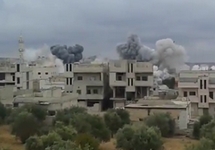
The regime of the Syrian President Bashar Assad did not fulfill the obligations to destroy chemical weapons and continues to use it. This is stated in the statement of the US State Department.
"The facts indicate an unworthy and extremely dangerous use of chemical weapons by the Assad regime. It continues to use chemical weapons and has not fulfilled the program to destroy it in full, which is a violation of its legal obligations in accordance with the Convention on the prohibition of chemical weapons and a resolution of 2118 Security Councils," the document emphasizes.
The statement of the State Department is based on a report of the organization on the prohibition of chemical weapons (OPCHO), which is widespread on Thursday, which confirms the fact of the use of Zarin on April 4 in the Syrian Khan-Sheikhun or a similar "poisonous substance. Ozkhu came to this conclusion on the basis of a “wide range of information”, an analysis of samples taken from the victims and in the environment, as well as evidence of eyewitnesses. The report will be transferred to the joint investigation mechanism (FFM), formed by the OPCHU and the UN, "to establish who is responsible for the attack" in Khan-Sheikhun.
On Monday, the White House spokeswoman Sean Spicer said that the same actions of the military Assad were recorded as they took before the April Himataku for the city of Khan-Sheikhun controlled by the rebels. “If Assad commits another mass murder with the use of chemical weapons, he and his military will pay a high price,” Spicer said in this regard.
The US Permanent Representative to the UN Nikki Haley, in turn, said that the responsibility for further attacks on the civilian population of Syria will be "entrusted to Assad, as well as to Russia and Iran."
The official representative of the Russian Foreign Ministry Maria Zakharova called Washington’s statement a provocation against Syria and Russia. "We do not know on the basis of what data such conclusions were made. The situation created as a result, in principle, resembles a large -scale provocation both in the military and information plan, which is directed not only against the Syrian authorities, but also against Russia," Zakharova noted.
On Wednesday, the head of the Pentagon Jim Mattis suggested that the Assad regime was abstained from another chemical attack after the warning received from Washington. To the clarifying question whether Mattis believes that Assad, in principle, abandoned further chemical attacks, the head of the Pentagon replied: "I think you better ask Assad about it."
The attack on Khan Sheikhun was committed on April 4 . Bombs with Zarin, as well as presumably chlorine, were thrown into the city. As a result of the raid, more than 80 people died, including children.
On the night of April 7, the United States fired at the Ash-Shayrat base with winged missiles , destroying it almost completely. It was the most stringent US action in Syria for all six years of the war, continuing in the Middle Eastern country.
On April 12, Russia imposed a veto on the draft resolution of the UN Security Council condemning a raid on Khan-Sheikhun and the demand for Assad to promote an international investigation of this crime.
On April 25, the United States expanded sanctions against Syria because of Han-Sheikhuna. 271 employee of the Syrian National Research Center - a state institution, which is supposed to be in the production of chemical weapons and means of its delivery, underwent restrictions.