
Translated material
Sergey Shnurov - Human Riceman
On June 7, the Moscow Museum of Contemporary Art on the Tver Boulevard exhibition of the soloist of the Leningrad group Sergei Shnurov “Retrospective of Brendrealism”, dedicated to the decade since the creation of this style by Shnurov himself and the twentieth anniversary of the group. The curator of the project Dmitry Ozerkov recently brought Yana Fabra to the St. Petersburg Hermitage, and now I have injured Shnurov in the field of artistic brands of the capital (mommy) and St. Petersburg (Erarta). We understand how the cord has become an exhibit of our own exhibition.
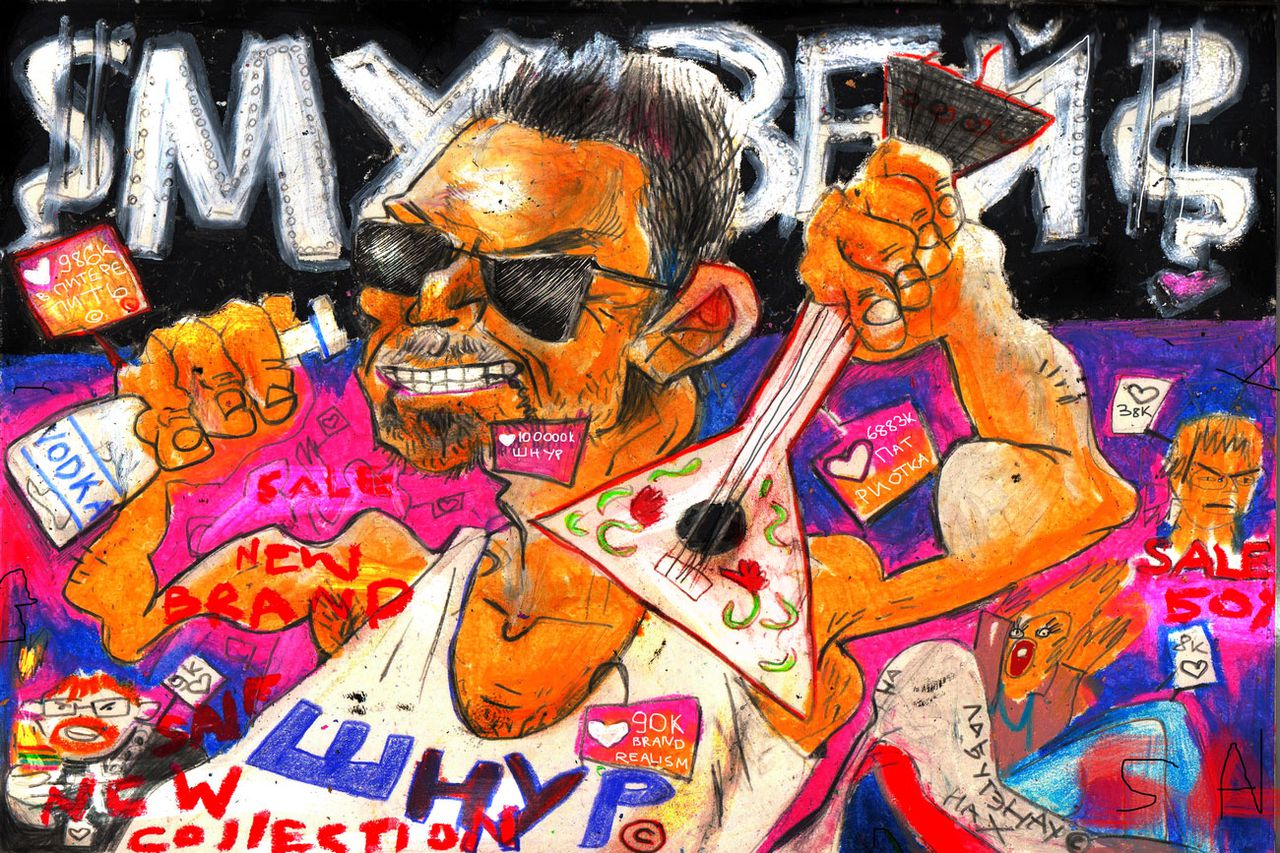
According to the curator in the introductory text, the concept of “brandrealism” was invented by Sergey Shnurov himself in 2007. On the museum’s website you can read that the exhibition is presented by “a potentially new direction in art, which reflects the transformation of modern life”. Shnurov himself claims that Brendrealism was born with him on April 13, 1973. The first exhibition in the style of brandrealism “ Exclusive Brendrealism ” was held in Moscow in 2010. Shnurov showed eight paintings in the Fineart gallery not without the help of his friend Dmitry Shorin, an artist, whose canvases are suspiciously similar to what is now exhibited in the mommy.
The basic concept of brandrealism is that the modern world has turned into a brand production machine, and people into consumers. Everything is a brand, and you are not you when you choose not a brand. Although you choose a brand in any case. But this is not the choice of the soul - as Cordov believes. The possession of unique products, brandrealism recognizes not the original, but the acquired need of pure spirit. Brendrealism is also critically expressed on the topic of contemporary art, which also became subject to the gaze of the one who wants to acquire it - and therefore, also became a brand. The brand is everything that exists: every symbol operated by culture, advertising, art, just a person is a brand. A person wanders, as in a mirror maze, in the world of brands that replaced the images, or reborn in them, and cannot find peace, since a pure spirit requires something else. What the spirit requires is not clear either from texts or from art itself, which is a natural continuation of the theory.
In the early sixties, Andy Warhol created a series of paintings with banks of Campbell soup , and in 2017, the black cans with the inscriptions “densely” are at the exhibition of brandrealism (of course, the work is called “oil”). A bright pink sculpture made of plastic in the form of inverted testicles in a scrotum called “Like”, sumpers from plastic plates, a knitted portrait of Zemfira in the national Tatar suit of the “Zemfira alive” bride, blue glasses and a glass on an empty table (Leps sung ”the composition). Instead of the Warholovskaya Marilyn at Shnurov - Zemfira. Instead of an anonymous bully, Banksy is an anonymous mannequin in Adidas, trying to write the most famous word in Russia on a pink wall with the Nike logo (the composition is called “Left” with a hint of universal Russian giftedness). Instead of the burials of Joseph Boyce (Palazzo Regale, 1985)-a coffin in the form of a Coca-Cola refrigerator, stuffed with sugar cubes to the edges. And a dozen other symbolic exercises.

It is amazing that there is not one among the exhibits that would be dedicated to Shnurov himself. His only portrait is in a picture with a printed screens from the clip “Leningrad”, but in this picture the main character is still the clip (or the clip as a brand). Surprisingly, since the audience goes, of course, not to the exhibition itself, but to the name of Shnurov: the most powerful brand of the exposition in this case is the name of the artist. For these adults of wealthy people, this name is the only reason to line up in the queue . Who would go to look at the next visual reflection of the genitals if it were not the genitals of Sergei Shnurov? In addition, the people are delighted that the forever hangover soloist of the Leningrad group, whom Yuri Luzhkov for genital poetry forbade at one time, today goes to the museum from the front door and flaunts knowledge of the word “retrospective”!
As a brand of cords, he develops rapidly, turning from a drunk person into a shirt No Name into post -chimmer Clogol in the vest of Balenciaga. In recent years, he not only became the hero of the fashion-piece in various publications (Dog.ru, SNC, Esquire-covers), starred in the Balenciaga for Dog.ru and participated in Rap Battle with Ivan Urgant , but also applied the Hero of “600 seconds” and the main utility of the country Alexander Nevzorov. Glebych Schnuru repaid intellectual conversations, in which the latter finally found the use of the experience of three-year philosophy at the theological institute-and now the famous banguine pussy from the stage has already performed with Vitaly Dymarsky at “amateurish readings”, as some expert on modern culture.
"In general, my place in the minds of youth is greatly exaggerated."
Sergey Shnurov
On the example of the figure of Sergei Shnurov himself, you can study the evolution of the brand as a species: starting with a complex image (eggs, tobacco, fodder and bristles), the brand over time is overgrown with signs of lifstail (mat, non-grata, consistent alcoholism) and concept (deconstruction of the norm). But the cherished dream of any brand is to turn into a meme , that is, to begin to multiply freely in the information environment. For some time now, Shnurov really tries to behave like a memetic virus: at first he applied cultural memes in his clips, parasitizing on the folk glory of Van Gogh, “Labutenov” , Ksenia Sobchak and which only not. By the way, he was canonized and recognized by the Holy of the Russian Pastafarian Church. And now - brandrealism in which the tradition of shameless quoting with fashion for fake was combined. According to Sergei Shnurov himself, he comes up with the concept that hired workers embodied for him - all according to the covenants of Damien Hurst. The works themselves are built conceptually according to the principle of semantic collage, as in the good old dummy memes: like + male eggs, Zemfira + Tsoi, selfie + tombstone. Or the exhibit “Running Line” with a running line on the site on the score - a somewhat naive Ommage “ Treaty of images ” by Rene Magritte. Of course, the main meme at the meme exhibition is Sergey Shnurov himself, without which the exhibition would be simply bored. Thank God, the cord made a small excursion for all the indifferent.

"" Drink in St. Petersburg! " “This, sorry, for a high parallel, as Dostoevsky came up with white nights.”
Sergey Shnurov
Probably, this exhibition of naive conceptualism has become a reaction to the excessive complication of meanings and a breakdown of form in contemporary art. The cord knows how to turn to the people and receives the gratitude of fans for this: finally, after visiting the exhibition of contemporary art, the viewer will not feel characteristic irritation, finally everything will be clear to him.
The Moscow Museum of Contemporary Art provided a platform in one of its buildings, calling himself a “neutral place where the viewer is invited to get acquainted with the manifestations of actual art” and setting his goal “ the formation of the general public in the field of culture and art” . However, the exhibition, of course, lacks the educational potential and a brief excursion in the concept from which the tree of brandrealism grows. There is a suspicion that the creators of the exhibition cunningly decided to use the gaps in the education of the viewer and put Shnurov and really the creator of the original concept - by brushing off, though the “society of the performance” of Gi Deborah.
If the reader is interested in this issue, we refer it to software texts so as not to get into the category of “suckers in dumbfound” from a meeting with such a complex name as “a retrospective of brandrealism”. “ A work of art in the era of its technical reproduction ” Walter Benjamin and the chapter “ Pop art: the art of consumption society? "From the book of Jean Bodriyar," Consumption Society. Its myths and structures ”are classic texts on the topic to help you. The book of Thierry de Duva “ The Bays of Marx: Boys, Warhol, Klein, Dyushan ” will tell about turning the artist into a production car in the postmodern world, and Irina Kulik's lecture for the Garage Museum of Modern Art will introduce pop art to the discourse. The most restless - early studies, for example, the “ theory of idle class ” Veblen.