
Translated material
Jules Verne against Robinson
"Mysterious Island": French answer to Daniel Defoe
“Robinson Cruzo” Daniel Defoe and the “mysterious island” of Jules Verne are the two most famous novels about survival on a uninhabited island. Especially for Gorky, Maria Elifarova compared these books, talked about how the Frenchman argued with the Englishman, and at the same time explained what was missed in popular Russian translations.Jules Verne, as you know, was a very prolific writer. However, he has a few real masterpieces. You can argue about tastes, but for me the most “mysterious island” from his novels. First of all, the ideal mischievousness delights in him. Between the arrival of the balloon and the final immersion of the island in the sea abyss there is no dynamics, any need for the adhesion of events - they could take place in that sequence, but could in another. Indeed, they could in another: the heroes manage to cut a spillway, the animal is quite large, a few chapters before they had knives. Jules Verne took out of the novel absolutely all the traditional plot engines, including the love, - and demonstrated that without all this, the novel can be read with binge, without looking up.
Moreover, note: “The mysterious island” is not only plunder, but also conflict. There are not the slightest friction between the heroes all the time. The modern reader is spoiled by the “lord of flies”, and for Jules the very thought that five good people on a desert island may experience a desire to beat each other is impossible. An amazing thing: in one place, as many as five positive heroes gathered, who will not even say to each other a rude word (although, it would seem, the sailor’s ease should be expected from the sailor of Pencroft), and this does not cause any objections. These heroes do not seem at all sugarin, they give the impression of reliably depicted ordinary people, despite the fact that Jules Verne clearly does not belong to the masters of psychological realism. What is the secret? Obviously, the author avoids showing heroes in situations where they could look sweet. They do not commit “noble deeds” - they simply keep with dignity in everyday life.
The scientific and cognitive value of the novel, of course, is currently equal to zero. What is really brilliant in it is the understanding of the Robinsonada genre itself. The name "Robinsonade" naturally refers to the "Robinson Crusoe" Daniel Defoe - the text to which the genealogy genre is being built. In fact, Roman Defoe, published in 1719, was not the first story of the “man on the island” in world literature (recall at least Shakespeare's “storm”). And yet he played a special role in the history of literature - so much that he is rightfully called the first modern European novel.

Defoe was the first to make the story of “Man on the Island” by the main plot of the story. The novel effectively deceives the reader: after a small series of rapidly changing adventures, the hero enters the uninhabited island, and ... and nothing. The next 28 years of his life (and most of the novel) Robinson spends completely alone on the island, even Friday appears only in the last third of the book. For the then era of an adventurous novel, which required continuous travels, intrigues, love dates and fights, this is an incredibly bold innovation.
Why did the definos need to put a single hero on a desert island? Recall that the author of Robinson Crusoe lived at the dawn of the Enlightenment, which was a lively way of the problem of “natural man”. However, how to determine what is natural for a person and what is introduced by the influence of society? It is logical to put a mental experiment and simply a person from the society to “take out”. According to Defoe, such a model can serve as a victim of a shipwreck on a uninhabited island, forced to build his life from scratch.
But Defoe himself does not build his story from scratch. Here it is necessary to explain that most of us read in childhood not just the “Robinson” that Defoe wrote. In the retelling of K. Chukovsky, the entire religious philosophy of the novel was released, as well as many unsympathetic details of the hero’s youth - for example, trade in slaves. In the original, the adventures experienced by the hero are constantly commented on the point of view of God's Providence - at first by others, and then Robinson himself. For some reason, God wanted the events to turn around that way, and Robinson lands on the island. The islands in medieval lives were the place of solitude of the Holy Hermit. Robinson does not seem to be a saint - however, as you know, the best saints are made from repentant sinners.
The paradox is that Defoe belonged to the Puritans - the course of radical Protestantism, which does not recognize the cult of saints. Nevertheless, he builds a story on the life model. Robinson repents of disgrace and thirst for easy profit, learns to live with the humble labor of his hands: a hut, goats and a vegetable garden - what is not the life of a hermit? So that there is no doubt, the saints in solitude must visit the devil, and be calm, the devil will appear: “... peering into the darkness (since it was completely dark in the depths of the cave), I saw two burning eyes of a person or devil, I don’t know-they sparkled like stars <...> I was numb with horror; Cold sweat appeared all over my body, and my hair stood on end, so if I had a hat, I can’t vouch that it wouldn’t fall from my head ... Nevertheless, I didn’t lose my presence of spirit: trying to encourage myself with the thought that the Almighty could protect me everywhere, I moved forward again and in the light of the torch that I held over my head, saw a huge terrible old goat on the ground.
The demon, however, would turn out to be fake - it was the final test of Robinson before God will finally send him Friday. As stipulated by the living tradition, which has imbued with the spirit of Christianity, Robinson begins to introduce its exotic comrade to it. The life template - “Preach the truth to the pagans” - imperceptibly develops into the educational principle of the novel of education: “He is brought up - educate another.” And in full accordance with Protestant ethics, Robinson Crusoe gains a completely material reward for managing to spiritually reborn: upon returning from the island, he discovers that he had accumulated a considerable condition.
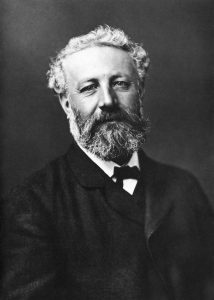
Jules Verne, a Frenchman living and writing a century and a half after Defoe, has a completely different worldview, and his novel was built as a conscious polemic with Robinson. From his point of view, the hero Defoe spends time on the island terribly unproductively (he takes several years to the healing column structure), and prayers cannot replace other people's societies. Belonging to French culture, bizarrely combining Catholicism and anti -religious skepticism, Jules Verne not accidentally chooses at all as the heroes of the Americans from the north, almost co -religionists of Defoe, because the North was populated by the Puritans.
The Russian translation was also unlucky with censorship: in the original, Jules Verne constantly emphasizes the Protestant piety of his American heroes, who, like Robinson Crusoe, every time they give praise to Providence, having discovered the next, so to speak, piano in the bushes. That's just the number of piano in the bushes goes off scale, and doubts are visited more and more pautan. Of course, in the end, it turns out that all miracles and incredible successes have purely earthly nature and are organized by Captain Nemo, who, since his island brought strangers, decided to help, but not to advertise his presence. Irony: The one whom they took for God not only turns out to be an ordinary person - he is not even a Christian.
However, most of the success, heroes still owe their knowledge, perseverance and the ability to work in a team. The elegant counterpoint to the history of five Americans is the history of Ayrton, the initial conditions for which were much better than their. Ayrton had everything that Robinson had at Defoe: a hut, instruments, a garden, goats and a Bible. Which, alas, did not help him. The meeting with a fierce to beast is preceded by a scene where the expedition discovers a moldy Bible in an abandoned house.
The Robinson plot is turned twice: the failed Robinson Airton simultaneously acts in the role of Friday. If Defoe Robinson is engaged in the upbringing of Friday's savage, accustoming him to his pants and Christianity, then the heroes of Jules Verne are pulled out of the state of wildness of the degrading white man, and, which is especially ironic, one of the participants in rehabilitation is a Negro, a former slave. It’s generally difficult for us to imagine what the American reader would feel a hundred years ago, having reached the scenes in which he does not ask who will help him in the kitchen today. I think Jules Verne well imagined what sedition from the point of view of the Americans he wrote, and consciously stuck. The polemic message is obvious: a lonely European with a dubious past on a uninhabited island is waiting for a rethinking of his life and rebirth, but degradation; You should not wait for help from religion. The touching religiosity of the five residents of the island of Lincoln is not a reason, but a consequence that they already have a moral rod. The skepticism in relation to religion is a traditional and integral element of French culture, and here Jules Verne, of course, is a very Frenchman.
At the same time, the plot of Captain Nemo tossing the secret help is also read in a different way: it is impossible to put a pure experiment with a robinsonade. Even the most competent and healthy team is not able to survive on the island without outside help. It is impossible in the field with your own hands, for example, to make modern medicines. Recall the episode where Captain Nemo delivers Herbert Khinin: a folk remedy in the form of willow bark, alas, turned out to be powerlessly against the infection brought into the wound. And this means that with all the power of technical knowledge, it is better not to get to the uninhabited island. The place of man is with humanity. And the idea of throwing a hero there with educational goals, as Defoe did - from the point of view of Jules Verne, is completely absurd. It is no accident that the re -education of Ayrton, when he repents in his former actions, occurs only thanks to contact with other people, and not a secluded life on the island with goats and the Bible.