
Translated material
Westworld
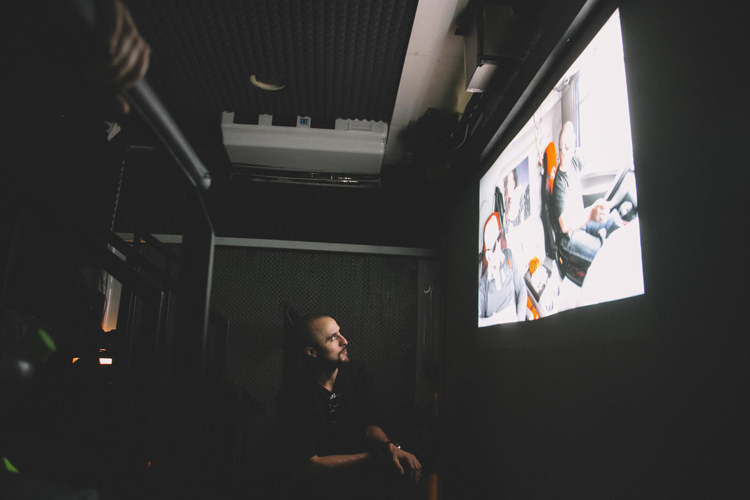
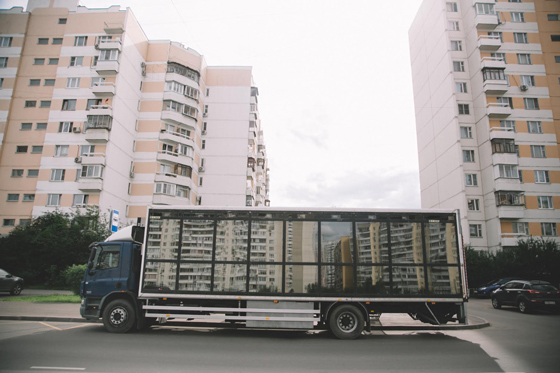
A sleepy trucker with a naked torso peeps out of the cab. The windows are curtailed - the driver parked in a cargo parking lot in Kapotne to relax after the flight. The trucker woke up the trucker: near his car there is a man with a set and speaks loudly into the void, now and then squinting at a newly -arrived truck with an unusual mirror body. "Where did you come from?" -the stranger asks the driver and for some reason repeats his answer to the microphone: from Kazan. The driver does not know that right now fifty people are watching their dialogue: a mirror -made truck, but transparent inside, and the body is equipped with three rows of soft seats.
A man with a headset is also a trucker: his name is Roman Romanov, he is one of the heroes of the Cargo Moscove play play. Typically, the novel carries goods from Magadan to Moscow - the road takes more than twenty days. This summer he has another job - to roll people on a steamer with another driver, Andrei Fomin, and tell passengers about life at the wheel: about the habits, about the diet, about the brands of trucks, about the first flights abroad, about thieves, on gas chafers, about families, about vacation, about domestic roads, along which the truck moves more slowly than according to Western.
Drivers call the audience only as a “load”.
Romanov and Fomin had predecessors in Bulgaria and Singapore. The documentary performance of the Bulgarian truckers “Cargo Sofia-X” was invented in 2006 by the Swiss director Stefan Kagi-ex-journalist and co-founder of the famous theater company Rimini Protokoll . Later editions - Asian and Russian - Kagi made a couple with Jorg Carrenbauer, his permanent co -author.
For the third year now, the main summer premieres in the capital is the same producer - Fedor Elyutin. The pilot episode of his theater series (and the first collaboration with Cage and Carrenbauer) was the Moscow version of the Remote X project - a hour and a half group walk around the city under the control of a barren voice like Siri . A year later, Elyutin launched another international project “Your_igra” - this time the Belgians of the Ontrorand GOED became his partners; In this performance, each viewer got a curator-actor who led him on a string of rooms, gently pushing him to an open conversation.
 © Dasha Nesterovskaya
Now, the producer took a new bar-two premieres with a difference of some few days: shortly before Cargo Moscow, a new OntroRend GEED production called Smile Off , which you worry (“watch” for this type of theater is an unsuitable word) with blindfolded hands and eyes. “Remote Moscow” and “Your_igra” also did not disappear - they will live at least another summer.
Elyutin did not just prove that in Moscow an experimental theater is able to feed itself - he gave the city a new original form of leisure. The producer prefers the word “performance” the vague term “expirence”, and this is not an empty whim: his projects can be advised to people who are indifferent to theatrical art or do not digest it at all. Instead of the recovery theater, Elyutin offers the public an adventure to the public. “Remote Moscow” , “Smile Off” , “Your_igra” - all these performances are based on interaction with the viewer and help him to know himself better.
 © Dasha Nesterovskaya
Cargo Moscow stands apart among them. The audience is passive here; Drivers call her only “load”. An important element of Remote Moscow was a reaction of passers -by: the participants were not just in sight - they had to perform strange tasks like ballet PA on an escalator. In Cargo, the passengers of the truck are invisible - they peep outside the city as if through a hidden camera, only in 3D . In a word, the idea of the fourth wall was found perfect.
“Welcome to Magadan,” the heroes of passengers welcome. The story of a 20-day flight from the Far East to the capital is superimposed on a one and a half hour trip to the Moscow outskirts. The curtains in a glass body rise, opening the view of real industrial zones, parking lots, gas stations and parks, then fall, turning into a screen with the frames of the mountains and taiga.
In “Remote X”, Kagi and Carrenbauer looked into the future, where people entrusted the cars to make decisions for themselves. “Cargo” , on the contrary, is an immersion in archaic, in a myth. The trucker is essentially the same cowboy, for nothing that the trucks are distilled instead of cattle: he is forced to fight the elements and wear weapons to defend himself from robbers. In his world, the archetypes of masculinity and femininity are nowhere: the husband on the road, his wife is waiting for him at home - the best director's find in “Cargo” is connected just with the wives of heroes.
 © Dasha Nesterovskaya
Spectators of the NET festival remember the production of Stefan Cage Sample in Kazakhstan : with examples of unprofessional actors-seekers, the director showed how politics intervenes in private fate. The “Cargo” stories of the heroes are also inscribed in the political context: the credits remind passengers of the events of new and recent history - from Stalinist construction sites to European sanctions - and explain their significance for champions. The latest certificates - of course, about the Plato system, which obliged the drivers of trucks to pay for travel along the federal routes, and the followed by the strike of truckers.
The secret of Rimini Protokoll is in a skillful combination of facts with emotions, the imagery of the theater with the clarity of numbers, personal evidence with statistics. Here Romanov talks about a dangerous river, which has to be crossed for a thing. Curtains are launched in the back, on the screen the video shooting of crossing alternates with photographs of trucks turned upside down. “This crossing I dream all the time,” the driver admits, while passengers observe how water floods the bumper of the car. The inscription over the image is dryly states: the bridge over the Aldan river has not yet been built. The curtains rise - and passengers see how soap water flows run along the windows with a continuous wall.