
Translated material
I believe, for it changes
The text continues the project on the Ecology "Variable" .
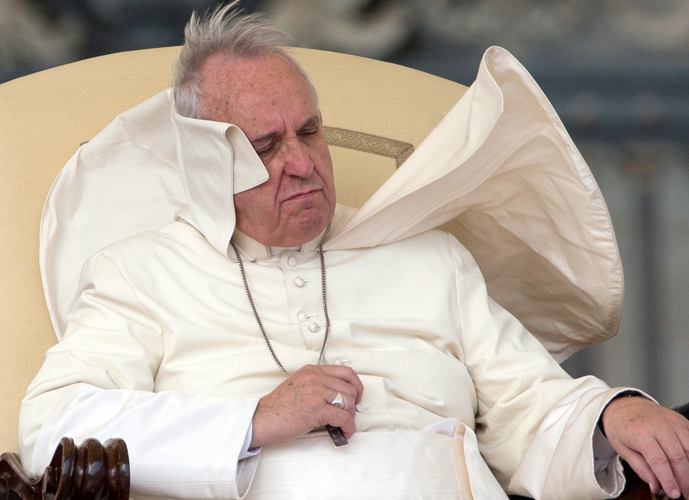
During the visit of Donald Trump to the Vatican in May of this year, Pope Francis gave him more than a transparent hint of the non -constructive position of the new American president - the encyclical “Laudato Si” , the papal message dedicated to the presentation of the church’s position on environmental issues and climate change. Encyclic with a large pomp came out in the summer of 2015 before the adoption of the Paris Climate Agreement, the very one from which Trump decided to leave in June. Either I did not read the 200-page document, or I read it, but this was not enough.
The Catholic Church is far from the only religious structure that formulated its position on such a worldly issue as climate change. Islamic theologians, some Jewish organizations, also presented their views in this matter, and the Dalai Lama repeatedly spoke about the importance of combating climate change. This may seem strange - where science is, and where faith is - but in fact, religious leaders are actively participating in the UN negotiations, protecting the interests of their followers.
However, it is hardly the climatic position of world and local religions that is explained only by the desire to “light up” at an international event. In the Abrahamic religions - Christianity, Judaism and Islam - the question of faith about the obligations of a person before the TVR -world, given to him by dominion, arises quite a question. Where are the limits of this rule and what can and cannot be done with the world that you tamed?
The papal document indicates the fallacy of the interpretation of the words about the “possession” of the earth, on which God blessed a person when creating it, as the right of a non -since the uniform and arbitrary disposal (although it recognizes that before these words were often understood that way). The pontiff, of course, is far from understanding the episodes of the book of being literally, and does not call anyone for this. However, Francis draws attention to the fact that the Lord, placing a person in the Eden garden, bequeaths him to “cultivate him and store him” - and not just exploit.
Of course, biblical quotes in many cases are not a final argument even for deeply believers - their understanding depends on the interpretation, and many statements can be challenged by other quotes. Nevertheless, Francis considered it necessary to propose such an interpretation of biblical symbols and prescriptions, which will allow you to coordinate religion with views on the integrity of the world and the danger of violation of environmental balance, which are adhere to environmental activists.
However, the encyclic does not come down to the interpretation of sacred texts. Dad, for example, agrees with the call to reduce the consumption of fossil fuel as soon as possible, providing the main influx of anthropogenic greenhouse gases into the atmosphere. Like ecologists, especially the left, he writes that such a reduction should not be carried out at the expense of the poor countries and generally the poor of this world. After all, it is the poor who are the first to suffer from climatic changes, and the fight against poverty in poor countries should remain priority.
Dad expresses the conviction that the anthropocentric picture of the world and the utilitarian, technocratic view of nature as a “soulless order” and “cold set of facts” (here Francis quotes the Essay Romano Guardini “End of New Time”) underlie the environmental problems of the world, including climate changes. And real changes can only be achieved with a deep change in the modern worldview - the achievement of that holistic perception of the meaningful and spiritual world, which can be found only by accepting a faith that does not contradict scientific knowledge.
In this sense, Francis does not turn out to be original-to heal modern political and social ulcers and to overcome the disconnection of a modern person with the world through the recognition of the values of religious faith, the Church offers a more or less universal recipe for a long time. Attention to the climate only means that the Catholic Church reacts quite sensitively to what hurts in modern society and the world.
The Islamic declaration of climate change is a much more compressed document. The absence of consolidated hierarchical structures like Christian churches in the Islamic world creates some difficulties in determining the source, on the behalf of which the “Islamic” declaration dedicated to climatic problems could be released. In this case, the declaration was adopted at the Islamic Climate Congress in Istanbul in 2015, in which theologians and non -governmental organizations focusing on the Muslim world took part.
In general, the Declaration also imposes responsibility for the observed climatic changes to a person and insists that it is the predatory consumption of fossil fuel, which had been accumulated in the bowels of the Earth, which led to a violation of the foundations of the world created by Allah. The compilers of the declaration quote, in particular, the lines from the Surah of the Qur'an “Merciful”: “And he erected the sky and set the scales so that they would not break the scales” (translated by I.Yu. Krachkovsky). Although it is usually customary to understand the criterion of justice established by God for relations between people, in this case, this image was decided to use this image to describe equilibrium, in which the world is located by the will and plan of Allah and which is now violated by people.
Interestingly, the Islamic climatic declaration decisively advocates the termination of oil use and generally writes about fossil fuel as the main reason for global warming. This sounds quite radical if you recall how important oil is for the income of some Muslim countries. However, this is most likely explained by the fact that the initiators of the declaration - Muslim non -governmental organizations Ecoislam and Islamic Relved Worldwide - are not connected with the Gulf of Persian monarchies.
At the same time, for example, the Bangladesh and the Maldiv Republic may be among the first victims of lifting the level of the oceans, and the African Sahel zone, the “bridge” between the sugar and the tropical forests, with the mainly Muslim population - will suffer from the desertification and deficiency of water. A sharp position on climate change for these countries is not a luxury, but a necessity.
In the same 2015, in the United States, 333 rabbi signed under a letter that described the approach to climatic changes on behalf of Judaism. The position of the Jews on such a global issue should inevitably differ from the approaches proposed by Christians and Muslims, because of their position and self-replacement. The Jews do not make up the majority of the population in any country of the world except Israel, therefore they can speak only as a certain influential community, which, as is separately noted in a letter, for centuries carried out in dispersion, has largely lost its direct connection with the earth.
The rabbi signed the letter speaks of the wisdom of the Rules of the Saturday of the Year - that is, the order prescribing to leave the land under the steam in the seventh year, and discuss the need to give the planet a similar “rest”. As a more practical response, the rabbis offer believers of the Jews to make financial decisions that can help the planet - for example, abandon the use of electricity developed by coal power plants, in their homes, as well as in synagogues and communal centers, do not invest in banks financing oil industries and coal production, do not invest in oil and carbon assets, and so on. Oil corporations in this document are called “new pharaohs”, ready to burn the planet.
The spiritual leader of the Buddhists of the northern tradition of the Dalai Lama repeatedly spoke about the need for urgent and decisive measures for suspension of global warming. At the same time, in his speeches, he is not inclined to talk about the possible contribution of the spiritual tradition of Buddhism to the solution of the problem of climate change, but insists on making specific technical decisions. On the eve of the Paris Climate Conference of the Dalai Lama, in particular, quite unequivocally said that climatic changes are a problem created by people, and it seems “very illogical” to him, that instead of doing something, people consider it necessary to pray to God or Buddha, waiting for a decision from them.
The dual position of the Dalai Lama as a spiritual leader and theocratic head of the Tibet government in exile determines his approach to the problem. Tibet is extremely vulnerable to climatic changes: the temperature in the Tibetan Highlands is growing faster than the average on the planet, and the destruction of the centuries -old permafrost threatens the extremely serious consequences for the entire ecosystem of the region.
The last couple of weeks, the English -language world has been discussing an apocalyptic article in the New York Magazine magazine - other media in full seriousness write notes under the headings like “were frightened by the same article? Great". Climate anxiety slowly but surely overtakes everyone except, perhaps, Donald Trump (which New York Magazine is unlikely to read). And religious leaders prefer to be with an worried part of humanity - with those who feel in danger. Moreover, the very possibility of criticism of the material power of modern civilization, human greed and the carelessness that led to these troubles is indirectly an argument in favor of religions that authorize material restrictions and insisting that the world does not come down only to its material side.
Perhaps it is worth noting that the Russian Orthodox Church - one of the largest Christian churches - did not formulate its position regarding climate change. In one of the few documents determining the position of the Russian Orthodox Church in environmental issues, “the position of the Russian Orthodox Church on topical problems of ecology” climatic changes are not mentioned in principle. The church, however, declares readiness to maintain initiatives aimed at saving the environment and reasonable, economical consumption.
But where others recall the poor or appeal to logic, the Russian Orthodox Church for some reason “emphasizes that environmental issues cannot be manipulated using this topic as a tool in political struggle and economic competition.” Donald Trump would probably approve such an approach.