
Translated material
Primate of the Spirit
In 1968, in Paris, students built barricades and captured Odeon. In the States, Robert Kennedy, the leader of the presidential race, and Martin Luther King were killed. Beatles recorded the White Album, and Doors - “Waiting for the Sun” . Kubrick took off the “cosmic Odyssey”, and Trufffo “stolen kisses”.
The output of the “planet of the monkeys” - in the same year - it would be worth it to include in this peculiar timeline. The sixty -eighth is considered a year to revolutionary, which has formed modernity. But the "monkeys" do not fit into this context. Nothing is related to the landscape. They do not sound in unison with the Beatles, “In the Summer of Love”, Kubrick and the construction of a “marvelous new world”. They are the opposition to him. While the angry young crushes and broke, the Fox studio built. While Mao and Marx were in honor, the Planet rumbled in front of Darwin. While the word “revolution” was blurred to an inaccurate appearance, here they sang the posture of evolution and the origin of species. Against the backdrop of the general fun “Planet of Monkeys” - as a pensioner who expels filthy youth from the front line.
The "planet" does not immerse the viewer in his "world" - rather, talks with him in the language of quotes, footnotes and allusions. The saga stands on the shoulders of giants, and their name is the legion. Darwin, Zamyatin, Orwell. In general, an impressive list of used literature. In part, this can be explained by the literary primary source. The Frenchman Pierre Bul composed his novel in 1963, when the entire corps of anti -utopian literature was formed. And Orwell, and Huxley, and Zamyatin, and Bradbury already wrote. Bul only collected the cream of this rich tradition. Concentrated it and gave an entertaining form.
But the film adaptation came out to match. The abstract of anti -utopian classics on the screen turned into a collage. In the "planet" of the seventies there was nothing of its own, and thereby she was good. The very image of the monkey is so rich in all kinds of connotations that only its brief review, say, in Russian criticism of the last third of the 19th century, is quite drawn to the dissertation. Here is Darwin, and small Dutch, and grandfather Krylov, and Pushkin, and French enlighteners with his ideal of a gallant savage, and Nazism, and the struggle for color rights.
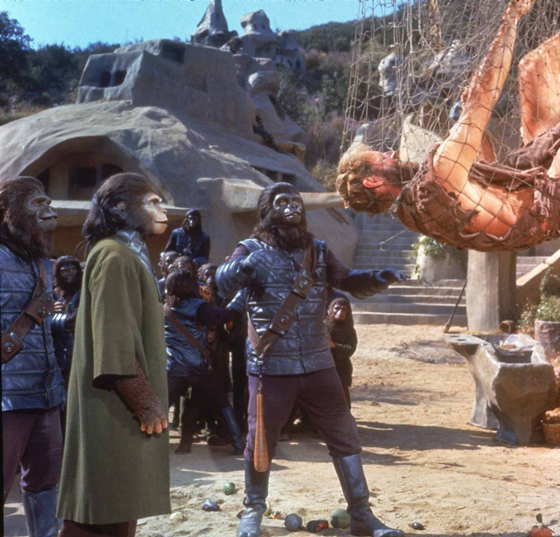 © TwentietH Century Fox Frame from the film "Planet Monkeys", 1968
Each action, every visual image of the “planet” is a transparent quote. Each iconic sign is clear without any explanation, as in the dreams of Warhol. In the second part, “under the planet of monkeys”, the most important - literally - a nuclear missile becomes a detonator of action. Here you have references to colleagues (Kubrika, first of all), and the topic of environmental disasters, and horror before the Cold War, who had been tanned today. Absolute statement, as the colleagues of ART Critics would say.
To close the conversation about the place of the first “planet” in the context of 1968: Charlton Heston, a leading actor in this film, is a completely representative hero of his time. He opposed the war in Vietnam, ate, prayed and loved. Then he became a trustee of the National Pacific (Reagan), opposed both wars in Iraq, participated in Michael Moore Bowling for Columbine.
But the enthusiasm of the “planet” was enough for a short while. The saga was not so much interrupted as it disappeared, remained in the history of cinema as an example of the skill of make -up artists and Guilty Pleasure for university minds. Anthropologists and sociologists love to exercise in deciphering the original series of films - where there is about “children of flowers”, where about Darwin it is said, where are hints of a cold war. By the new millennium, the saga reached a funny object from the past. Like a grandmother's sideboard. The shots from the Planet, once frightened and impressive, became a common place. There is a funny parody of the very canonical final of the first part - in addition to the sandy statue of freedom, the hero of Heston finds on the ground the future of Robert Pattinson with two Oscars, the newspaper with the news that Kim Kardashian received Nobel in physics, and there are many more signs that evolution is garbage. Everything becomes only worse.
In the same way, in the 21st century, the collage made of quotes was outdated. Therefore, the restart of the “planet”, which was started six years ago, was originally risky. This is not to actualize the races of “crazy Max” or bow to the “star wars”. Here we must really do something with the plot in order to return it to life.
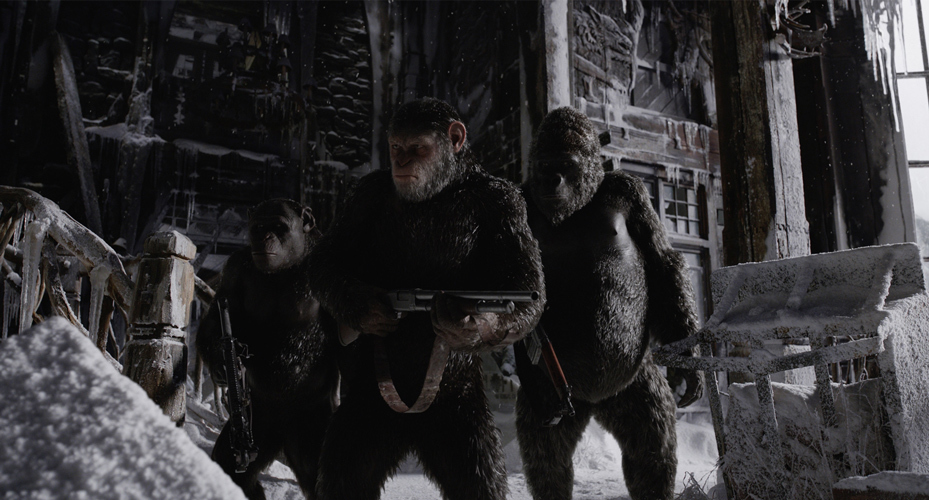
Fox approached the case of the resurrection of the saga with the businesslikeness of the plumber. She threw back everything related to anti -utopia, and subjugated the film to the laws of the formed tradition. Rebut "Planets" is made simply and diligently. The scriptwriters Amanda Silver and Rick Jaffa composed the plot as a textbook. They started with a small one: the “uprising” was a chamber drama about the relationship of a particular person - a scientist - and a separate monkey. Then they switched to a more serious scale: the society of people and the society of monkeys in the “Revolution” find out relations. In the War, which will now be released, the scale will increase even more seriously - two species will collide in the new world.
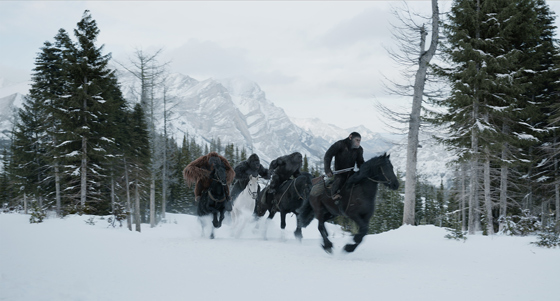 © TwentietH Century Fox Frame from the film "Planet Monkeys: War", 2017
Be a saga with a living creature - it would be sorry for her. The “planet” of the 21st century looks back at “close contacts”, “strangers” and others. This is no longer anti -utopia, but a film about the boundaries of human. Darwin was replaced by Nietzsche (in the version "Pretend to be an expert"). It is important not the painting of the medium, but the characters itself. The differences are not worlds, but those who inhabit them.
Having lost what was her charm in the original, the “planet” greatly acquired in classical artistic components. It was impossible to talk about the actor in the classical series, there all the roles played wool and rubber. Restored, on the contrary, has become very acting. The main role in the “uprising” was played by James Franco. The key character of the entire saga, Caesar chimpanzees, plays Andy Serkis - plastic and possessing a very bright mimic talent. In the second part, Gary Oldman was released, in the new film in general the main villain is played by Woody Harrelson. Smarts and allusions were also subordinated to the laws of the art form - they left them only at the level of names. A particularly cruel primacy with the manners of the leader is the name of Koba, the representative of the decaying human civilization is highlighted with drifus. But all this is soft and unobtrusive. At the level of hints, not images.
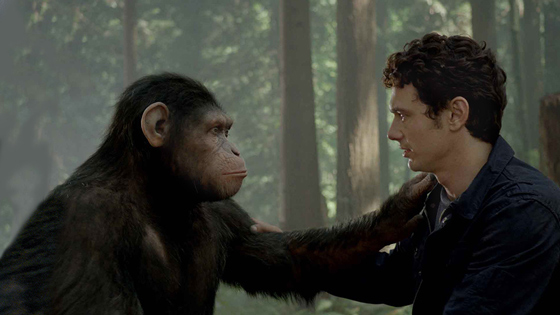 © TWentietH Century FOX Hard from the movie "Uprising of the Planet Monkeys", 2011
Line under the standard “planet” at the level of visual decision, attracting operators with a specific background. The first part was removed by Andrew the forest, which worked on the Lord of the Rings, the second and third-Michael Serezin, who once cooperated with Alan Parker in his youth, but (which is more important in this case) withdrawing Azkaban.
The new "planet" is noticeably more flat and primitive. It has an effect, a powerful orchestration. But there is no energy of the discoverer, there is no opposition to the spirit of time. This is a very calm and fairly ordinary movie about the need for peaceful coexistence. About the world as a single ecosystem. Without crafty and figs in your pocket. Everything is honest.
It is impossible to blame the Fox that the studio turned its own strange masterpiece into ordinaryness. The screenwriters, Amanda Silver and Rick Juff, are not to blame for this, they are honest artisans. And certainly there is nothing to nod to Matt Reeves, the author of Monstro. The Planet fell out of the general context in the sixties - and it would be strange if the surrounding landscape did not finally subjugate it to itself. Living in society - even a film - is impossible not to depend on it.