
Translated material
Tsarist remains: return countdown
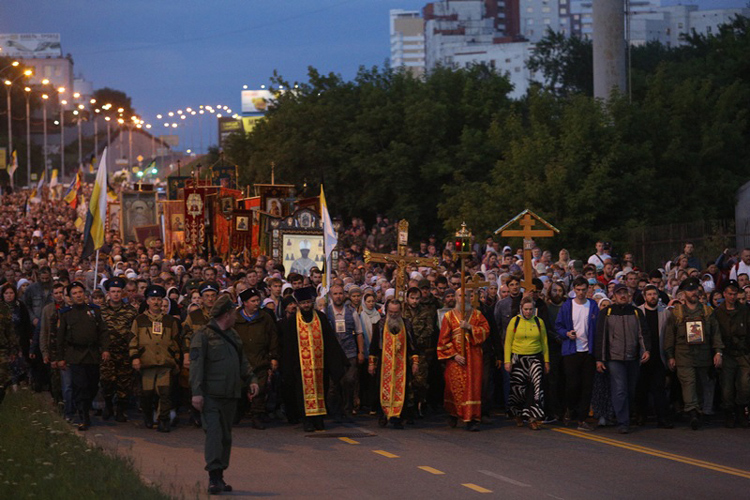
This year, the next anniversary of the murder of the family of the last Russian king was noticed even far from church and historical themes of the media. Popular publications publish articles about the events of the July Night of 1918 in the Ipatievsky House , the daughter of Shchelokov in his first interview tells how her father invisibly helped in search of the remains of the emperor in Soviet times, reports on the procession in memory of the royal family are shown the first channel and NTV . Is it possible to say that a new information campaign begins, somehow associated with the remains of the royal family?
From year to year, the night procession in Yekaterinburg collects tens of thousands of pilgrims and is the culmination of the Tsarist Days program. Leaving the city, people pass by Porosenkov Log, but none of the pilgrims at this place even stops, although it was here that the remains of the royal family were found, buried with honors in the royal tomb in the Peter and Paul Cathedral of St. Petersburg in 1998. Numerous pilgrims, including the local metropolitan, are convinced that the found remains are fake.
Moreover, in Russia and exile, there are uncompromising opponents of recognition of the authenticity of the remains, and among them, for example, Olga Kulikovskaya-Romanova, the widow of Tikhon Kulikovsky-Romanov-his native nephew Nicholas II. A few years ago, she said : “For almost a quarter of a century, a“ unequal duel ”with those powerful forces that contrary to the position of the Russian Orthodox Church and the foreign commission recognized the remains of unknown martyrs with tsarist and reburied them in the Peter and Paul Cathedral. Now the grandiose international scam with the forge of the holy relics of the royal chapter enters the new phase. ”
One of the centers that has invested forces and means in the formation of this mythology of non-recognition for many years was the Russian Institute for Strategic Research (RISI), headed by Leonid Reshetnikov, Lieutenant General Lieutenant, for many years. Historian, author of volumetric labor about the royal family, Peter Multatuli, is the head of the analysis sector and assessments RISI - in 2007 he wrote : “After the Holy Synod expressed his special opinion on the“ Yekaterinburg remains ”, and the Holy Patriarch did not bless the burial in the Peter and Paul Cathedral as holy relics, interest in the“ Yekaterinburg remains ”began to decrease noticeably. The tombstone in the Catherine’s chapel of the Peter and Paul Cathedral is perceived by most people as museum exhibits. More and more people ceased to believe that in 1998, members of the royal family were buried in St. Petersburg. ” In 2015, he considered it necessary to add : “No one recalls that in 1998 the so -called The “Yekaterinburg remains” were buried according to the conclusions of the commission, headed by the future leader of the Bolotnikov and “Belarusians” by Boris Nemtsov. ”
Of course, the state expects - and so far quite patiently - that the church will change its position.
However, the situation is changing. Next year, such a rhetoric can be recognized as obsolete. The countdown begins in the church - the recognition of the authenticity of the remains of the tsarist family executed by the Bolsheviks is being prepared. And there is no doubt that exactly a year later, July 17, 2018, the Russian Orthodox Church will perform a prayer service at the holy relics in the Peter and Paul Cathedral of St. Petersburg. And there will be no more - at least officially - use the shameful euphemism "Yekaterinburg remains."
The authenticity of the royal remains is perhaps the only question on which the Russian Orthodox Church radically diverges with the state. The identification of the remains was carried out in the mid-90s on the initiative of the Russian government. And in the end, the state recognized the authenticity of the remains, but the church did not.
If 20 years ago this discrepancy could be explained by the fact that the authorities insisted too actively, then after the discovery of the remains of Tsarevich Alexei and Grand Duchess Mary in 2007 and the following series of new examinations that confirmed the results of the former (Colta.ru wrote about this in detail here - ed. ), There are no reasonable reasons for refusing to recognize the remains. And if 20 years ago, during the time of Boris Yeltsin and Patriarch Alexy II, the disagreement of the leadership of the Moscow Patriarchate with the authorities was still possible, today, during the time of Vladimir Putin and Patriarch Kirill, it looks flagrantly inappropriate anachronism. Of course, the state expects - and so far quite patiently - that the church will change its position.
To get out of this inconvenient situation of the church will have to independently - and, if possible, without significant reputation losses. However, this is not easy to do.
Back in the late 90s, a wretched conspiracyology was widely spread in church circles, based on the legend of the words allegedly spoken by Emperor Nicholas II: “Do not look for my grave.” She is accompanied by a complete denial of the results of scientific examinations, unfounded accusations of investigators, forensic experts, historians and geneticists in conscious forgery and lies.
For those who adhere to the version of the ritual murder of the royal family, perfect with the active participation of the world backstage, and the subsequent complete destruction of the remains, the names and scientific regalia of scientists who conducted examinations, nor repeated genetic examinations using the latest scientific techniques do not matter.
The recognition of the authenticity of the remains implies the complete deconstruction of the prevailing conspiracyology, concentrating on criticism of secondary issues, but ignoring the general picture of occurring on the night of July 17 to 18, 1918. The task of deconstruction of the myth is not so difficult (its supporters do not understand the results of examinations) as it is unsafe for the authority of the current leadership of the Moscow Patriarchate. For the church and personally, for Patriarch Kirill, this decision, although forced, requires courage. Conspirology was so deeply found in the consciousness of a significant part of the flock that attempts to deconstruct the myth can cause excitement, indignation and even open protests.
The church could not say anything significant about February, or about October 1917. Popular, including in the church environment, nostalgia for the “Soviet” prevents the historical scale and significance of two Russian revolutions.
Not so long ago, Patriarch Kirill has already encountered something like that. After last year’s meeting with Pope, he had repeatedly sounded accusations of ecumenism, and cases of refusal to remember the Patriarch’s name for worship - in fact, a direct protest against his actions - fell into the press. It is clear that the Patriarch is painful to such things and he definitely does not need another scandal.
This, most likely, means that neither Patriarch Cyril himself nor the Holy Synod will take responsibility for recognizing the authenticity of the remains. But, apparently, they already have an action plan. The official statement will be made by the Bishop Cathedral of the Russian Orthodox Church, which will be gathering this in the fall of this year. The logic here is obvious: it is necessary to divide the responsibility for this important decision between all bishops of the Russian Orthodox Church. In addition, according to the charter of the Russian Orthodox Church, the Bishop Cathedral is the highest body of the church administration, and its authority (at least formally) is higher than the authority of the Patriarch.
The recognition of the authenticity of the remains was to occur in the year of the century of Russian revolutions. The church could not say anything significant about February, or about October 1917. Popular, including in the church environment, nostalgia for the “Soviet” prevents the historical scale and significance of two Russian revolutions.
But at the same time, the church cannot but speak in the anniversary year with some significant initiative, noticeable, at least in Russian society, if not in the entire post-Soviet space. And such an event may well be the recognition of the royal remains.
The success of the “recognition policy” lies in the one-single area-informational. It is necessary to conduct a bright, positive, positive PR campaign in state and church media, explaining the inevitability of the recognition of the remains.
But the problem is that in recent years the church has not had a single successful information campaign addressed to Russian society. The meeting with Pope in Havana was preparing secretly - there was no information training in anticipation of a historical event. On the eve of another historical event - the All -Orthodox Council - Patriarch Kirill decided not to participate in it, and almost everything that was written about this in the media was a negative character. It reached personal insults against the Patriarch Bartholomew of Constantinople, including state media .
It seems that the church in Russia has lost the ability to contact society with a positive message. Metropolitan Halarion (Alfeev) ardently supports the ban on the work of supermarkets on Sundays. Deputy Natalya Poklonskaya on behalf of the church advocates the ban on the show of the film "Matilda". The public gets the impression that the only thing the church knows how and loves to do is to ban it.
In case of success, Bishop Tikhon will receive his laurels. Like Patriarch Kirill, he is a tough pragmatist and perfectly understands how personal reputation is formed and what role the media play in this. Moreover, he is the best - and even better than Patriarch Cyril - knows what modern Orthodox identity is.
Is there any chance that the Church will be able to make a positive program? Oddly enough, yes. This is due to the fact that Bishop Tikhon (Shevkunov) is the organizer of the campaign to recognize the authenticity of the royal remains.
Despite his significant personal resource - and the media, and financial, and political - Patriarch Kirill has not yet entrusted him with such large public projects.
In early June, Bishop Tikhon said : “When the investigation ends, I can’t say ... A large number of new circumstances and new documents are opened.” This is a rather curious formula. There is a request for novelty, but not a hint of what these “new circumstances and new documents” may relate to. Moreover, Bishop Tikhon voluntarily or involuntarily uses inversion: the main intrigue is not whether something new will be open, but whether the results of previous genetic examinations will be confirmed.
For 20 years, many have already decided for themselves the question of the authenticity of the remains - there were more than enough publications on this topic. Their authenticity is recognized not only by scientists, but also by a fairly wide circle of Orthodox, for whom scientific arguments are more significant than Orthodox conspiracyology. This circle belongs not only to the laity, but also a significant group of bishops. In particular, the episcopate of the Russian foreign church is almost in full force. And Bishop Tikhon knows this very well.
How will he convince opponents of recognition to change his position? We will learn this already in September-October-it is unlikely that it will postpone the active phase of the information campaign for a later date.
If Bishop Tikhon does not cope with the task, the Patriarch does not lose anything - in the most extreme case, he will again postpone the issue of recognizing the remains. If the campaign is successful, the patriarch will lead the celebrations and say all the words that are adhering to the moment. And it will be his success.
In case of success, Bishop Tikhon will receive his laurels. Like Patriarch Kirill, he is a tough pragmatist and perfectly understands how personal reputation is formed and what role the media play in this. Moreover, he is the best - and even better than Patriarch Cyril - knows what modern Orthodox identity is. All his public projects - the film “Byzantine Lesson”, the book “The Non -Saints”, the exhibitions “My History” - are successful because they meet the interests of the state and are focused on the mass audience. And here it does not matter that in the genre these projects are closest to fairy tales. It is important that these are fairy tales with the right morality, ideologically verified.
The information campaign for the recognition of the remains is focused on the same - mass - audience. Bishop Tikhon knows how to work with this audience.
With the participation of Anna Golubeva