
Translated material
"Antarctica does not solve problems"
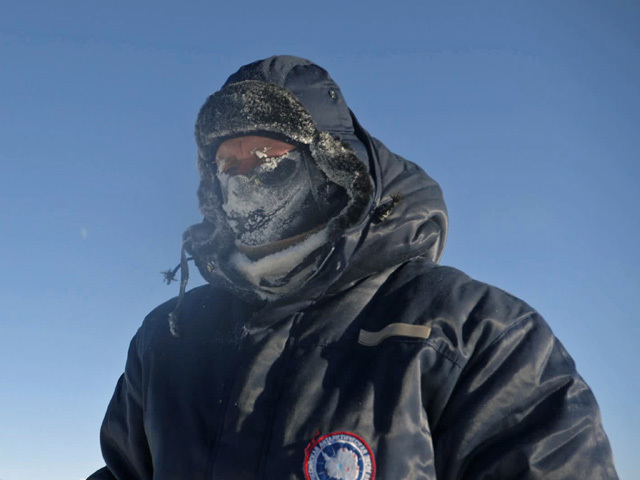
The text continues the project on the Ecology "Variable" .
The recent news that from the shelf of the glacier in Antarctica was broken off and sailed to the sea of Wedell Iceberg, equal in area of the two territories of New Moscow, it seems, even in the most remote from the climatic subjects of the publication. The event is not ordinary, but not exceptional - in 2000, for example, an iceberg broke off from the Ross glacier, more than twice as much as the current one. Experts discuss mainly a potential danger to shipping in this remote corner of the world ocean, although there it should be minimal.
The glaciologist, candidate of geographical sciences, associate professor of St. Petersburg State University, employee of the laboratory of climate changes and the environment of the Arctic and Antarctic Research Institute of Roshydromet (Aania) Alexei Ekaykin believes that the problem is different:
- Shelf glaciers, as it were, propagate mainland ice. If this support is removed, the dynamics of mainland ice is accelerated, that is, Antarctica will lose weight a little faster. Well, in general, it is believed that the offend of shelf icebergs is one of the consequences of climate warming.
- Antarctica is large, and in its central part, warming is hardly felt. But it is from there that scientists receive data indicating that it is and is precisely due to the fault of a person. Tell me how this is done.
- Kernes (these are such large and heavy ice cylinders that scientists cut out of the thickness of the ice) is a very important source of data on greenhouse gases, thanks to which we know that now in the CO2 atmosphere there are much more than before, over the past 800 thousand years. First of all, the cores contain data on the gas composition of the atmosphere and the content of greenhouse gases. Only by ice cores can we find out directly. There are no other direct research methods of these parameters.
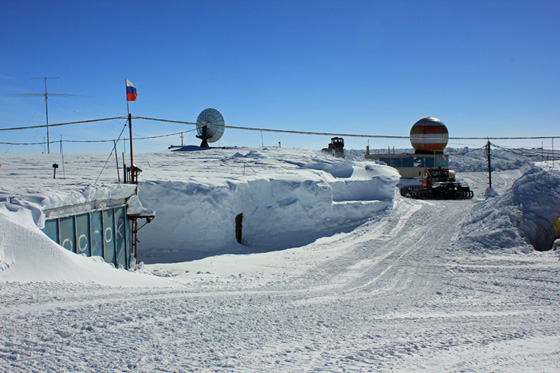
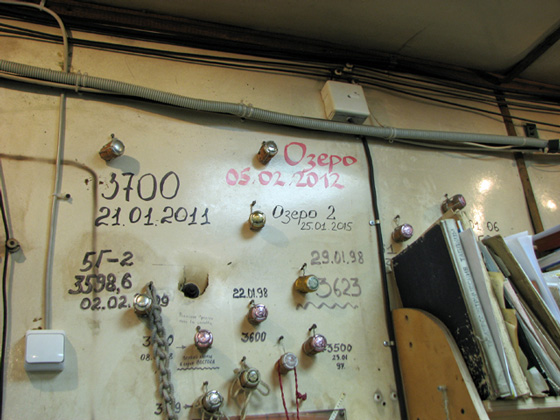
These data on Kernes can be provided by Greenland and Antarctica. In Greenland, the longest continuous temporary series is 120 thousand years, and in Antarctica - 800 thousand years. True, this is not from the Vostok station, it is an ice from a dome C 500 kilometers from the lake, where the French Condordia station is located. In the "East" we managed to get a continuous record for 420 thousand years. But we have ice, which is supposedly 2 million years old . It is so hard to say, because it is the ice from the basal, that is, the trumpet, the thickness of the glacier under which the mountains are located. Because of this, the sequence of layers is broken, and it is impossible to date this ice with ordinary methods.
 © from the personal archive of Alexei Ekaykina
- And how do Antarctic and Greenland cores differ?
- They were formed in different conditions. In the Greenland Kern, due to the fact that there is a higher snowball rate, permission will be better. And in Antarctic there will be more the age of ice. It is also worth paying attention to the processes of smoothing the signal in the formation of ice. The air moves freely in the snowy thickness and mixes, and the closing of the pores and the formation of air bubbles occur at some depth: in the “east” it is 80-100 meters. The age of ice at this depth is already 2000 years. That is, it turns out that the ice is old, and the air in it is still modern. In Greenland, this difference is less, because the accumulation of snow is greater and at the same depth the age of the ice will be less.
- How is the age of ice in Kerny assessed? How do we know that this particular ice is 800 thousand years?
- All models are based on ice dynamics. The glacier spreads from the central dome to the edges. (Alexei draws a hemisphere in my notebook-this is a glacier. Inside the sphere, something like a schematic Christmas tree, through the branches of which the ice is spread-does not melt, but spreads due to the action of ordinary gravity.)
This is all to be modeling, and for anywhere in the glacier you can calculate age. Plus, in the ice, tips for absolute dating can be contained: traces of volcanic eruptions, radioactive elements. If it is known, when some volcano erupted, then you can set the age quite accurately; True, this is more suitable for the historical period. But for 2 million years, the models do not work anymore, here you can only focus on absolute dating, such as Berylli-10-the period of its half-life is about 1.5 million years.
You can’t go to Antarctica if you quarreled with my wife. Antarctica does not solve problems.
- Let's get back to warming. How does the information from the Kern helps to understand what the climate was in the past?
- Unlike the average temperature in the hospital, the average temperature in the planet makes sense. In the hospital, people with different diseases are not related to each other, and the planet is a single system where everything affects everything. So, studying Kern from Greenland or Antarctica, you can understand at the same time what the climate in Europe was. In particular, we can say about the level of carbon dioxide. Because if the temperature is still a more local indicator, then the CO2 content is a global parameter. The CO2 content in the atmosphere in Antarctica, and in Greenland, and on the entire planet is the same.
But the temperature at a single point can tell a lot. Since the physics of the process does not change, then if you lay in the modern climatic model all the data on the air temperature obtained from the cores, as well as local sources of information like lake deposits, peat, glaciers, you can obtain temperature distribution on the planet at the last maximum glaciation, for example. And data on Kern can be used as control, that is, the model ideally should reproduce natural conditions.
In the lake ice, the function of the dependence of age on the depth is completely non-linear, and it cannot be said that the Kern meter is so many years. At first, with depth, age grows slowly, then faster. First, this is due to the compaction of snow. When the density of the thickness reaches the density of pure ice (0.92 g/cm3), it stops growing, and then the annual layers simply sophisticate and flatten due to the dynamics of the glacier. The ice rolls like a dough - everything is thinner and thinner.
 © from the personal archive of Alexei Ekaykina
- In the spring of 2017, an excellent documentary was released about your work - “Lake East. A ridge of madness. " How do you like the feature films about polar explorers? It looks like the truth?
- There is an old Soviet film “72 degrees below zero” about the Vostok station. Although some household details are shown close to reality there, it is still a cheerful cranberry, of course. The main thing is that people in the film are not at all. There is one film about Antarctica based on real events - “Antarctic history” (there is an even later Hollywood film on the same topic - “White captivity”). But there is not about people, but about dogs. In the 50s of the last century, there was really such a story-the Japanese could not take sled dogs from the station, and when they returned a year later, it turned out that two of them survived. In the film, all this is very well shown. Now, by the way, it is forbidden to bring animals to Antarctica.
- Now the project to drill Lake East is suspended. What is it connected with?
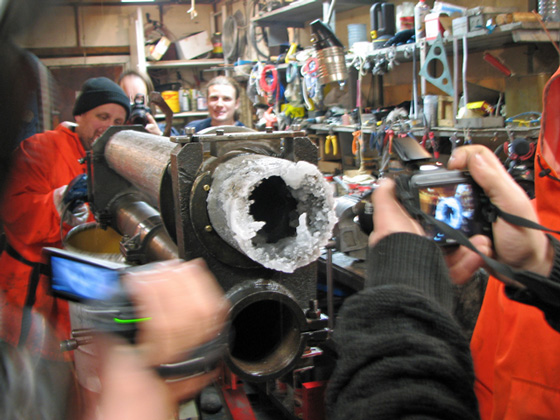
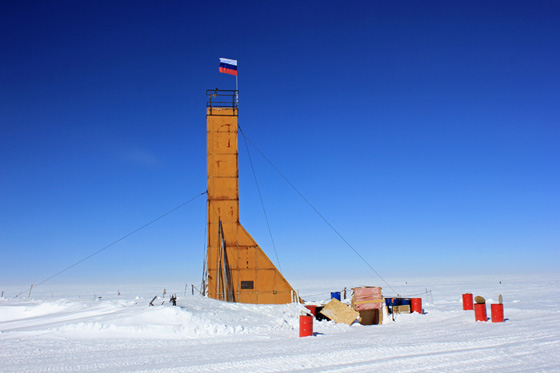
- Now Vostok is not mothballed, but drilling is not produced. In the next season we will come there, but in the coming years we are not going to drill and get into the lake. The project decided to suspend for various reasons. Home - there is no money. Money is needed to develop a new technology of penetration into the lake. The current technology is not suitable due to insignificant, but still pollution. The fact is that kerosene is used in drilling fluid, which is lighter than water, but something can still get into the well. The most important thing is that when water contacts with a pouring fluid, a freon hydrate, a dense, solid substance that forms faster than ice, and the well is closed with a traffic jam. Now no one uses kerosene with Freon, because it is believed that it is environmentally not very “friendly”. In Greenland, Estisol ( TM is a trademark) is used for drilling, these are some complex broadcasts. This substance does not smell of anything, absolutely hydrophobic and safe for man and nature.
 © from the personal archive of Alexei Ekaykina
The French at the Concordia station plan to drill a new well with silicone oil. Also completely environmentally friendly, and no bacteria live in it. In the next season, we (a glacial-brown detachment of the Russian Antarctic expedition led by a professor of Mining University Nikolai Ivanovich Vasiliev. - Ed. ) We will experiment with silicone oil in the “East”. We will collect the stand where we will imitate drilling and study the behavior of our drill shell in the silicon. This technology has one huge minus - silicone is much more expensive, but in any case, the bolt fluid in the well will have to be changed, and this is 60 tons of liquid. Or in the lower part of the well, pour silicone 100 meters, and kerosene will remain on top.
And you also need money to build a new Vostok station. What is there now was built in the 70s of the last century. This is long-outed technologies, now everything is different, modern thermal insulation, new materials are used.
- Where is heavier - there, in Antarctica, or here, at home and in the laboratory?
“I feel good everywhere, but by the end of the year you get tired of this pace of life.” And in Antarctica, I am going to rest morally and work physically. For 13 seasons - this is from December to February.
In the morning I got up at 7 o’clock, brushed my teeth, had breakfast, and then there can be a lot of things - to dig pits (shallow pits for sampling. - Ed. ) To study the paleoclimate in the recent past, for 300 years, to select samples and so on. In addition to the main program related to the drilling of the lake, there are many more projects for which something needs to be done. For example, we measure the balance of the mass of the glacier. In Central Antarctica, it is still not bad, but in general the ice cover of Antarctica, of course, is very losing weight.
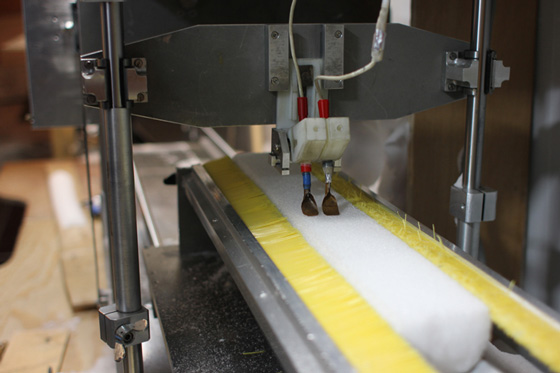
A lot of work with deep drilling cores. After the core is extracted from the drill shell, it is lying down for some time to dry the kerosene. Then I inventory it - you need to dock pieces, measure it: it is very important, because it is by Kern that we know the depth of the well. I take samples, if necessary, measuring the electrical conductivity of the core, make grinds (thin sections of ice that are used for crystallographic studies. - Ed. ). A lot of small things. On average, one meter is processing an hour, and all the time you also carry it in your hands in the laboratory, and a meter of Kern weighs eight kilograms.
Plus, there are some optional programs every year, someone asks to do something. Last year, samples of ice from old reserves were selected for the French.
 © from the personal archive of Alexei Ekaykina
- And what is your work here, in the laboratory?
- When we return, a more diverse activity begins here. Analyzes, measurements, data processing, articles, conferences, etc. Ordinary scientific routine.
- When in 2012 you first penetrated the lake, the Vostok project was compared with space missions. For money, too, is it all as space?
- No, it is much cheaper. All logistics of the Russian Antarctic expedition costs a little more than 1 billion rubles a year. This is not only Vostok, these are five stations, several seasonal bases and two ships. This is just to bring us to the station, put on, feed and warm. Science is paid separately. Previously, there was a federal target program of the World Ocean, in which there was a subproject of Antarctica. It ended in 2013, and despite Putin’s resolution (who was then Prime Minister), there is still no money for this. And it was only about 8 billion rubles for five years-all projects related to the study of the oceans and Antarctic. This is very small money for Russia.
- How did you get to Antarctica?
- Since childhood, I dreamed of traveling and therefore went to the geographical faculty (now - the Institute of Sciences of the Earth of St. Petersburg State University. - Ed. ). Practice began with the first year, and I liked it terribly - a field life in a complete absence of comfort. Then he got to Aania and immediately after graduation went to Antarctica.
The first time was exciting and exciting. Psychologically difficult, because you are young, and there is already a prevailing male team, and it is important how you will react to some things. Since then I spent 13 seasons in Antarctica.
 © from the personal archive of Alexei Ekaykina
- And if life turned out differently, what else could you do?
- Probably the history of the early Middle Ages or archeology. In any case, it draws to natural sciences and field research. Archeology according to its methods is very close to paleogeography. Or maybe linguistics: I like to think about how different languages are arranged. What will happen later is also terribly interesting, but still we can only build assumptions. And you can look into the past, and although it has already passed, its traces have been preserved.
- Why do people go to Antarctica?
- The motives are different. For some, this is just the usual, native place. For me, this is a favorite job and a place where I feel good. Someone for the sake of money: for wintering you can earn about a million rubles. But there are those who once arrived and no longer a foot.
They probably go to Antarctica because you feel better in moral terms there. But only if you are not worried about what remains at home. You can’t go to Antarctica if you quarreled with my wife. Antarctica does not solve problems. Not so long ago, the Internet appeared. This, of course, is good, you can keep in touch, but without it it was calmer - no urgent affairs and letters. And now in the "East" they will get out, if that.
- What is there at the station, the hardest thing is given?
- The need to constantly undress and dress. You need to put on many layers of clothing all the time - thermal underwear, pants, sweaters, heavy boots, down jacket.
(We go to the next room where I try on the down jacket, which the polar explorers in Antarctica wear it. Perhaps half of my wardrobe would fit under it. And we still have to walk in all this, but hard to work hard.)
There is still no soul. Once a week a bathhouse, and once again you can just wash yourself. All because it is necessary to spend expensive diesel fuel to melt snow.
 © from the personal archive of Alexei Ekaykina
-And what if someone gets at the station?
- It’s very bad to get to the “East”. Previously, I was not sick there, not counting frostbite. This winter, an epidemic happened-apparently, someone brought the influenza virus. In one form or another, everyone fell ill, I lay for three days without getting up, I could not eat. Then he began to get out to the station once a day, and so on another week. But we did not completely recover there, coughing the rest of the season due to cold air. In addition, low pressure, hypoxia (Vostok station is at an altitude of 3.5 thousand meters above sea level. - ed. ) And so on. This is the first time in my memory.
-And yet: all Antarctica is melting?
- At the “East” it will generally warm a little, but so far in Central Antarctica, the manifestations of global warming are not visible. Antarctica is an inert system, and everything happens there with a delay. There will be manifestations of warming, but maybe in 100 years. And in Western Antarctica and on the Antarctic Peninsula, ice melting is already very noticeable. There, the spoon of the glacier is below the sea level, and the relatively warm sea water at some point can leak under the glacier. Then the glacier will simply come up and collapse. Such processes could already occur in the past-for example, during the previous interglacial, when sea level was five to six meters higher. But now it can happen due to human activities.