
Translated material
Devillers | Colta.ru
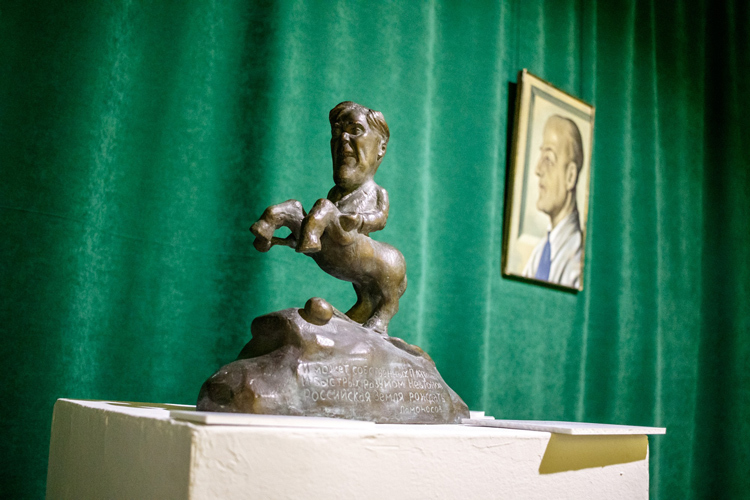
In the Gallery “On Shabolovka”, an exhibition-study “Surrealism in the country of the Bolsheviks” , which caused both the praise of critics and disputes, is completed. Alexandra Novozhenov could not ignore this project.
In Soviet art, there really was no surrealism - that sober, but also radically joking movement, sometimes almost mechanistic art science, which would formulate its foundations in manifests and practices of which would be based not on impromptu, but on the result that could be obtained during the calculated experiment like an automatic letter or game in a “exquisite corpse” . The movement, which was based on the idea of the unconscious-as something that shifts and decenses the subject with the help of different, including visual, tools, finding its causality on the other side of the “I”, asking questions about the status of the view, about the lack And also about error and automatism as ways to gain access to what is present, but inaccessible directly. In the Soviet avant -garde there was no such organized movement that would not be subjective in the sense of private, personal, private, but asked questions about the place of a single subject and his desires, which claimed universality: the surreal revolution was not a private affair - it should be the next step or, rather, the only faithful development of the social revolution. It may sound too straightforward, but French surrealism, say, in the version of La magazine Revolution Surrealiste was engaged in criticizing bourgeois morality and humanism, Christian hypocrisy and, yes, capitalism - and this was one of his most consistent critic.
Surrealism, which managed to synthesize Plungan and Selivanova, is theatrical and neoclassical.
For Walter Benjamin in 1929, French surrealists were the only ones who, properly understood the “communist manifesto”. In his text, he writes about the “Profantnnne Lighting” in his “instant photograph of the current European intelligentsia” : “He [Breton] calls the“ Nadia ”“ Livre à Porte Battante ”,“ Book with the Clapping Door ”. (In Moscow, I lived in a hotel where almost all the rooms were busy with the Tibetan lamas who came to Moscow to the Congress of the United Buddhist Churches. I was struck by how many doors in the corridors of the building were constantly ajar. What seemed at first, it became something ominous for me. I found out: there were members of the sects that were solemnly swelled never in the closed. The shock that I experienced then should feel the reader of “Nadi.”) Live in a glass house - this is the revolutionary virtue of Par Excellence . This is also a kind of intoxication, moral exhibitionism, in which we really need. ” So, for Benyamin, surrealism, which was not in the USSR, is an absolute transparency, radical openness, exhibitionism flooded with light.
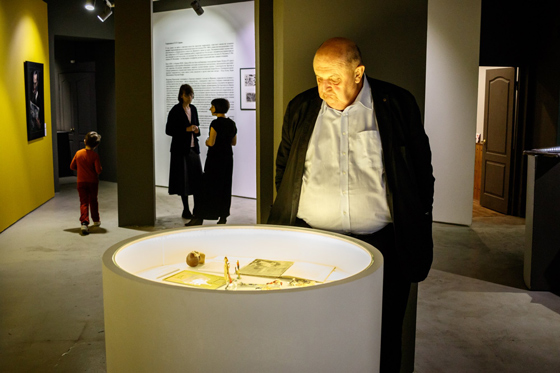 © Grigory Matveev opening of the exhibition "Surrealism in the country of the Bolsheviks"
Then what does it mean to say how the curators of the exhibitions of Alexander Selivanov and Nadezhda Plungan do this that surrealism in the country of the Bolsheviks was still?
The curatorial effort in this exhibition is the most interesting: its meaning is not to prove that in the Soviet context there was an analogue of the Western movement, although there is partly such ambition (but then it would be easier to work with someone in direct stylistic connection with the Western surrealists, like Casimir Malevich). Rather, it is art history constructivism of a high -class expert that sees the unobvious objects and not directly related to each other by the authors and conjugates them into an unexpected discourse, which so far no one could think of himself in this form. The division of the exhibition into thematic sections such as “animals”, “unconscious”, “other” (another is not in a psychoanalytic sense, but in the sense of “other”, a terrible or strange stranger), “holidays” recalls standard thematic practice, with the help of which the exhibition of Soviet art is structured for the past couple of decades. But it is unlikely that anyone, except for these two curators, could come up with and gathering these objects together: in this sense, the exhibition with its gloomy, cabinet-theatralized design (Selivanova did the exposition architecture) is not a “start of the study”, that is, does not lead from a sketch to something more; It itself is a finished, previously not existing object, to a greater extent a design than a documentary evidence of previously not taken into account, constellation, crystallized only in the curatorial look - this is its limits, but also its luck.
French surrealism, say, in the version of La Revolution Surrealiste, was criticized by bourgeois morality and humanism, Christian hypocrisy and, yes, capitalism - and this was one of his most consistent critic.
The same authors and objects that do not form a real historical circle or movement (except for the members of the Oberiu) could be easily subjected to other discourses of the 1930s and 1940s-neoexpressionist and neo-symbolist, socialist and other, but at the exhibition of artists and poets are connected in the measurement The “surrealism” that does not recognize itself, as if organically, in the form of crypto practitioners and mannerisms, more often individual than group, in the form of mutations against the background or away from public discourse of socialist consciousness. It already contains a problem: after all, many works, from the sculptor of Aizenstadt to Labas with Plaksin, could be read as versions of realisms of the 1920-1930s, extremely diverse and really often maneous, but responding to the current situation, and not escapated.
But that unwashed surrealism - in the form in which the curators bring it out - could be called dissident and demobilization. Understanding what surrealism is, here is liberal - as the right to private artistic practice in the face of total mobilization; The right to go into the shadow when everything is flooded with the sun; The right to stay in the room behind the closed door.
You can try to reconstruct the positions from which the curators emanate, collecting their several dissident surrealism: we can (rudely) assume that their concept arises in contrasting some “dominant” discourse, most likely, to the general discourse of industrialization and the production of the production advent of the production advent. The latter demanded from the subject of voluntary exit to the public field and subordination of his mental forces to public production, which implies complete consciousness and self -control - hence the very myth of the production of a new conscious person who scares the Slavists with his apparent totalitarianism. But at the same time, it was in this that the industrial avant -garde, who searched a way to overcome the lack of socialism in the inalienated and irentropic economy and at the same time recognizing leaks and gaps in this economy, closer to surrealism with its theory of lack of capitalism in the economy of capitalism. In fact, these are two sides of the same medal. The surrealism that was bred by curators at the exhibition took place relative to these two discourse on the tangent.
Understanding what surrealism is, here is liberal - as the right to private artistic practice in the face of total mobilization; The right to go into the shadow when everything is flooded with the sun; The right to stay in the room behind the closed door.
Industrialization and discourse of the first five -year -olds that the majority of works presented at the exhibition coincide in the chronology require, in addition to consciousness and fidelity, public construction also complete complete dedication - that is, without a trace, the subject’s strength to build a public good. But instead of raising the question of the unconscious and the economy of the subject in the new production system, the “surrealism”, obtained by curators, contrasts complete consciousness (which many, however, understand as ideological hypnosis), is not the question of the unconscious, as French surrealism does, but rather decadent irrelevant.
In short, surrealism here is understood as evading, a refusal to participate in mobilization. The exposition contains quotes from the article by Maxim Gorky “War Iwls” , where he calls for fighting parasitism: “Probably, following the All -Union campaign against weeds, the same campaign will be announced against rats, mice and other rodents that destroy a huge amount of grain and food products.” Useless plants and animals are opposed to useful, and it is clear that one step from uselessness to wrecking, but is the refusal of the production of benefit a fairly good reason to talk about surrealism as a way to indicate that it is on the other side of the good? Rather, no, and the surrealism, designed here, is synonymous with deviation, the struggle for the right to private braking behind closed doors. This surrealism looks like an application for the right to alternate, on a macabra, to grow mold in its corner, to the right to hallucinate its small nightmare in a room with detached curtains, not succumbing to the sunny call.
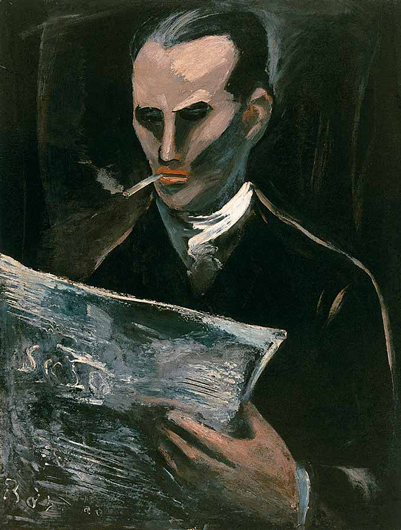 Rostislav Barto. Reading magazine. 1928
Thus, the gloomy picture “Reading Journal” by Rostislav Barto is represented by a kind of antipode of “Ratcore” by Viktor Perelman: the curators come out that a person weakened, immersed in himself, not included in the public debate, literally went into the shadow, this is a surrealistic subject. There is a bunch between a terrible reality, for example, repression and the position of fuel artists-however, the slope can be not only evasion of mobilization, but also a slope of stylistic, like Meer Aizenstadt in his “Tractor”, a sculpture that opens the exhibition. He has a tractor on his shoulder, and the explication reports that he crawls on the shoulder like a snail, but it would be possible to read it as a work with space: a small tractor is far away, but in sculpture plans are sticking together, and working with spatial plans and layers in the spirit of plastic exercises of Vhutemas-this is what is generally interested in this sculptor. Aizenstadt worked in a completely production topic-it could be included in any overview of realisms of the 1920-1930s. His maneralist version of the neoclassica (in fact, he is interested in synthetic monumentality in the design of the socialist space) does not contradict the searches of the most diverse leftist artists, sculptors and architects. But curators manage to include it in a completely different context.
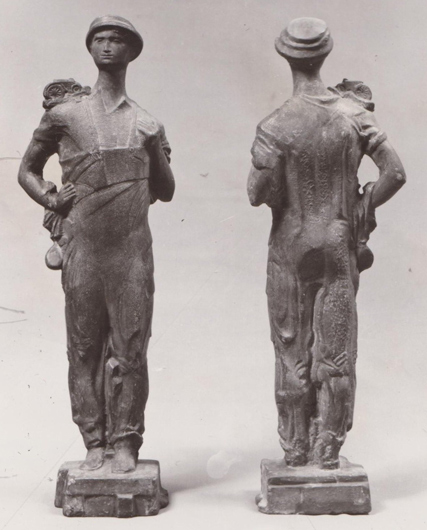 Meer Aizenstadt. Tractorist. 1930
Dark and terrible - not synonyms: how to work with a connection between repressive reality and sinister or simply eccentric worlds? Small horrors and fun of Oberiuts and other participants in the exhibition cannot be made by a "mirror of repression." This ladder is not terrible or even tragic. Yes, this is really an application for the right to breed their personal spiders, twirl dolls from candy wrappers, the right to braking at the time of general inspiration, the right to stay at home and not go out. But to worry terrible and read or look at something frightening-experiments of a very different order, Freud wrote about this in his essay “The Terrible” (1919). The twilight of the exhibition with a bewitching curved curtain creates just such an atmosphere of the Home Theater of Horror, somewhere between the cabinet and the nursery. That is why the exhibition becomes pure pleasure: in the works themselves there are no terrible, terrible worried only in life, and it is not connected with the imaginary - not with a terrible mask, not with a dark room, not with a revived doll, not with an unusual one - but with repetition, coincidence of signs, with a gap in the ordinary, in which a real glitter appears.
Surrealism, which managed to synthesize Plungan and Selivanova, is theatrical and neoclassical - especially in his St. Petersburg component. Nikolai Akimov, Vladimir Konashevich, Harms with Porut and other participants are immersed in their game, and its foundation is a subtle passsism, a set of St. Petersburg cultures in which they escapated in rooms, in theaters and parks; I recall the “world of art” and the magical lantern that the little Benois watched in their happy pre -revolutionary house. Of course, the house where the Oberiuts make their living paintings is not the house of the prosperous Benois. On the other hand, sketches for the design of the Kirov Park in 1937 are a lovely ruin, with great taste a stylized carnival against the background of repressions - this is precisely a myriscusic neomanism tradition, and not surrealism as a radical practice of exposing and opening doors.
And again to the light and darkness, as well as to open and closed doors: in the same article “Treasy”, Freud wrote that the most crazy feeling of horror does not arise at all in the darkness, but in the midday heat, when the shadows disappear, he describes how he got lost in the Italian town and, waving, returned three times to the same place. About the same half -time fear, panic horror writes Oberit Leonid Lipavsky in his “study of horror” - quotes from it are given at the exhibition: about the special fear of afternoon watches, when a premonition of irreparable misfortune suddenly arises. But what is this misfortune? Lipavsky does not contrast the horror of the repression of May Day, but enthusiasm - passivity and escapism. He writes only about a terrible feeling that occurs on a forest walk when the day suddenly freezes.