
Translated material
"Nonth conversation" about projects without the future
Carnegie.ru - about the mistakes of the president when communicating with talented teenagers
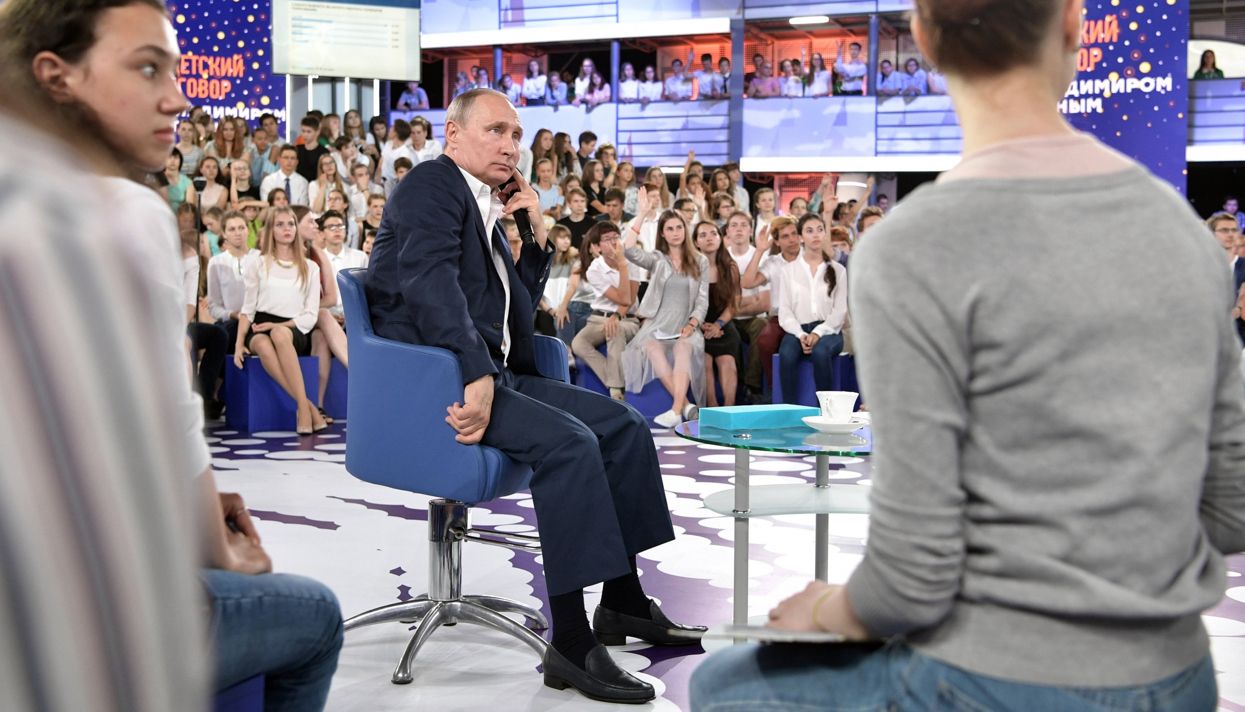
On July 21, Vladimir Putin held a “nonsense conversation” with adolescents who study at the Sirius center in Sochi. The conversation was to show that Putin, the president, including talented youth, too, but it didn’t work out to be convincing: the president was emphasized, he was not interested in questions, he answered many very dryly. The head of the analytical department of the Center for Political Technology Tatyana Stanovaya in a column for Carnegie.ru tells what exactly went wrong.
On July 21, Russian President Vladimir Putin for the first time held a big meeting with children from the Sirius educational center, answering their questions for three hours, in its format it resembled its traditional straight lines. The program itself, called the "non -: unfamiliar conversation", was broadcast on NTV and on social networks. Almost immediately, it became clear that the Kremlin thus took up youth policy, or rather, for “schoolchildren” precisely against the backdrop of March protests and with an eye on the 2018 presidential campaign. The idea is understandable and simple: the public was going to present the president and the right children who form the future responsible national elite. But it did not work out exactly as we would like.
The motives of the Kremlin to do children are obviously connected with the protest on March 26, whose faces in public space became young people of 14-16 years old. The theme of “school protest” was informed informationally fed of various kinds of students and teachers merged into the UTUB, when the latter tried to calm the unexpectedly politicized youth, discussing corruption. On the eve of March 26, a great resonance received a story in Bryansk, where the school principal reported students for the distribution of a film about Medvedev, conducting an educational conversation in the spirit of Soviet times. Already after the action, one of the most discussed characters was a teacher of OBZh and history in Tomsk, who, for example, accused his students of fascism and called them “slaves of the Anglo -Saxons” for criticality in relation to the authorities.
On the terms of anonymity, the Kremlin replied that the school problem is far -fetched, speculative and consciously inflated by the non -systemic opposition to give itself greater significance and search for the missing social support. But the work in the youth direction clearly began, and Putin’s current communication became, of course, part of such a work.
Not in full contact
The comparison of the "non -to -ethnic conversation" with straight lines is not true. Putin spoke directly with those who were in the hall, and the audience on a country's scale was represented not only by schoolchildren, but outstanding students and athletes: about nine hundred pupils of the Sirius Center, a unique project, were invited to the meeting. The center appeared on the initiative of Vladimir Putin in 2014 and is designed not only to create conditions for young talents, but also to support the viability of the Olympic city of Sochi and its objects. The winners of competitions with their own scientific projects are invited to the center, children spend 24 days here, engaged in the best minds of Russia. The format of the meeting meant relatively free communication: there was no presidential spokeswoman who often chooses who asked the question, Putin could move around the hall to look at the inventions, there were no specially specified topics.
However, it was precisely such a freely launched format that created difficulties, and the very idea to call the president to communicate with the “botanists” turned out to be a very bold decision. Vladimir Putin had to, for the first time in many years, to speak with an audience presented by really outstanding children, many of whom speak well, already have merits in sports or science, do not abuse courtesy (although, of course, they have not done difficult questions without this. The deprived, often unfairly offended participants in traditional straight lines with their deeply local or very private, personal issues that see the last hope in Putin - the full contrast with young, ambitious youths and girls who, with all the understanding of the rules of the game, sincerely spoke of sore.
Putin’s communication in such a new audience immediately revealed several conceptual problems regarding its direct election positioning.
The first problem: too pronounced conservatism and, if you like, Putin's “backwardness” against the background of the audience. Almost from the very beginning of communication, it became clear that the president looks like the personification of the last century: he watches films on cassettes, does not use social networks, does not understand the meaning of using nicknames, presenting to modern children an endangered political dinosaur. So, he absolutely did not understand why the network users use pseudonyms (although it was about nicknames, that after all, not the same thing). “Why hide? If a person does something worthy, interesting, then what he can be proud of ... I must say to whom this belongs. Why hide behind a pseudonym? Something is not very clear to me. But in any case, in my opinion, I answered you, ”Putin said uncertainly. It was evident that it was very difficult for him not only to speak the same language with Internet users, but in general to perceive reality as a new technological era, where life on the network is not a contrast of reality, but its integral part.
The second contradiction is also added immediately: the globalist thinking youth (Putin was asked twice to help the center of foreign schoolchildren and young scientists), aimed at developing contacts with the outside world, encountered Putin’s anti -globalist, conservative position that Sirius should have no longer a national property closed to foreigners. Such a guardian position turned into the country looks hopelessly regressive.
The protective rhetoric was expressed in theses about the consolidation of the nation (discussions about history), and in the plots of war obviously emotionally significant for Putin (the topic of readiness to die for the homeland), despite the fact that he had to speak not with the army, but with those who are of individual, exceptional value for the country and are interested in searching for personal opportunities for development.
The third problem is extremely difficult to act as moral authority and give moral lessons to those who have already achieved brilliant results. The Kremlin’s idea to form the image of a “wise elder”, who was ready to share experience from the height of his years, was unsuccessful in this audience. Putin, who did not demonstrate serious success at school, was brought up by the street (as he himself noticed), allowed himself repeated incorrect behavior against opponents, can hardly give lessons here. A peculiar (from the point of view of achievements) the advantage of the audience has gravitated over Putin. “Do you want me to look so -so against me on your background? Not only does Vanya pull up 25 times, humiliates me, and you still want me to look like a duck on ice, ”he threw, adding that, of course, he was joking. This reservation was not so rhetorical.
The president could not clearly answer and the question of whether in Russia the program “on the disposal and processing of household glass waste with automated use of funds” would be introduced, as the sixteen -year -old schoolboy from Tula asked about. "Don't know. So you bent the question, ”Putin answered, reminding of the already existing waste disposal program that has nothing to do with what the student was talking about.
A lot of personal, psychological, albeit childishly naive questions were asked, but this gave Putin the opportunity to share his feelings and emotions not as a president, but as a person. In full, such an opportunity was not used due to the fact that Putin was not ready to reveal himself. In the audience, he felt uncomfortable, and questions were perceived without interest and received boring and routine answers. For a number of exceptions (for example, a story about scallops), the president showed an almost complete lack of a desire to talk about himself, his experiences, although this was exactly what the children were waiting for (like young audiences as a whole).
Botaniki Street
At the same time, questions were far from children, relevant not only for those present in the hall, but also for the opposition: the effectiveness of the use of Olympic objects, oil dependence of Russia (the issue of the country's energy future), censorship on the Internet, dependence on imports and so on. On political issues (probably directed), the answers were given on duty (for example, about the opposition and the fight against corruption); On serious, conceptual topics - superficial excuses. It was difficult for the president to behave in the usual stylistics - a little rude, causing, with provocative jokes and often a neglect of interlocutors. In this hall of Botanikov, Putin tried to seem his own, but he was not such.
Perhaps one of the mistakes of this format is that it was used to show that the youth elite chooses Putin: the president had to convexly demonstrate his political talent against the background of brilliant youth. But it turned out the other way around: the children themselves turned out to be more interesting with their fantastic and maybe somewhere utopian projects. And then the main question arose: that the state, led by Putin, is ready to offer the same progressive youth asking questions about the development vector, about the possibilities, about the prospects of the future? One of the main conclusions that suggests itself from Putin’s communication is that he came to the youth without a specially prepared message, without that image of the future, critically important for those present.
The nature of the children's audience also differs in that the questions raised in it are often poorly and inaccurately formulated, but imply complex and important stories. However, Putin preferred to speak the same language, without raising special children to his presidential level, but lowering to the middle school. Astronomers barely make ends meet? There is a program for this. Reducing budget places in universities? This is not true. Attitude to feminism (clearly a veiled topic of human rights)? No perversions. Negative population growth? Lies (although in fact the truth ). And no details, no immersion in the problem.
The format of dialogue in such an advanced audience was also strange: an attempt to force Putin to pull questions, as in a school exam, or get in the place of a participant in “his game”. All this clearly embarrassed the president and gave awkwardness: why are all these difficulties, when there are so many people around to ask questions personally?
It seems that with the organization of the presidential dialogue and representatives of the most intelligent and young social base, support clearly overdid it: talented participants in the meeting with their inventions seemed to emphasized that they had achieved a lot not thanks to, but in parallel to political and economic reality. The Sirius center itself, which is clearly proud of both its pupils and Vladimir Putin, looked like an exception to the rest of Russia. This isolation was also striking: several times the question asked what to do with projects launched within the center did not receive a satisfactory answer. Projects without a future - it seems that this was precisely presented as part of a “non -toe conversation”, who only once once again confirmed that nothing in Russia is decided without the intervention of the president, who unaccountably prefers to see the future in the past.
Read also on Carnegie.ru:
- Power without politics: how a direct line revealed a new quality regime
- In search of exacerbation. Why protesters fell in love with forbidden rallies
Tatyana is becoming