
Translated material
Human life
And now I dreamed that my heart did not hurt,
It is a porcelain bell in yellow China ...
(Nikolai Gumilyov)
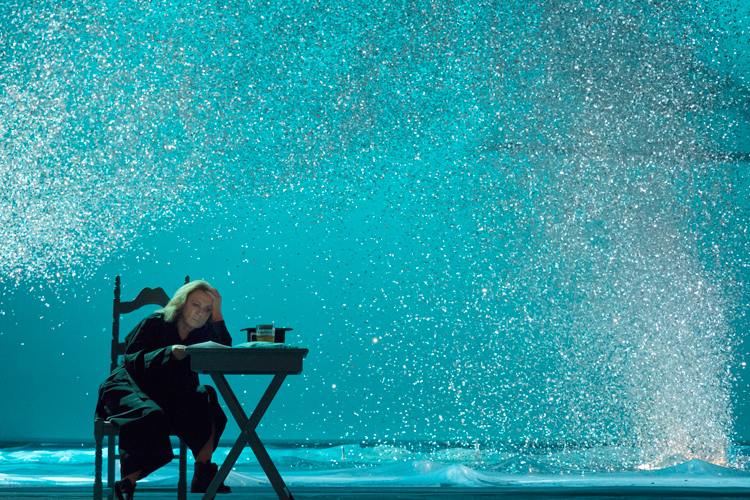
Just find this wave, just wait for its touch or blow to the wind, which will change everything inevitably, besides the will. The delicate fringe of the air silk panel concerns the face, which has long become part of the landscape, sea, sand, boats, more like a skeleton of fish, faces that do not belong to a man or a woman, but a master of his life.
The face with lumpy, burned with the sun and sea hair. The edge of the silk fabric applies to the forehead because the wind blows gently and evenly, without changing its strength. Then the fabric crawls up, opening seven more silk curtains behind him. The dance of the seven covers ... The "old man" has a free "Chinese" suit: wide black trousers-skirt, free robe. A table and chair, a mug of fishing beer, paper leaflets with the text of Hemingway’s story “Old Man and the Sea”, translated in the 60s into Russian with love, which at once as a burn, like a macrel and as the smell of a Gavan cigar. Ham, says Vasiliev in an introductory word, turning into a character of his ancient performance "An adult daughter of a young man." Ham, a mug of beer in the seaport and the sea, whose air always fills the blue sails of Vasilyevsky fantasies.
He puts the thing almost entirely, it is big. Alla Demidova sits in a chair (the very thing Vasiliev was thinking in his long -standing essay "63" ), drinks beer and begins to read. He sits in a chair, reads, quickly fits his fingers, lures the birds, waits, not forgetting, but eagerly wanting to defeat the fussiness of the huge hall, in the hope that the character, actor will disappear, we will disappear with our questions. “Humility,” the old man calls it, accustomed to sit in anticipation for hours.
 © Pavel Antonov
Slowly, not immediately, perhaps, only later, after it ends, we are aware that we are not a person - but the one who, like a fisherman, threw tackle and waits, the one who went to search for the fish and, while waiting for it, became fish, a boat, gear, a sea in sails. That before us is only the distance between the text and the person, fate and will, the sea and the coast, formed by the effort of the master in the hope of catching fish. Perhaps it was to this being that Vasiliev once gave a name-a person.
Our effort is also implied. It is no coincidence that the director called the "old man and the sea" not a performance, but by the action. The action of the restoration of living memory about the departed Master - Yuri Lyubimov , whose centuries will be celebrated on September 30. We get involved in it slowly and inevitably - as in the sea, attracting the old man: resisting and humbled, we feel the friction of life itself, its fatality, in which skill and will are increasingly drawn - the effort of love. “So a person at the end of life can love, a person who has reconciled with loneliness, a person who has nothing left to cherish, that it is scary to lose once.” Through the humble feat of the viewer, the living feeling of the whole comes to you - how it came to the fisherman.
Before us is only the distance between text and man, fate and will, the sea and the coast, formed by the effort of the master in the hope of catching fish.
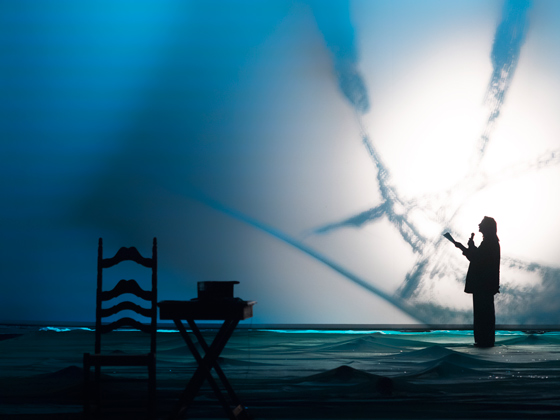
As always in the Vasilievsky Theater, the whole is divided into different plans - it doubles, multiplies in front of the eyes, like silk fabrics and screens in the Chinese theater of shadows, appears with the outlines of a boat pierced into the sun. We learn the same sails and light silk curtains flying in “six characters in search of the author” and in “Today we improvise”, in “Masquerade” and “Peak Lady”, in “Amphitrion” and “Mozarte and Salieri”. Abrias of ancient cities against the backdrop of the sea, games against the backdrop of death - philosophical landscapes of the Vasilievsky Theater.
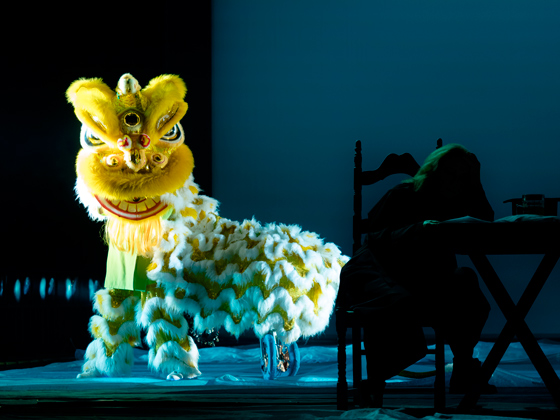
The porcelain bells ring while the outlandish Chinese lion is dancing - a fantastic object consisting of a smiling muzzle, a fur plumage, two legs in front and two wheels behind (Vadim Andreev), slowly stealing behind his back in the old man's silence.
Sunny, lunar, predawn and sunset landscapes, invented by Vasiliev and carried out by Peter Popov, the son of his late Comrade Igor Popov, sometimes resemble the exquisite compositions of Robert Wilson. But the dialogue of a person with space here is completely different. To seize his whole, you will still have to go back and forth, having lost fish, gnawed by sharks on the road, get lost in the rustle of words and the manifesto of screams, tolerate the defeat in order to touch the African coast on the edge of the memories and see the dancing lion cub.
 © Pavel Antonov
Chaos hunts for a man like sharks - for a beautiful fish. About this in the essay “63” a whole life back he said: “Perhaps this is the life of a person who passes under the influence of improvisation of the subconscious, or elements ... This freedom of darkness is incredible by its nightmare ... And only under the influence of beauty, under the influence of the Divine, this can have some kind of meaning. So it seems to me ... I am disturbed by the fact that the assertion of disorder, chaos becomes a worldview, worldview - the idea, philosophy of the world. I don't like it. Why should I like that the artistic ideas expressed in chaos are human? People must object to this. ”
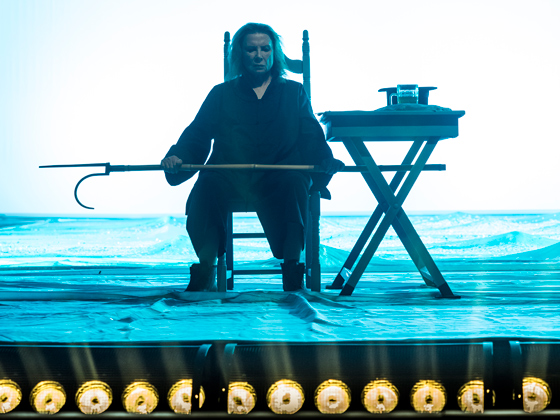
... At some point, the reed fishing rod trembled and pulled, lifting the marvelous vision of the scene, fish in the width of the mirror,-delicate tissue overflows allow you to distinguish the head and tail, the plumage of a miracle merging with the sea. A gluing gait moves a warrior in a black silk kimono, a hook on a long pole carefully “leads” a huge fish-eye, slowly circling behind the old man.
In the rays of the light curtain, the famous curtain of Lyubimov, we lose sight of the actress, her voice separates from the body and is part of a minted acoustic sparring with the music of Vladimir Martynov. The battle of the old man with sharks - the last, hopeless and impeccable battle for beauty and life - looks like a mechanical ballet: the tentacles hidden under the blue fabric until time, suddenly wake up and begin the chase behind the boat. The crystal beads of sea spray, awakened by this secret mechanics, takes off over the surface of the stage, and at some point it seems that it retreated, became the sea. So, after many mechanical efforts of the tongue and palate, suddenly an image is born, living life. Vasiliev knows the price of these contrasts. He himself, like a fisherman, has long learned to patiently wait for the bait to work. Together with the spell spell Igor Popov, they came up with so many “bait”, so many delightful mechanisms and objects that a whole museum could be made of them.
 © Pavel Antonov
If you are engaged in the theater as a life, then you find yourself at the last line, next to the creation itself. They swam too far. This fatal delight of art seems to have always been a theme of Vasiliev. In the parable of the old man and the sea, you can read all his life in art as one scroll, as a quiet touch of fabric, wind, waves, fate.
The old man was waiting for a long time, and on the 85th day he went to sea and caught the largest fish of his life. But the sharks devoured her all, to the very skeleton.
Bright light will blind the auditorium, Demidova will cry: “Microphone! Give me a microphone! " -exactly interrupting the performance and wanting to say something from yourself. Then he will approach the screen on which the skeleton of fish-lodges (the famous Khemingway drawing) barely shines through, and tells about the tourists who, having looked at the remains of the fish, called it a shark.
“And how easy it becomes when you are defeated! He thought. “I did not know that it was so easy ... Who defeated you, old man?” He asked himself ... Nobody, ”he answered. “I just went to sea too far.”