
Translated material
David Lynch refuses to manipulate us
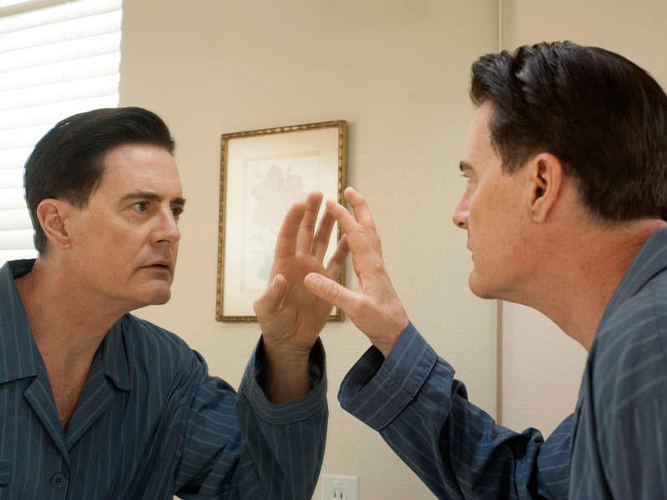
When the cinema ceased to be dumb, when the first medium appeared, which allowed the audio and visual component of human perception to merge into one happy whole, Mimesis- the project with a length in human history- reached its climax. The fact that we can finally copy this world has become another evidence of our endless power over it. The opportunity to record the world gives a chance to know it completely, as well as to strengthen in the opinion that the title of nature of nature we assigned to ourselves rightfully. Copping the world means making it your own.
In the new Twin Pix, the motive for copying reality is inextricably linked with the desire to control this reality. From the supposedly harmless aesthetic principle, Mimesis turns into a means of inconspicuous and ubiquitous manipulation, designed to hide from us the essence of life, truth, good, evil and everything in general. All the most importantly, “Twin Pix” insists, you cannot see or hear.
Note, first of all, as Lynch takes the largest achievement of television and kinemudium- the ability to transmit both the image and sound- and defiantly gets rid of it. In the first seasons, Laura Palmer herself became an antithesis of the human model imposed by television, which has appearance and voice (opinions, principles, history) coincide and create a homogeneous image. In the case of Laura, everything is different. In the photograph, which ended with each episode of the old Twin Pixe and to which each episode of the new begins, we see the ideal of traditional femininity, the queen of the school ball. When this photo has a languid voice - a cassette recorded by Laura for Dr. Jacobi, ”he tells us the things that we did not expect to hear from the Queen Ball at all. Ears and eyes in the series are in a state of constant dissonance. Nadin still managed to open a store of silent curtains - this Lynch reminds us that this character who has lost his eyes has a hearing overlap to the limit.
Lynch takes the largest achievement of television and kinemedium- the ability to transmit both the image and sound- and defiantly gets rid of it.
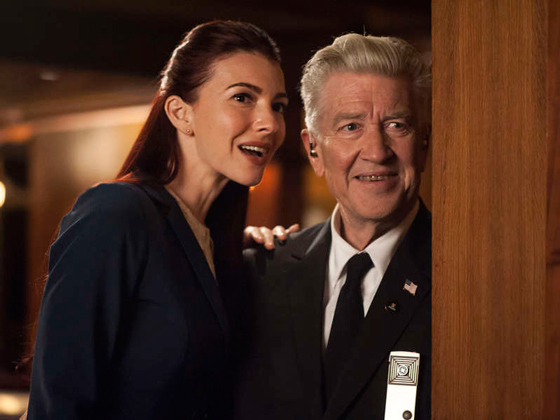
The double of Nadin is, in fact, Lynch himself, playing the role of agent Gordon Cole. As a director, Lynch sees everything, each frame obeys his orders. In order to somehow undermine the claim to omniscience, his own and his hero, Lynch gives him serious problems with hearing. In these characters, which constantly balancing between the periphery and the center of the series, the intention of challenging the idea of an objective and balanced perception as such is read. This motive is noticeable when Albert, Gordon, Diana, Tammy and Macley cannot understand what happened at the crime scene, since each of them saw (or did not see) something of his own. Lynch thus hints: we all look like Nadine and Gordon. Each of us has a sensation of the world from all kinds of imbalances, inconsistencies, “handicaps”, no one is able to hear everything and see everything. Although there are people who are constantly trying.
The world "Twin Pix" is the world of recording, eavesdropping, peeping devices. In the first two seasons, these were tape recorders and microphones. From the already mentioned by Lorina, through the eavesdropping tree by Bonsai Windom Erla and to the unfortunate bird, Wildo, which, to his misfortune, also turned into a tape recorder - all the most important information here is transmitted from his mouth to his ear, including the glorious moment when Laura whispers to the merchant's name of his killer. A few visual tips come mainly from the world of dreams, visions and fantasies, which with the so -called objective reality have nothing to do. Even the video recording of the picnic of Laura, Donna and James (almost dumb, naturally) with her otherworldly landscapes and muffled laughter more like a dream than reality.
 © HBO
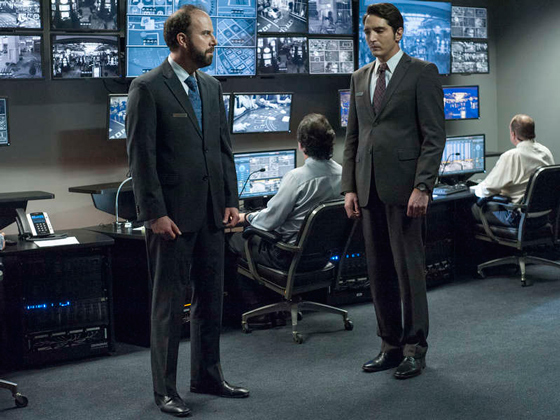
© HBOIn the new season, the space of the series is filled with cameras. Already at the very beginning of the first part, returning from the “Red Room”, we get into the room in New York, where several cameras, Non-Stop takes a glass cube. The only function of the person attached to them is to change the cassettes in time. In the police station, Twin Pixes changed a bit: several new employees, everyone was a little old. But the main assault for the police, to which the Lynch returns again and again over the past few parts, is the control system served by the dispatcher Mega Brown (Jody Teen) and on whose monitors we see various dark corners of the city. During interrogations in the FBI and in prison, Lynch also constantly draws our attention to what not only he takes off here: everywhere we see cameras and monitors. And finally, a casino, where every step and every movement fall into the field of view of cameras. One of the Brothers Brothers Brothers (James Belushi and Robert Neconov) is, in fact, the contemplation and discussion of a giant wall with monitors where the image gets.
It is clear that for Lynch, the camera is, first of all, an element of control and management. We all live in an ideal prison of Jeremiah Bentam - a panopticum, where not only “good guys”, but also “bad” are constantly observed. The peculiarity of the panopticum, however, is not in simple observation, but in the ability to control the behavior of people. The border between the presence and the absence of one or another observant authority is blurry. Since we never have a guarantee that no one is watching us, we always have to act in accordance with the rules, with this authority established.
We all look like Nadine and Gordon. Each of us has a sensation of the world from all kinds of imbalances, inconsistencies, “handicaps”, no one is able to hear everything and see everything. Although there are people who are constantly trying.
This moment is emphasized in an episode where one of the visitors of the casino looks at the merchant won and, apparently, absolutely indifferent money, and then looks up at the ceiling, from where the video surveillance camera winks on. Having shown the cell a middle finger, an elderly woman leaves the idea to steal someone else's winnings. Everything, it would seem, is good: cameras guard the law. But only a typical gambling player, burning the family’s budget, acts as a potential violator in Lynch. The look of an elderly woman in rags causes the viewer only one emotion: "Lord, help her." Perceiving it as a victim of an unfair system (the 11th series dispelled all doubts about this), and not a potential criminal, the viewer is forced to question the rules of this system, and what pressure they are.
But, of course, the best allegory of Mimesis as a means of control is a glass cube. The veil of secrecy and mystery, enveloping the cube, is only dust in the eyes of the viewer. In fact, his function is absolutely clear: to see what refuses to show himself. The essence of the supernatural is that its existence cannot be proved. Supernatural, recorded on the film, becomes natural - a fact. At the same time, it does not lose the status of a threat, but becomes an enemy with whom you can fight and who can be defeated. A glass cube is a desperate attempt to make visible and thus neutralize the parallel measurements along which the Cooper is stuck. However, this attempt is an almost complete failure. Cameras are able to catch only blurry forms of an object or creature who appeared in a cube for a second, and two innocent lovers become victims.
 © HBO
© HBOThe motive of helplessness and insolvency of recording devices is traced in the entire third season. The casino cameras are not able to explain how the merchant managed to disrupt Jack-on 30 times in a row. Neither the drug trafficking pix, nor the moment when Richard driving a teenager gets into the town of Twin, does not fall into the field of view of urban video surveillance. In prison, Evil Cooper uses cameras to blackmail the boss: “Who would I call? Mr. Strawberry? " And, I must say, successfully. When the evil Cooper is brought to the office of the boss, where they have to agree on the conditions of the escape, the boss opens the dialogue with the phrase: “I turned off the video surveillance cameras” - that is, all the most importantly will remain behind the scenes again.
The helplessness of recording devices and, therefore, Mimesis as an instrument of cognition, is also evidenced by the fact that all the most important - the peculiar quintessence of good and evil - squeezes in the zones of the invisible and inaudible.
So, for example, in the tenth series, a clear connection between electricity and the forces of good in the series finally establishes. Electricity here acquires a voice and shape, but neither one nor the other is not available to recording devices. But they are fixed by the third eye of a lady with a log (Katherine Coleson). In her long monologue, she reports Hawku (Michael Hors): “Electricity makes a sound. It can be heard in the mountains and rivers. You can see how it dances among the seas and stars, how it glows around the moon. But today his light dies. What will remain in the dark? " It's clearly not about lightning.
Whatever picture you collect this mosaic - the answer will be correct, but only on condition that you will not stop and will collect further.
As for evil, here the third season clarified at least one thing: the problems began with the first nuclear tests in the history of mankind, conducted in 1945 in New Mexico. Evil, according to the creator of Twin Pix, is generated by the intention of using radiation, another force that acts imperceptibly and inaudibly, as a weapon of mass destruction. And here the recorders - or rather, transmitting - devices (also the form of mimesis and copying) play an important role. Radio and endless monotonous repetition of the same quatrains become weapons that newborn evil uses to brutally deal with its first victims. (By the way, another very real attempt to manipulate the public consciousness with the help of the media is associated with Trinity. Although there was only one journalist, William L. Lawrence, after the bombing of Hiroshima and Nagasaki, which occurred three weeks after testing, the American government began to organize excursions for the scene. The main goal of these excursions was not To impress the country's size and the military power of the country, and to convince that the consequences of the bombing of Hiroshima and Nagasaki will not be long-term.
In general, it becomes clear: Lynch does not believe in a copy. Traditional cinema and traditional television for it are no different from video surveillance cameras. All the same heart -rending attempts to recreate and write down reality, to inhabit it with “realistic” events and characters, so that everything is like in life. Such art for him is inextricably linked with control and manipulation. A traditional realistic film with a clearly drawn storyline makes a rat from the viewer running along the labyrinth, in which only one route can be reached before the exit. Is this not a manipulation? Step to the left, a step to the right is a dead end. The viewer thinks that he understood and interpreted the film is his own achievement. In fact, he simply does not have a chance to come to any other opinion. And when one film is watching millions and everyone comes to the same conclusion - the problem of copying acquires a completely different scale. Where, I want to ask, the border between such art and propaganda?
 © HBO
© HBOLynch plays according to other rules. Having carefully looked at the third part, you will notice that in the office of Agent Cole, that is, Lynch himself, two posters hang on the walls. One of them enters the frame quite often, against his background and the first conversation (evil) Cooper and Cole in all these years. It depicts a nuclear explosion. I must say, genuine trials in New Mexico look different, but, as we already understood, the exact copies of Lynch are not interested. The second poster appears in the frame only occasionally - this is a photograph of Franz Kafka. Lynch, as it were, hints: what happened in 1945 in the framework of nuclear tests, Kafka, an expert in the field of elusiveness and indescribability of evil can tell us much more than photography. Its texts are also overpopulated by various kinds of doubles, but, like Lynch’s, each double of Kafka is unique in its own way. More importantly, Kafka’s books - if we use the categorization proposed by Umberto IVF, is “open” works. The reader here does not find the meaning hidden by the author, but creates it during his own interpretative efforts.
The driving force of the new “Twin Pix” was just such a desire to make the viewer an active component of the creative process. All the most important in the series is played on the other side of reality. No one knows what exactly is happening there, but Lynch provides us with images that can bring us closer to the essence. The essence of what? Everyone must find an answer to this question himself. Whatever picture you collect this mosaic - the answer will be correct, but only on condition that you will not stop and will collect further.
As for our measurement and the realistic part of the series, then, judging by the development of events, the supernatural will be visited here more and more often and more and more to attack causal relationships and logic. It is possible that in the end we even find out who is whose relative and who is whose lover. On the other hand, it is quite possible to expect that everything will ultimately cover the veil of the “open” Lynchevsky chaos.
 © HBO
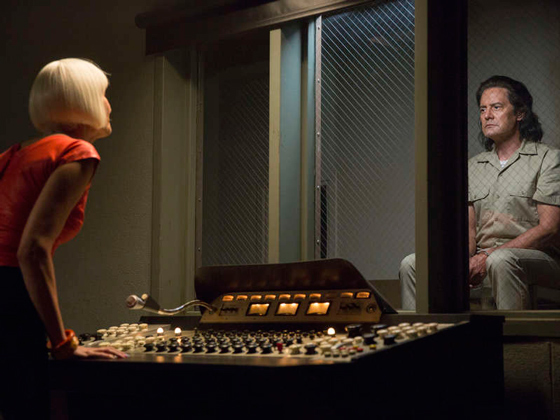
© HBOAt the Paris Fair Photo - 2012 David Lynch spoke for almost an hour with Paul Holdengrer about the essence of art and representation. When Paul asked him why it was the paintings of Francis Bacon that had such a strong influence on him (and the “red room”, they say, inspired by the picture of the back of the “sitting figure” ), the director went into the argument about the role of the viewer: “As we all know, paintings, photographs, films in themselves never change, but the viewer is just a magical component. Each viewer sees something unique. This process seems to me in the form of a circle, which connects the viewer and the work into an inexplicable, endless dialogue. ”
Later Lynch also notes that in art he is primarily attracted to things and images that are difficult to give a name: “When we know exactly what is depicted in the picture, most often we just stop looking at it. The result of interaction with something, for which it is difficult for us to choose words can be truly exciting. ”
Twin Pixes gives us the experience of such exciting interaction. Lynch puts us in a complex position, which, perhaps, is not everyone is ready. But if at least some lesson can be extracted from the new season, then it is approximately as follows: in the world where the border between art and propaganda is becoming more and more ghostly, we, spectators, have the right to see not a copy for once, but the original. And become the original, not a copy.